Chapter One
Still Breathing
Cinder had almost reached the shelter when someone took her left arm.
“Keep your hood up.”
The woman's voice came through a breather, flattened and close. Her glove closed above Cinder's elbow. Behind the clear faceplate were pale eyebrows, a line of sweat, eyes moving between Cinder and the hand she still had free.
Cinder looked past her. Three more steps would have put her through the shelter door.
“Both hands where I can see them.”
She brought the other one out slowly.
Rain struck the officer's hood. Some drops shone green as they ran down the black seam, briefly bright beneath the amber streetlamp before losing themselves in the water at her feet. Cinder watched one gather on the officer's cuff. It swelled, trembled, fell.
“Turn around.”
“Am I under arrest?”
“Yes.”
Across the road, a second officer stepped into the passage beside the shuttered ration office. He had a hood, a full mask and a long coat like the woman's. His boots were planted wide enough to close the narrow space.
She had been thinking of that passage.
“For what?”
The woman glanced towards the covered lorry waiting at the kerb.
“You can ask inside.”
There was no urgency in her. That made Cinder want to wrench her arm away. The woman's evening was going along as expected. She had found the person she had been sent to find. Soon there would be a room, a chair, perhaps something hot in a cup.
Cinder turned.
The officer checked her coat, then pressed one gloved hand against the small of her back. Nothing was said about the smell. Cinder could smell it herself inside the mask: smoke held in her hair, in the knitted collar under her work shirt, somewhere behind her nose where the filter could do nothing about it.
The shelter door opened.
An old man stood just inside, trying to put on a glove while holding a parcel beneath his arm. The glove's fingers hung empty. He looked from the officer to Cinder and began backing away, pulling the door with him.
“Hold it,” the officer said.
He stopped.
For a moment Cinder thought they would all go in. The shelter's little electric heater was dark, but it was dry in there. There was a bench. Someone had pasted a picture of a summer field above the route board, grass so brightly green that it looked less believable than the rain.
“We need the step clear.”
The old man withdrew. The door shut between them.
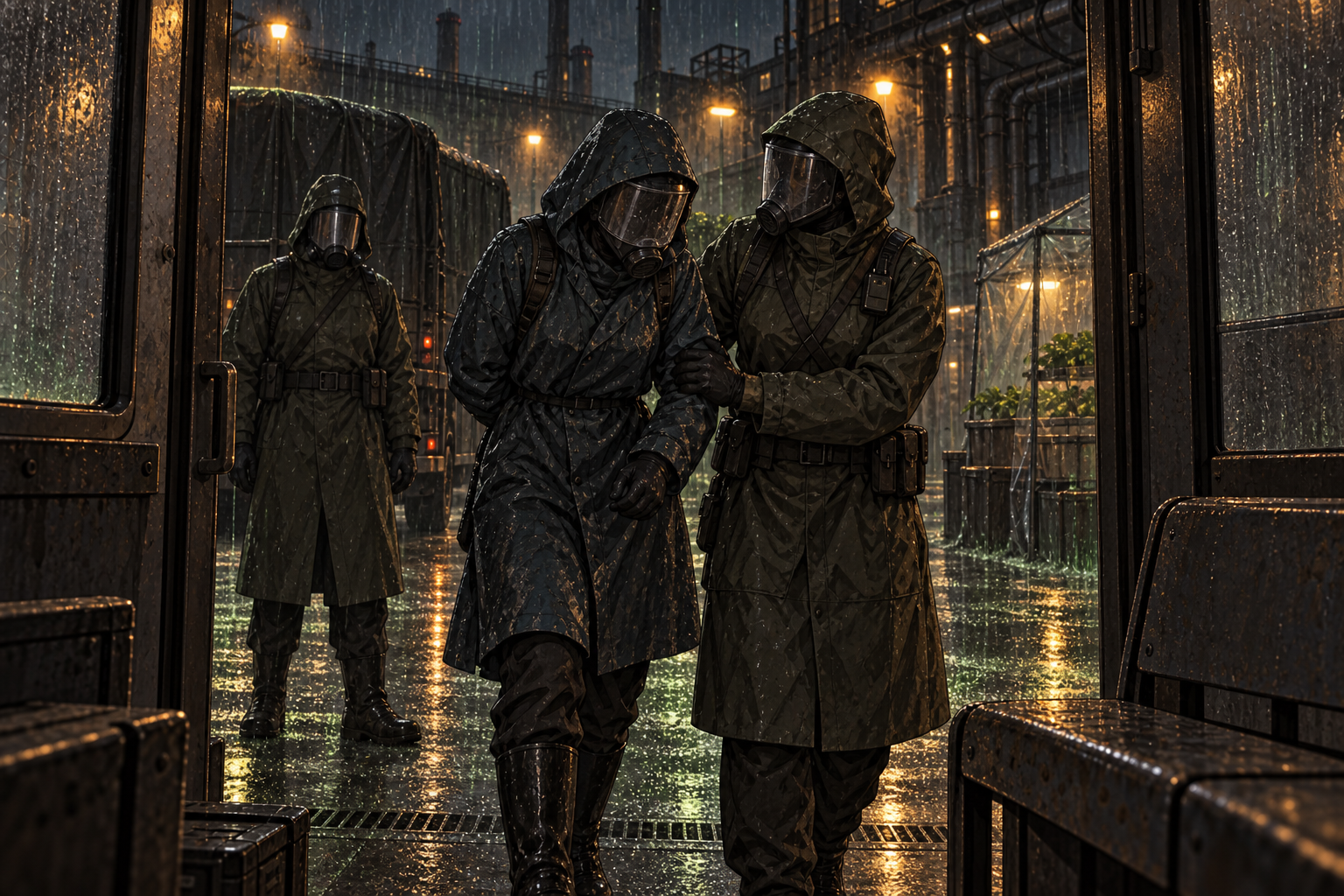
They walked her past the ration office. A delivery slate still promised the previous day's issue. Beneath it somebody had scratched a reply deep enough to expose the pale wood. The second officer saw her looking and moved between her and the wall.
Beyond the office, the neighbourhood's growing shelter crouched in a service yard. Its roof was a patchwork of transparent bags joined over narrow timber ribs. Several patches had yellowed; the newest were so clear that the little plants beneath them appeared uncovered. Green drops collected along a sag in the roof. A woman inside was pushing the sag upward with the padded end of a broom, sending the water towards the outer gutter.
Cinder had helped carry timber for a shelter like that once. Four adults, one length of wood, each refusing to let the others take the heavy end. They had argued over the door for most of an afternoon. Someone wanted a lamp. Someone else asked whose electricity allotment would feed it.
In the end there had been no lamp.
The first onion had been divided among six kitchens.
She remembered the smell before she remembered anything else: a few pieces softening in a pan, the neighbour upstairs coming down to ask what she was cooking. Her husband had stood in the doorway and told the neighbour that he looked after his wife.
Her foot slipped at the kerb.
The officer caught her more firmly.
“Watch it.”
Cinder pulled herself straight before the woman could help her further.
The lorry door opened. Warm air came out, smelling of damp rubber and old disinfectant. The escort guided her beneath its short canopy and onto the step. She had to bend her head to get through the door. Her visor struck the frame with a hollow knock.
Two people already sat on the inner bench. Neither looked up. One had wound string around a split boot, over and over, until the ankle resembled a badly repaired parcel.
The officer sat opposite her.
“Mask stays on until we reach the dry room.”
Cinder would not have taken it off. She knew what rain could do. A woman on the packing line had once shown them the back of her ankle, furious because the split in her boot had been too small for the stores clerk to accept. Cinder remembered the raised swellings above the heel, and how carefully the woman put her stocking back on.
The door closed. Someone outside struck its metal twice.
As the lorry moved, Cinder turned towards the narrow rear window. The glass was clouded and wire-reinforced. Through it she could see very little of the town.
She looked anyway.
There had been people outside the house when she left. More were arriving. She had heard a man shouting for something to be brought round from the back. Then an engine. She could not remember whether she had heard the siren before the engine or afterwards.
She tried to see smoke above the roofs.
“Face forward.”
“Was anyone brought out?”
The officer's eyes stayed on her.
“From the fire.”
“You'll be told what you need to know.”
Cinder watched the dim window until the woman said it again.
The dry room had three hooks, a floor drain and a bench too narrow to lie on. They made her wait there while water ran from her coat. A custody attendant checked her cuffs and boots before directing her to a place on the floor away from the wet gear.
“Face covering.”
Cinder lifted off the mask. Air touched the sore bridge of her nose. She had not noticed how hard she had been pressing the seal against it.
The attendant looked at her, then at the photograph on the paper she was carrying.
“Any rain against your skin?”
“No.”
“Any damage to the covering?”
“No.”
“Itching? Burning?”
“You asked me about the rain.”
The attendant put a mark beside a box. She was younger than Cinder, with bitten nails and a flattened curl where her cap had been. Her face showed no interest in an argument.
“Through there.”
Without the coat Cinder was cold. The corridor's pipes were warm only where they disappeared into the ceiling, beyond reach. She followed the attendant past two closed doors and a man asleep upright on a chair. His boots were clean. She noticed them because almost everything else was dirty.
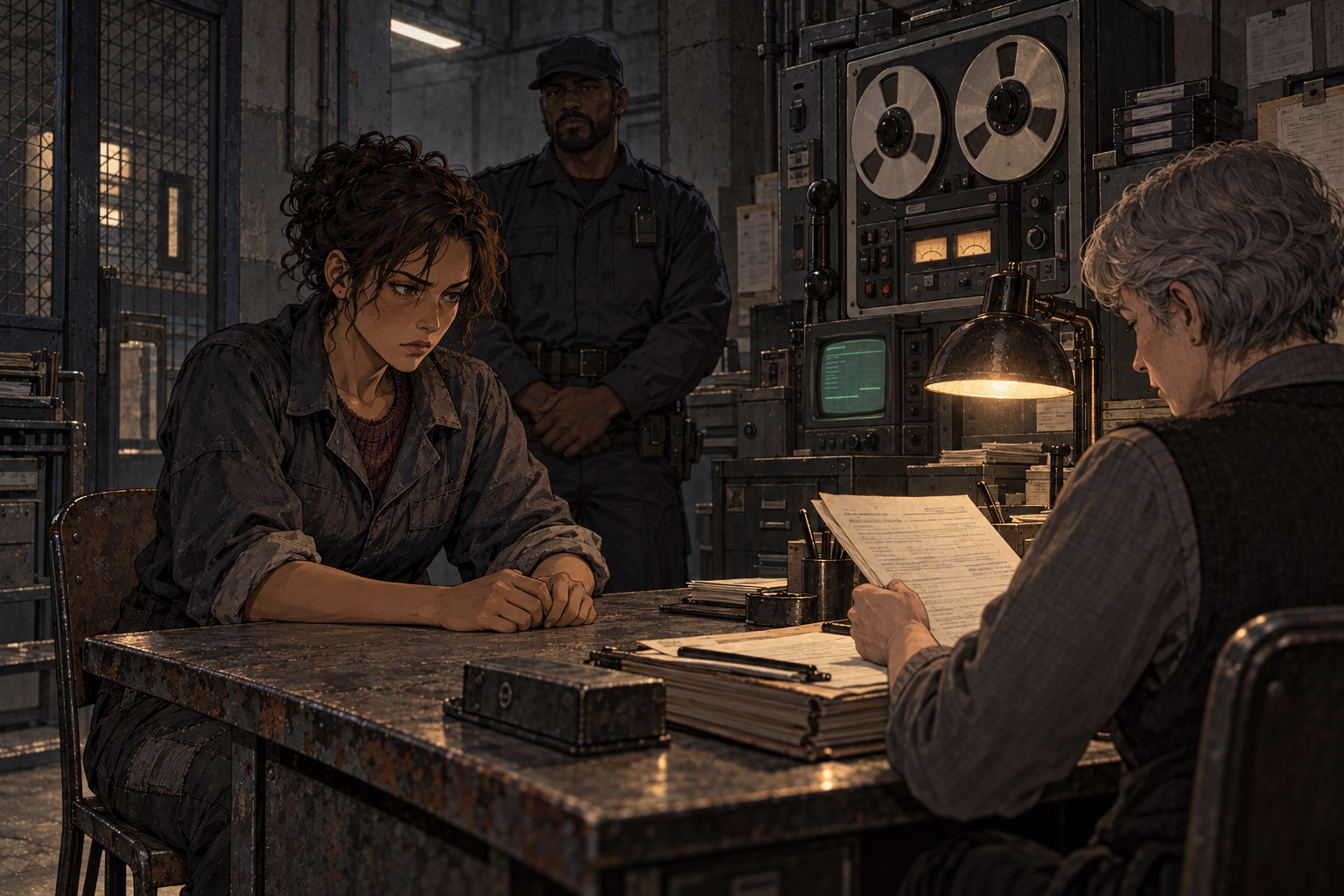
At the end of the corridor an older woman sat behind a desk, holding a form near her face. A lamp lit one side of her grey hair. The main light hummed above them. Beside a small CRT terminal stood a cabinet with two large reels behind a scratched transparent cover.
Cinder recognised the recorder before she looked at the woman.
The take-up reel wobbled.
Not much. Enough.
“Sit.”
She sat.
The escort who had taken her from the street went away. Another officer stood between Cinder and the door, dark-skinned, heavy through the neck, turning a pencil between his fingers. His cap was dry. He had rolled one sleeve a finger's width higher than the other.
“Hands on the desk,” he said.
Cinder put them there.
She could see soot in the creases of her knuckles. Her hands looked older in that light. In the shallow groove beside her thumbnail was a line of black she had missed when she washed them.
The clerk asked questions already answered by the documents in front of her. Address. Employment. Date of birth. Cinder answered. When the woman read back her occupation, she called her an audio operator.
“Data,” Cinder said.
The clerk looked up.
“High-speed data reel-to-reel technician. I don't operate an entertainment system.”
“It's the nearest category.”
“Then write it beneath the category.”
The officer stopped turning his pencil.
Cinder looked at him. She could feel how easily she might keep going. Explain what the machine behind him did. Explain the work it took to keep a full shift of records readable when other people treated every fault as an excuse to strike the cabinet. Ask what he did when a line stopped, besides standing over someone who knew how to repair it.
The clerk wrote beneath the category.
“Like that?”
“Yes.”
The woman moved to the next question.
Cinder kept her hands flat.
For a little while the work of answering steadied her. She knew dates. She knew the name of the department that paid her. She knew the difference between her registered address and the entrance actually used to reach the rooms above the old shop. There was satisfaction in preventing a small mistake, even here. She hated that they could get it from her so cheaply.
The recorder clicked.
“That reel isn't seated,” she said.
“We aren't asking for repairs,” the officer told her.
“It will damage the edge if you leave it.”
The clerk glanced at the cabinet. She pressed a switch and the reels stopped.
“There's a technician in the morning.”
“There is one now.”
“And she's occupied.”
The woman reached for a fresh sheet. Cinder could not tell whether the answer had been a rebuke or a tired attempt at humour. She did not smile.
On the far side of the desk stood a cup with a lid laid over it. An onion smell lingered around the rim. Probably a pinch of dried pieces stirred into broth. Cinder had three cloves of garlic wrapped in paper at home, behind the crock they no longer used. She had been saving them.
She thought of them sitting there while the rooms burned.
For several seconds that seemed more difficult to understand than the rest of it.
“Medical conditions?”
“You have a hospital record.”
“Not here.”
The clerk waited with her pen raised.
“I was treated recently.”
“For what?”
Cinder looked at the officer.
“He can leave.”
“No,” he said.
The pen remained raised. Somewhere behind the wall a handset rang, stopped, began again.
“An injury,” Cinder said.
“Where?”
She pressed her palms harder against the desk. The skin beneath them had begun to warm. She could feel a raised spot in the wood near her smallest finger and followed its edge without moving the rest of her hand.
“I lost a pregnancy.”
The clerk lowered her pen.
“Are you having pain now?”
“Some.”
“Bleeding?”
“No.”
“I'll request the record.”
The answer was ordinary. Cinder had prepared herself for something worse and did not know what to do with it.
She had told the hospital woman she understood. Again and again she had said it, because the woman kept trying to explain. The injury. What they had been able to do. What they had not. Afterwards there would be appointments. There were things to watch for.
And she would not be able to have another child.
She had understood the words. She still did.
At home she had opened the bottom drawer and looked at the little pieces of cloth she had put aside. One was from an old shirt, soft from years of washing. There had been no reason to throw it away. There was no reason now, either, except she no longer knew what to do with it.
Her husband had asked her to stop leaving drawers open.
The officer tapped the desk with his pencil.
“We're speaking to you.”
“Then speak.”
The clerk shifted the paper so he could read it.
“Your husband is alive,” he said.
Cinder looked directly at him.
“He was taken from the building. He's in hospital.”
The main light hummed. She could hear it above the pipes, above the faint traffic outside. There was a brown insect caught inside its shade, motionless among the dust.
“Alive?”
“Yes.”
She had pictured an empty room. In every thought since leaving, there had been a point beyond which he ceased to occupy anything. No footsteps on the stairs. No hand closing around her arm. No waiting to hear how he put his key into the lock.
Now he was in another room, breathing.
“How badly?”
“Seriously injured.”
“Will he die?”
The officer put down the pencil.
“The doctors are trying to prevent that.”
She wanted to strike something. There was nothing within reach that she could strike without being held down. She knew that before she looked. The cup, the recorder, the woman with her pen: all of it stayed where it was.
“You understand what you're being held for?”
Cinder drew her hands into her lap.
“On the desk.”
She put them back.
The fire had done what fire did. She had known its appetite long before she knew him. As a girl she had stood near another burned building and kept her mouth shut while the adults counted what was missing. Later she had acquired a trade, wages, a reputation for work that could be trusted. Years had passed in which there had been no fires to explain.
She had been proud of those years.
Tonight she had wanted him never to leave the bedroom.
She could still hear him speaking from the bed, irritated that she had disturbed him. It was the familiar irritation that had stayed with her, more clearly than the rest. He had expected her to answer. He had expected the evening to continue.
“Did you intend to kill him?” the officer asked.
The clerk's pen stopped.
“You know what he did.”
“I'm asking what you intended.”
“You have the hospital.”
“We'll obtain the relevant records.”
“He killed my child.”
The words seemed to make the room smaller. The clerk looked down. The officer did not.
“That's an allegation we can record.”
“Record it, then.”
“We will.”
“Record what he did before. Record who I spoke to. Record how often he came home and there was nowhere else I could go.”
“Lower your voice.”
She heard herself take a breath. Her fingers had curled around the edge of the desk.
Outside that room they had forms for who could live where, cards for food, allotments for heat. There were streets you could not enter after certain hours and journeys you could not make without permission. Her husband had known how little she could afford to lose. He had reminded her when he wanted her quiet.
The Rift had taken a whole life she might have had. She could never picture that life clearly, but she knew it would have been better. Then men in uniforms had spent years telling everyone what the emergency required.
Now another one wanted her to lower her voice.
“Was it your intention that he die?”
“Yes.”
There was no satisfaction in saying it. She had expected at least that much.
The clerk wrote.
They took the contents of her pockets in a second room.
A work pass. A folded ration card. A key. A handkerchief. Two coins.
The attendant named each thing as she placed it in a shallow tray. Cinder stood with her arms at her sides, looking at the coins. One had a smooth place on its edge where she could find it by touch.
She had used that coin for years. It could travel across her knuckles while she read a maintenance sheet; it could disappear when a colleague looked up from the next bench. They thought she fiddled because she could not bear to be still. Nobody had asked how long she had practised, or why she went on practising once the movement was effortless.
She had never told anyone about a stage.
Not even a proper theatre. A little platform in a room where people had paid to sit down. A light she could stand inside. Hands raised because they wanted to be chosen.
“Anything else?”
She could feel the habit asking for a movement. A turn of the wrist. Something of hers remaining hers.
“No.”
The attendant counted the coins again.
In the cell there were two bunks. The lower was occupied by a woman with her back to the door. A meal sat beside the empty upper bunk in a covered metal bowl.
Cinder lifted the lid. Paste and water had separated around the edges. Someone had stirred in a few flecks of something dark; she could not smell enough to identify it.
“If you don't want it, put it down here,” the woman said.
Cinder put it down.
The woman rolled over, reached for the bowl and caught Cinder still looking at her.
“What?”
“Nothing.”
“Then let me eat.”
Cinder climbed onto the upper bunk. There was a narrow window beyond her feet. Rain had gathered against the lower edge of its outer pane. Every so often a drop caught a faint green light of its own.
Below her, the spoon scraped steadily.
She tried to remember whether she had closed the bottom drawer before she left home.
On the morning they moved her, the conviction was already signed and filed.
A clerk in the transit depot put two sheets on the counter. She had spent the intervening weeks in rooms where people asked her to repeat herself. Now the papers asked only for receipt of property and confirmation that the sealed packet beside them travelled with her.
Her husband had survived those weeks too.
She had asked every time there was someone new to ask. Eventually an officer told her that asking did not improve her position. Afterwards she asked less often.
The packet was thicker than the papers she was permitted to read. Across its top, beneath a series of routing marks, someone had written KALTBRUCH.
She knew the name. Everyone knew some version of it.
Her first thought was of distance.
“Across the continent?”
“That's the receiving institution.”
“I can read it.”
“Then there's no need for me to repeat it.”
Her work classification had been copied onto the outer sheet. This time it said data technician. Somebody had underlined the words. She looked for a signature she recognised and found none.
“Will I be working?”
“They'll assess you there.”
“Who requested—”
“Sign for the property.”
The tray contained the same key, the handkerchief, the two coins. Her work pass had been retained. The ration card had been cancelled with two heavy strokes. The depot clerk put everything else into a bag and sealed it while she watched.
He handed her the coat instead.
It had a stiff patch on one sleeve where it had dried badly. She put it on. In the adjoining room an escort checked each person's hood and face covering before admitting them to the platform. A prisoner ahead of her tried to explain that the issued gloves were too small.
“Put them on.”
“They pull the cuffs back.”
The escort took his wrist, looked, and called to the store window for a larger pair. Nobody thanked anybody. The queue waited until they arrived.
Cinder watched the exchange. Then she checked her own cuffs.
At the store window they loaded her with a pack and a shoulder bag of travel issue. She had to account for everything inside before they would let her move on.
Outside, the morning was dry and bitterly cold. Meltwater had frozen beneath the platform edge. The train stood under a corrugated roof, its dark panels dulled by soot and weather. Farther along, steam drifted across a signal and broke apart in the wind.
There were people travelling who were not prisoners. She could see them beyond a second barrier: a man holding two cases, a woman with a parcel tied in blue cloth, an older couple arguing quietly over a ticket. All of them had somewhere they were trying to reach.
The guard at the carriage door compared a movement sheet with the little CRT on his equipment trolley. He waited for something on the screen, tapped the side of the housing, then waited again.
Cinder knew better than to offer.
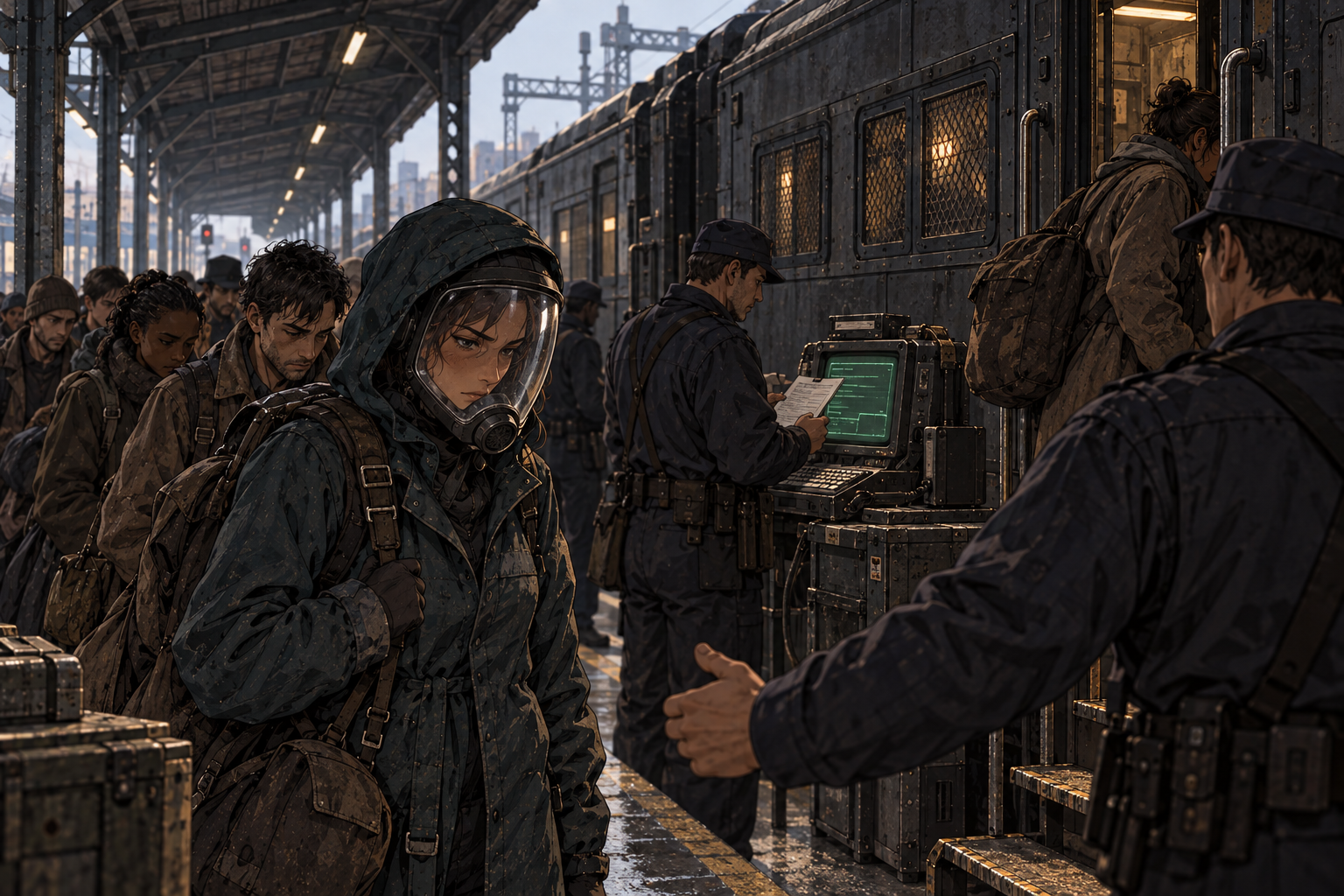
When he called her forward, she stepped up into the carriage. The seat was hard and the window did not open. A young man sat opposite, holding his hands between his knees. He looked at her mask and then at the officers beyond the glass.
“They say you can see it from there,” he said.
She turned towards him.
“The Rift.”
She had seen pictures. Everybody had. Military lights beneath a sky that would not settle into the right shape. Each picture had come with a caption telling her what was being done to keep people safe.
“I don't want to see it,” she said.
The young man nodded, as though this answered something he had been afraid to ask.
For a while nothing happened. A porter pushed an empty trolley past the window. An officer recounted the people in the carriage. Somewhere ahead, a coupling took up with a heavy knock.
Then the platform began to move.
Cinder watched the depot slide away, followed by a wall, the backs of houses, a little yard enclosed in patched transparent plastic. A person inside the shelter had raised one hand to keep a door from blowing shut.
Her husband was somewhere in that town. Hurt. Watched over. Alive.
She kept looking until the buildings thinned and the track curved, taking the town out of sight.
Then she turned back to the carriage and began to pay attention to the journey.