How a child learns to read the world
Stavenbruck's Municipal School Service runs neighbourhood classrooms rather than one uniform school experience. Children usually begin organised lessons around six and continue general schooling into their early teens. These local expectations are not a biological threshold or an identical rule across Earth #0239. Interrupted attendance, informal teaching and later return are ordinary enough that a child's class placement need not match age precisely.
The Rook Lane School shares a building with an evening classroom and a municipal collection room. Its teaching covers reading, sums, practical measurement, regional geography, public notices and civic accounts of the Event. School meals use the child's registered allocation unless a specifically funded supplement is announced; attendance does not create a second universal ration entitlement. Anja Rusk, a teacher who repairs her own classroom receiver, wants children to explain how they reached an answer instead of repeating the approved sentence.
Official civic history stresses endurance, reconstruction and the necessity of containment. Teachers can believe in protecting pupils while recognising that the official account omits things. She may identify contradictions in dates or texts without knowing their cause. Children learn quickly which questions earn a demonstration, an evasive answer or a private warning not to embarrass a visiting inspector.

Anja asks learners to explain observations, while official answers and institutional pressure remain part of school life.
Open full-size illustration ↗People in this picture · 4
Anja Rusk
standing at the centre of the demonstration · Goes by Anja
Residence: Northbank, Stavenbruck. Anja teaches at Rook Lane School and repairs its receiver. She values a demonstrated observation more than a confidently repeated answer. She is teaching Leni, Davi and Misha, who are classmates.
Leni Tervik
pupil seated at the left · Goes by Leni
Residence: Northbank, Stavenbruck. Leni is a school pupil without paid employment. She likes working out how a model behaves before being told its name. Davi and Misha are classmates; Anja is their teacher.
Davi Koren
pupil at the centre with the upright ruler · Goes by Davi
Residence: Northbank, Stavenbruck. Davi is a school pupil without a paid job. He wants to hold the measuring tool himself rather than copy another pupil’s result. Anja teaches him; Leni and Misha share the experiment.
Misha Vell
pupil at the right, writing · Goes by Mish
Residence: Northbank, Stavenbruck. Mish is a school pupil without paid employment. He keeps notes carefully enough to discover where two attempts disagree. Leni and Davi are classmates, not siblings.
Apprenticeship is education and power
Apprentices usually enter workshops in their middle teens, later after a change of career, or through a preparatory class. An apprenticeship agreement specifies a trade, an allowance, a responsible instructor and expected access to practice. The Bench Register is the labour office's local record of participating employers, not a complete qualification authority for the world. A workshop can teach badly while keeping immaculate attendance records.
Brackenzell's good foundry instructors make apprentices describe a rejected casting and what it would cost to replace it. Poor employers keep novices sweeping floors for years. Tarnfeld offers intense practical knowledge of pumps, soils and crop storage but less recognised certification. A rural repairer coming to Stavenbruck may be more competent than the person demanding a certificate. That conflict need not be resolved by claiming that every certificate is worthless: some jobs have genuine requirements that matter to other people's safety.
Oda Kern presses for paid instruction hours at Cinderbank. Pavel Dren, a shop owner in Stavenbruck, worries that he trains people only for larger employers to recruit them. His daughter Rika thinks loyalty cannot be bought with a low apprentice allowance. She wants recognition as a skilled maker, not permanent designation as the owner's child. Their disagreement is about a future workshop as much as a labour dispute.
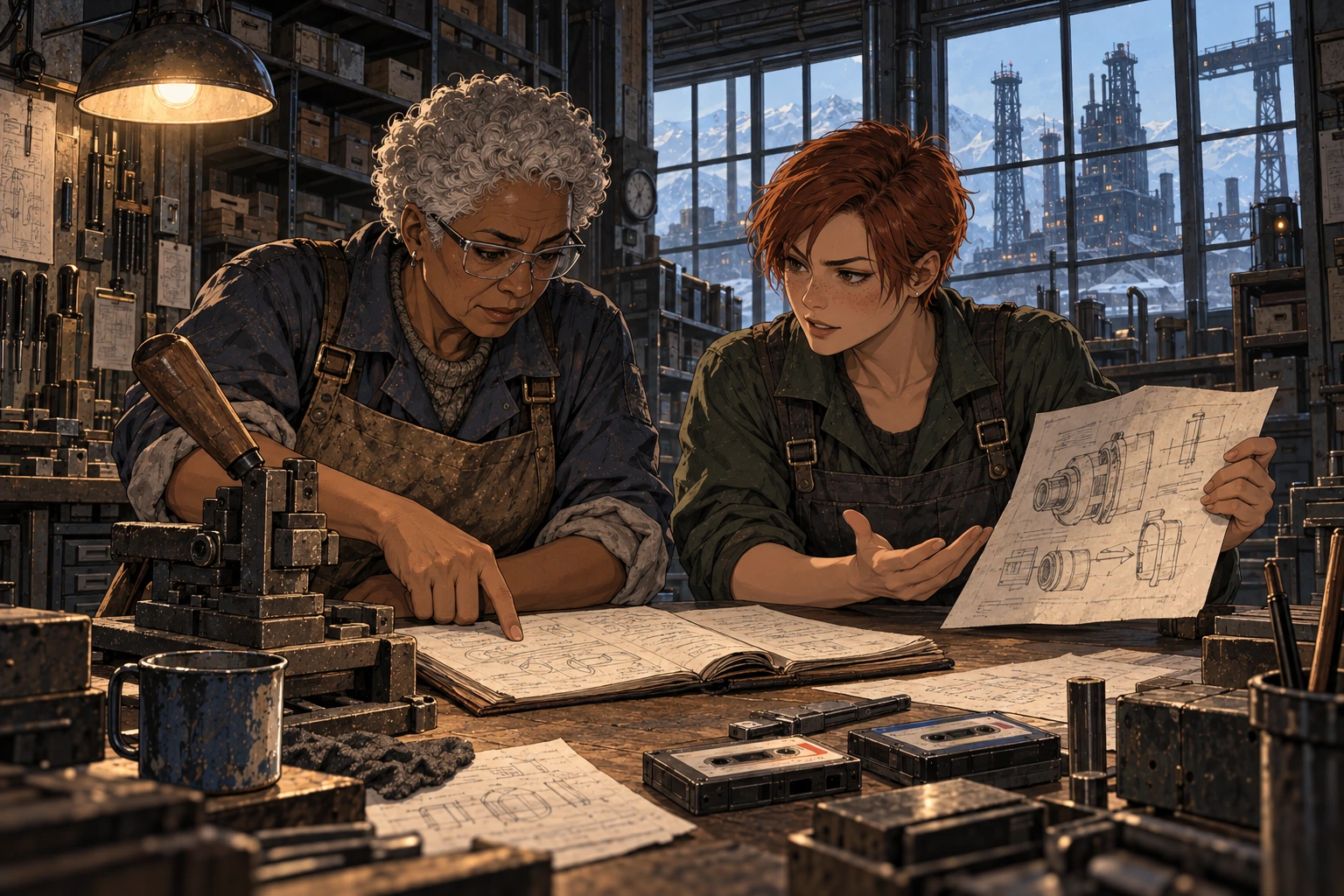
Practical adaptation and access to knowledge raise questions about whose labour receives credit.
Open full-size illustration ↗People in this picture · 2
Oda Kern
left, pointing to the maker’s record · Goes by Oda
Residence: a brick terrace near Cinderbank Foundry, Brackenzell. A senior moulder, Oda teaches ways to work around reduced hand strength and insists that skilled labour deserves credit. Rika is a younger workshop collaborator; they disagree over credit and the circulation of designs.
Rika Dren
right, holding the adapter drawing · Goes by Rika
Residence: rooms above Dren & Daughter, Stavenbruck. Rika makes small mechanisms and adapters. She wants her own name attached to her work without abandoning the family workshop. Oda is an experienced collaborator whose practical methods Rika wants others to learn.
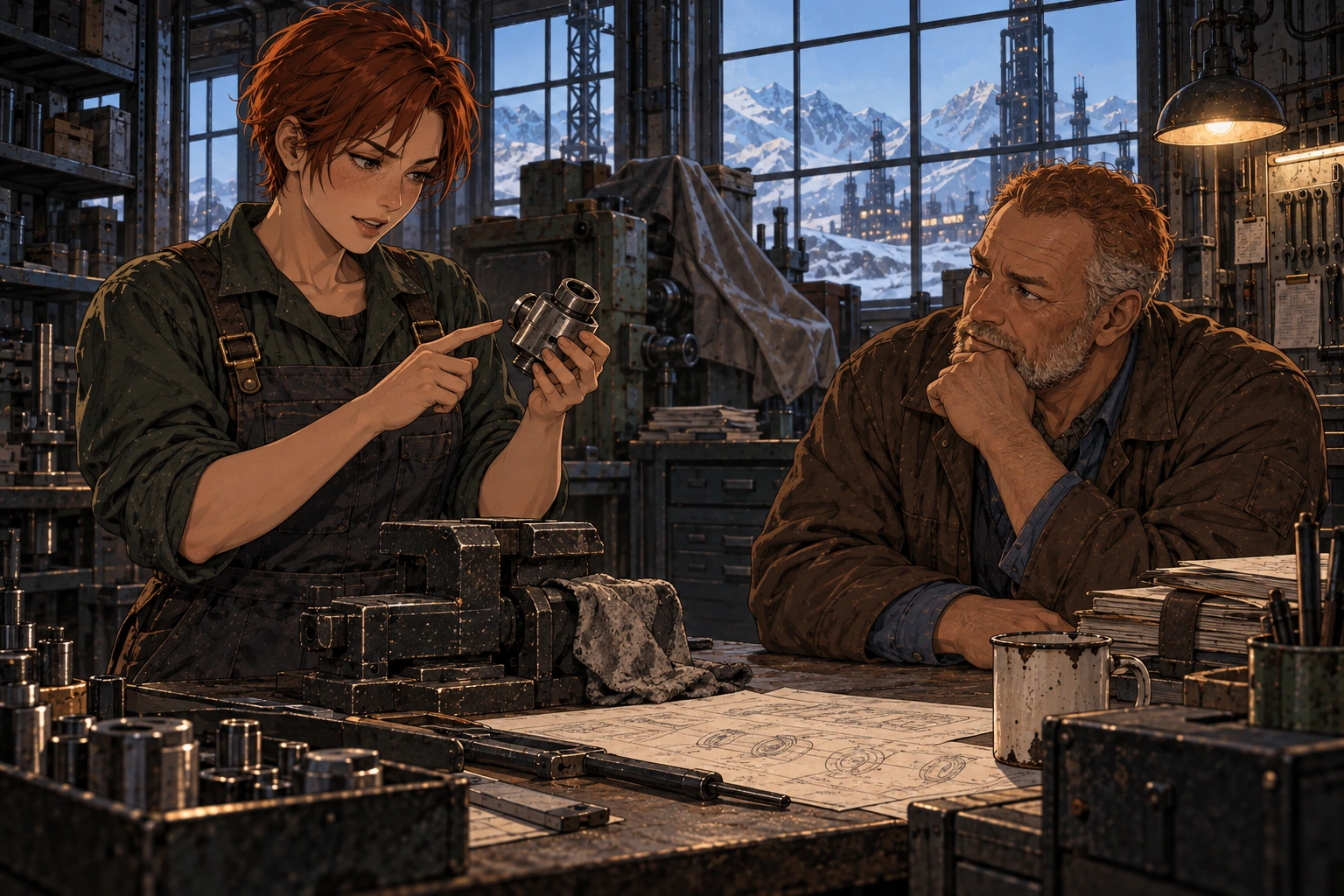
A maker’s recognition, training costs and a family workshop’s future can pull in different directions.
Open full-size illustration ↗People in this picture · 2
Rika Dren
left, holding the completed adapter · Goes by Rika
Residence: rooms above Dren & Daughter, Stavenbruck. Rika makes small mechanisms and adapters. She wants her own name attached to her work without abandoning the family workshop. Pavel is her father and a co-owner of the family workshop.
Pavel Dren
right, listening across the bench · Goes by Pavel
Residence: rooms above Dren & Daughter, Stavenbruck. Pavel co-owns Dren & Daughter. Proud of his daughter’s skill, he finds handing over responsibility harder than maintaining machinery. Rika is his daughter and a skilled maker in her own right.
Libraries, recording rooms and unofficial knowledge
The Municipal Reading Exchange lends books, printed bulletins and listening copies of authorised recordings. Its public room has tables, supervised decks and a catalogue cabinet. The reader who owns no player can still hear a lecture, but queueing and opening hours determine practical access. Teren Vale, its cataloguer, maintains separate records for an item's title, edition, physical condition and loan history. A familiar label does not prove that two cassettes contain the same edition.
Important documents have paper finding aids. Slow copying, scarce readers and sequential access make the catalogue itself a source of power: an unfriendly clerk can claim a record is missing, while a helpful one can find an obscure manual from a fragment of its title. Restricted works manuals remain with the relevant office; the public library is not a universal archive. Selected households keep copied songbooks, recipes and diagrams in tins. Some unofficial reading circles begin with forbidden political writing; others begin because the official manual never explains how to repair a part that is no longer made.

An edition, a usable copy and time with a listening deck are different forms of access.
Open full-size illustration ↗People in this picture · 2
Teren Vale
right, comparing two cassette editions · Goes by Teren
Residence: Old Exchange, Stavenbruck. Teren catalogues the Municipal Reading Exchange. He wants a useful collection that survives his retirement, including its unfashionable music. Niko is a reader asking which copy will serve his study.
Niko Svaren
left, leaning toward the editions · Goes by Niko
Residence: Freight Ward, Stavenbruck. Niko is a repair apprentice who uses evening access to the Reading Exchange. He wants a manual he can follow with borrowed equipment. Teren is helping him as a reader, not assessing him for employment.
Science under institutional pressure
The Stavenbruck Institute of Applied Measures trains technicians and studies water treatment, atmospheric readings, materials and instrument calibration. It is proposed as a civilian-facing institute with compartmentalised military contracts, not an omniscient Rift laboratory. Students compete for places partly because an institute berth offers tools, food access and a future. Dr. Vera Senk, a materials researcher, wants to publish a method that smaller workshops can use; a sponsor claims its manufacturing contract requires secrecy.
Testing requires calibrated instruments, machine time and somebody willing to record an inconvenient result. A scientist can understand one phenomenon exceptionally well while trusting a false account of another. Rivalry can produce fraud, better work or a friendship formed over a shared broken instrument. No institution automatically knows the secret of the Veythari.

Calibration, careful records and access to equipment shape the Institute’s work.
Open full-size illustration ↗People in this picture · 2
Vera Senk
left, working at the dial gauge · Goes by Vera
Residence: Pump Ward, Stavenbruck. Vera works on materials and calibration at the Institute of Applied Measures. She wants useful methods published and their makers credited. Kian is her laboratory colleague and is recording the observations.
Kian Vesel
right, writing beside the gauge · Goes by Kian
Residence: Pump Ward, Stavenbruck. Kian is an Institute laboratory assistant. He prefers a blank entry to a tidy figure nobody actually observed. Vera supervises this calibration work; they do not share a household.
In Vesk Halt, Nell Tavor's canteen hosts evening correspondence lessons. A freight clerk reads questions aloud for a learner embarrassed by their handwriting. That person may be a competent driver rather than a fool awaiting enlightenment. A possible story follows the class trying to retain its tutor when the railway changes shifts. Another follows a contested apprenticeship completion, with practical demonstration, personal testimony and paperwork offering different routes to a result.

A canteen can support learning without providing the permanence a child wants.
Open full-size illustration ↗People in this picture · 2
Nell Tavor
left, clearing a mug from the table · Goes by Nell
Residence: rooms above the Blue Kettle, Vesk Halt. Nell runs the Blue Kettle canteen. She supports evening learning but wants her daughter’s lessons to have a permanent place. Evi is her daughter, trying to finish lessons in the canteen.
Evi Tavor
right, beside the open schoolbook · Goes by Evi
Residence: rooms above the Blue Kettle, Vesk Halt. A child without paid employment, Evi is a school-age learner who wants a classroom that cannot be displaced by a late supper. Nell is her mother. Evi has no paid job; this is her study time.
Challenging a refused completion requires more than finding a sympathetic instructor. Practical assessment places are scarce, a former employer may delay access to the training record, and travelling to a demonstration can cost a shift or a fare the learner has not saved. An advocate or recognised craftworker can help substantiate the case but cannot create an assessment vacancy. A successful demonstration and corroborated record can still win recognition; a delay does not establish that the learner lacks skill.