U.N.P. (Universal Nutritional Paste) is issued in many large population centres. Vegetables are a premium; river-town fish is common. Rural agricultural-belt settlements tend towards pressed bread-like discs. A compact-disc-sized ration has four perforated wedges; boiling water expands each into a nominal serving. Four servings are not a proven daily nutritional allowance.
Gourmet paste combines protein, vegetables and herb flavouring. Its wider-world price is two to four rations in some places and more elsewhere. Vendors mix paste with customer-selected available ingredients; menus change within a day. Dense bazaars include fish heads, fins and tails, chicken feet, wing tips and other useful offcuts. Visible goods do not establish affordability. Craftwork and adult sexual barter coexist with other exchanges; consent and coercion depend on the actual circumstances.
In Stavenbruck one ration unit is a claim to one standard ordinary-paste meal portion. It is neither a day of nutrition nor a fixed money value.
| Local arrangement | Selected operation | Limit |
|---|---|---|
| Resident baseline | Three meal claims per registered resident per day | Administrative entitlement, not guaranteed adequate nutrition or stock |
| Dependants | Children and care-dependent residents have their own allocations | A registered carer may collect them |
| Collection | District counters administer dated books; registered household collectors can collect for others | Shift workers have an alternate window |
| Missed claims | Present them the following day at the district counter | Stock is not guaranteed |
| Missing papers or displacement | Provisional relief registration | Delay and discretion create vulnerability |
| Canvas Square gourmet serving | Baseline price: three ordinary meal claims | A stall's actual price changes with supplies and is established in the scene |
| Kaltbruch | Three posted ordinary meal issues per inmate per day, mainly paste | Posted, booked and received portions may differ; staff control distribution |
Prison work supplements and medical diets require specific orders. Disc wedges have no automatic exchange equivalence to city meal claims. Paste recipes, weights and nutritional penalty schedules remain unspecified. Disc preparation needs boiling water, heat and a vessel; no identical paste preparation rule is assumed.

A household collector waits with a repaired vessel while paste is ladled from the serving bin. Registered meal claims remain distinct from cash, wages and nutritional adequacy.
Open full-size illustration ↗People in this picture · 2
Elsa Vren
left foreground, presenting the food vessel · Goes by Els
Residence: Rook Court, Northbank, Stavenbruck. Els cleans stairwells and collects the household’s issued meals on the way home. She checks the vessel’s repaired seam before joining the queue. Dina is the serving worker handling her collection.
Dina Orsen
right, lifting the ladle · Goes by Dina
Residence: Rook Court, Northbank, Stavenbruck. Dina is a paid meal-counter worker who portions what the kitchen has actually received. She wants a serving rota that includes rest breaks. Els is a regular collector, not her dependent.
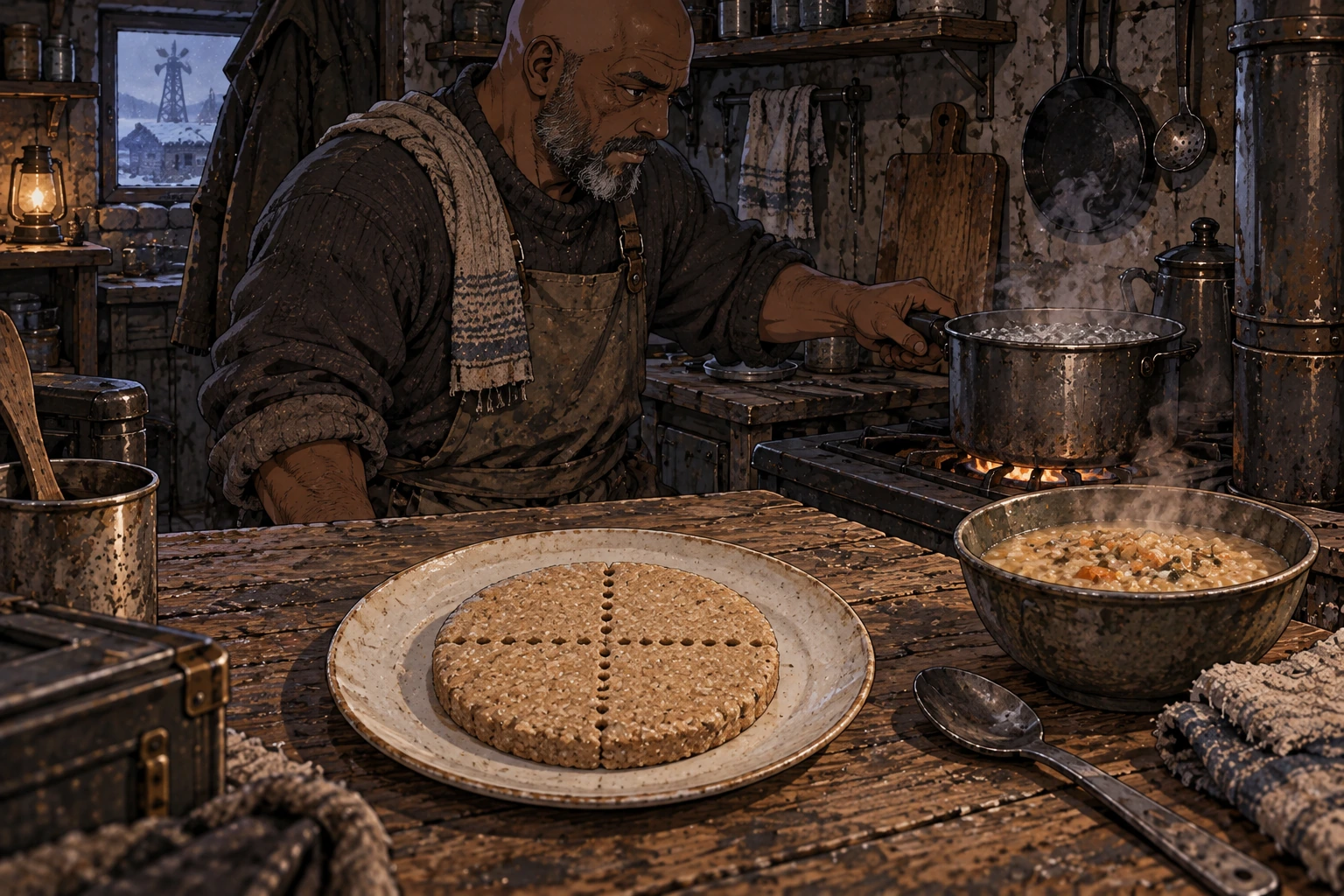
A compact-disc-sized rural ration has four perforated wedges. Preparation uses boiling water and a vessel; four nominal servings do not prove a daily nutritional allowance.
Open full-size illustration ↗People in this picture · 1
Samir Oltan
behind the ration disc, tending the pot · Goes by Samir
Residence: Tarnfeld. Samir maintains cooperative drying racks and prepares his meals from issued rural discs. He keeps a favourite spoon despite its badly repaired handle. No companion is shown in this kitchen.
At the baseline price, one gourmet serving costs three ordinary meal claims—the number in one resident's posted daily allocation. It is not thereby nutritionally equivalent to those meals. A household's choices depend on other food, resources and obligations actually established in the story.
What people actually eat
The ordinary paste issue is served into a lidded household vessel or an exchange bowl at a counter. Stavenbruck's counters favour washable metal because containers return chipped and survive; poorer residents carry repaired tins, while a well-off household owns nested enamel carriers that keep flavours separate. This is proposed local packaging, not a new universal property of U.N.P. The standard portion remains an administrative meal portion without a fixed calorie claim.
At home, a serving can become a fried cake, a thick bowl with hot liquid, a filling in a folded wrapper, or the base for a meal with fish and herbs. These are suggested culinary uses of available paste, not assurance that every formulation behaves identically. Cooks learn their supplier's batches. A dense issue that browns well may make a poor broth; a thin one may require grain the household cannot spare. The complaint “good for carrying, bad for chewing” usually concerns a counter's ladle rather than its advertised recipe.
A short regional kitchen book
| Meal | Where it belongs | What makes it ordinary or special |
|---|---|---|
| Pan-edge cakes | Stavenbruck kitchens | Paste browned in a greased pan with onion tops or crumbs when available; prized crisp edges are divided carefully |
| Pilot's bowl | Roven Ferry | Hot grain or paste with cooked fish pieces and a sharp relish; quality changes with catch and customer's purse |
| Tarnfeld pocket | Agricultural courts | Rehydrated disc used alongside a cooked root filling; portable only after the household has prepared it |
| Black-pot supper | Brackenzell | A communal pot with beans or roots, paste and smoked scraps; each kitchen has its own version |
| Heron smoke plate | Hollenmere | Smoked fish with a sour accompaniment and a small grain portion; a good batch is a trade gift, not necessarily a luxury at its place of origin |
| Three-claim bowl | Canvas Square | The local baseline gourmet-paste serving, protein, vegetables and herbs; price and actual additions remain posted per stall |
| Stillroom custard | Better-paid urban households | An occasional egg-and-milk dessert, served in small cups; much discussed because fresh inputs and fuel cost money |
The rural disc remains a boiling-water preparation. No scene should have somebody effortlessly eating a dry wedge as a complete prepared supper unless a later design explicitly changes that fact. A cook's skill lies partly in making different supplies feel like something chosen. Some people enjoy ordinary paste dishes; poverty does not invalidate taste or make every fond food memory false.
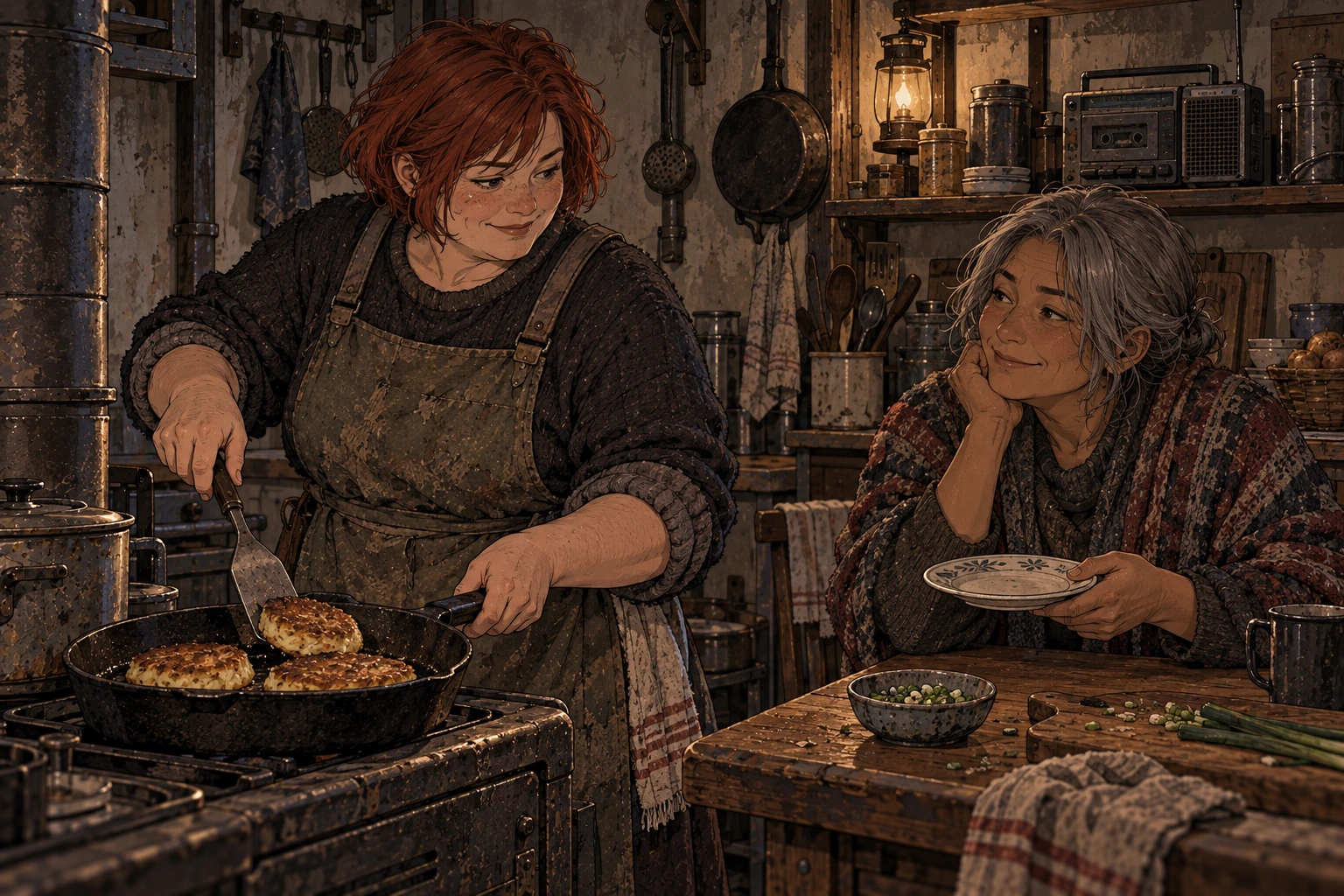
A cook works with the character of an available paste batch, dividing the crisp edges carefully. Familiar food can carry taste and affection amid scarcity.
Open full-size illustration ↗People in this picture · 2
Rita Jask
left, turning the paste cakes · Goes by Rit
Residence: Northbank, Stavenbruck. Rit works in a laundry and is the better cook in this household. She takes pride in dividing the crisp edges fairly. Meda is her mother, sharing supper after Rit’s shift.
Meda Jask
right, waiting with a plate · Goes by Meda
Residence: Northbank, Stavenbruck. Meda is a retired cleaner who still mends household linen. She knows when to offer advice and when to let the pan’s owner work. Rit is her daughter; they live together.
Canvas Square at serving time
The Copper Ladle, run by Mila Renn, has four small burners and a board replaced throughout the day. A customer can bring a redeemable claim for an eligible serving or buy additions in cash under the local arrangement; not every vendor accepts every form of payment. Mila's board separates the meal's claim cost from purchased extras. She dislikes the bigger traders' habit of displaying an enticing bowl whose affordable version contains none of the pictured garnish.
Across the aisle, Hessa Korr sells fish parts in separate bins and can explain which buyers reserve which pieces. Fish heads are not a secret sign of desperation. One household wants them for flavour; another cannot afford a different cut; a third dislikes them. A vendor's explanation of a preparation does not prove the batch is uncontaminated. Inspection, storage, heat and honesty remain separate concerns, treated as fictional scene facts rather than real food-safety instructions.
Better-off customers pay for consistency: the same texture, a known supplier, a reserved egg, an attractive plate and a seat away from the queue. Households with less cash buy when prices change, pool purchases, exchange labour or develop a relationship with one seller. The vendor may genuinely care for a regular customer and still be unable to extend another week of credit. Affection does not refill the pantry.
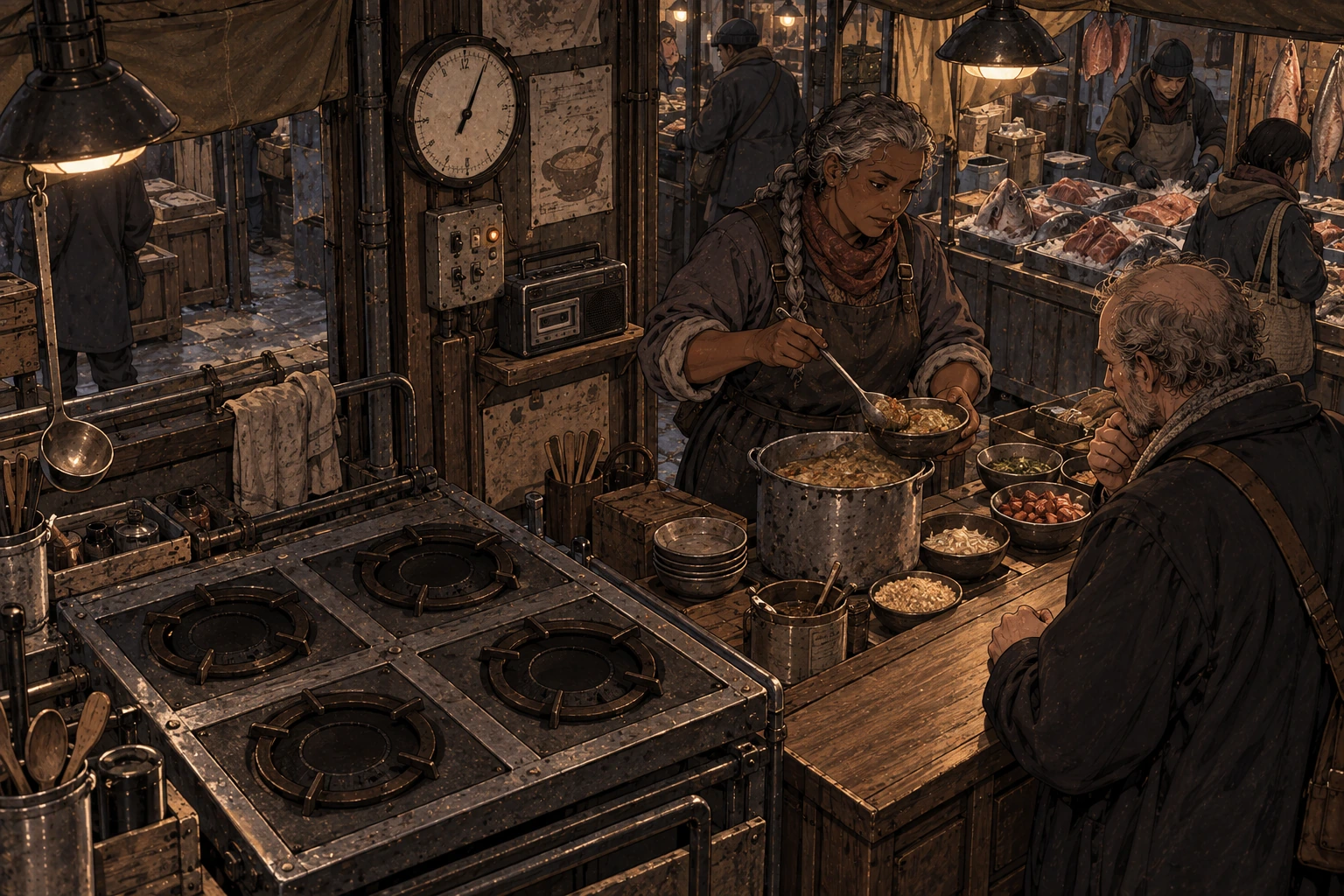
Available additions, ordinary servings and individual purses meet at Canvas Square. Meal-claim costs and cash extras remain separate arrangements.
Open full-size illustration ↗People in this picture · 2
Mila Renn
behind the serving counter, holding the ladle · Goes by Mila
Residence: the streets beside Canvas Square, Stavenbruck. Mila cooks at the Copper Ladle. She experiments carefully with issued paste and scarce additions, without treating fresh produce as ordinary. Oto is a regular customer deciding which additions he can afford.
Oto Karlen
seated at the right edge of the counter · Goes by Oto
Residence: the streets beside Canvas Square, Stavenbruck. Oto is a retired crate maker who buys an occasional meal at the Copper Ladle. He asks the price before praising an addition. Mila is his usual cook, not a member of his household.
Keeping food and keeping promises
Dry stores, smoking rooms, pickling crocks and cold cupboards extend the use of different foods. A cellar's practical value depends on damp, temperature and the household's equipment; the region's cold does not provide an effortless universal refrigerator. Hollenmere sells smoking labour as well as fish. Tarnfeld households exchange access to drying space. City tenements argue over whether a strongly scented crock belongs in a shared cupboard, not over an imagined unlimited harvest.
The Roven Crate Pool owns standard returnable boxes marked by maker and size. A damaged box can delay payment to a supplier even when its contents arrived safely. That gives carpenters, ferry crews, inspectors and food sellers a shared interest in good packing. A story about a missing crate deposit can expose an unfair contract, support a family business or simply recover money. It need not reveal a continental plot.
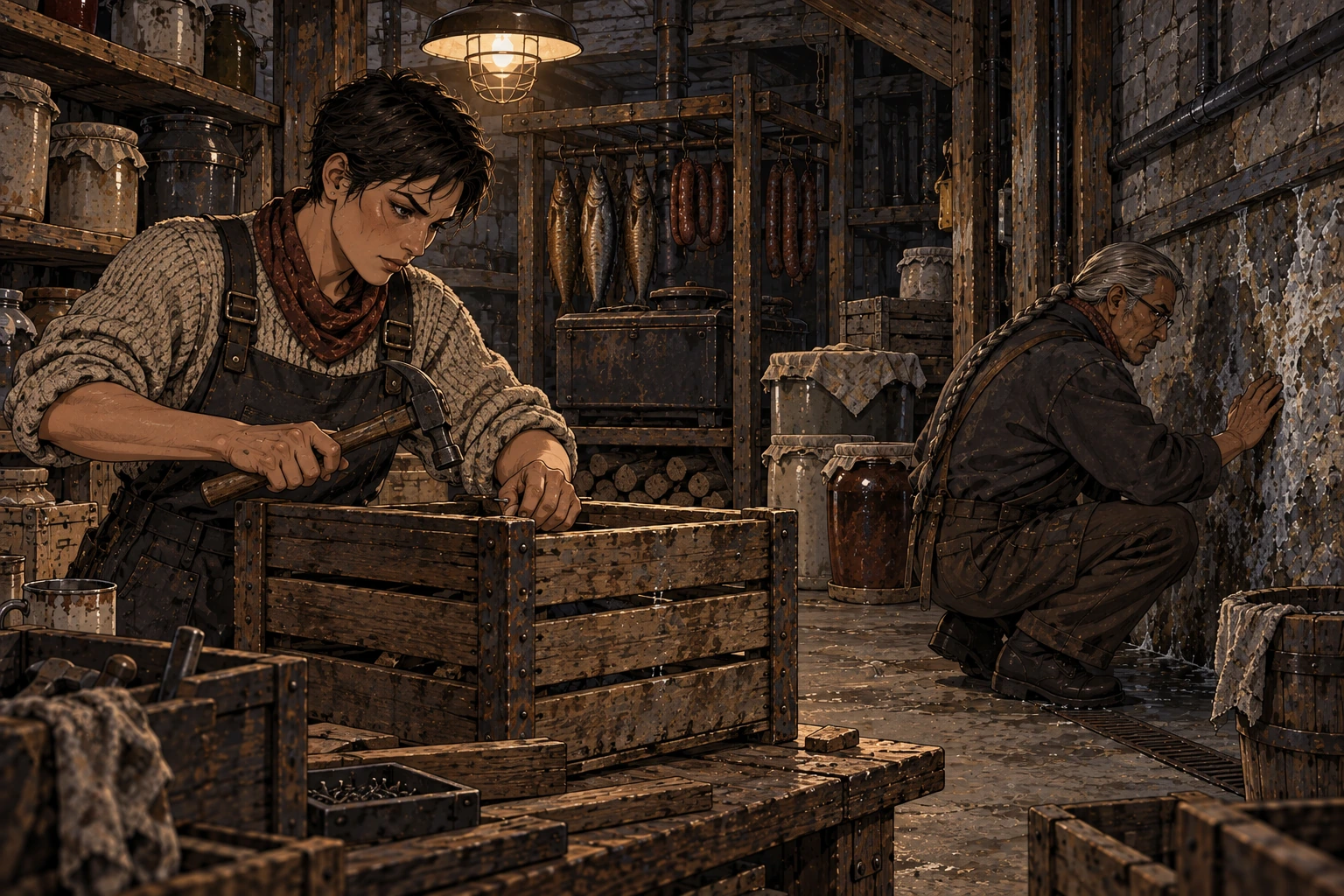
Preserving food and repairing packing are connected work. Damp, fuel, equipment and a damaged crate can all affect a household’s plans.
Open full-size illustration ↗People in this picture · 2
Zina Havel
left, repairing the crate · Goes by Zin
Residence: Freight Ward, Stavenbruck. Zin repairs returnable packing and likes a crate whose joints reveal how to fix it. She wants damaged stock counted before it reaches her bench. Anatol is the stores colleague examining damp at the wall.
Anatol Vernik
right, crouching by the wall · Goes by Tol
Residence: Freight Ward, Stavenbruck. Tol is a preservation-room attendant who traces damp before moving the shelves back into place. Zin repairs the room’s returnable crates; their work depends on the same storage conditions.
Clothing the table
Furniture is repairable and visibly altered: a stool with one replacement leg, a table shortened to fit a room, tins reused for tea, buttons sorted in an old tobacco box. A wedding present may be an unchipped basin or six matching spoons. Embroidered table strips and carefully painted cupboards survive because beauty is something people make, not merely buy. The cleaner display rooms of Old Exchange sell matching sets; the repair markets sell pieces with histories that some customers prefer.
Special meals mark visitors, reconciliations, departures and a wage finally paid. A person may save for a restaurant evening without secretly planning rebellion. Mila wants to serve a cold-weather tasting supper on her own terms; Hessa wants one afternoon when she can eat fish somebody else has prepared. These desires give the market a life beyond provisioning an adventure.
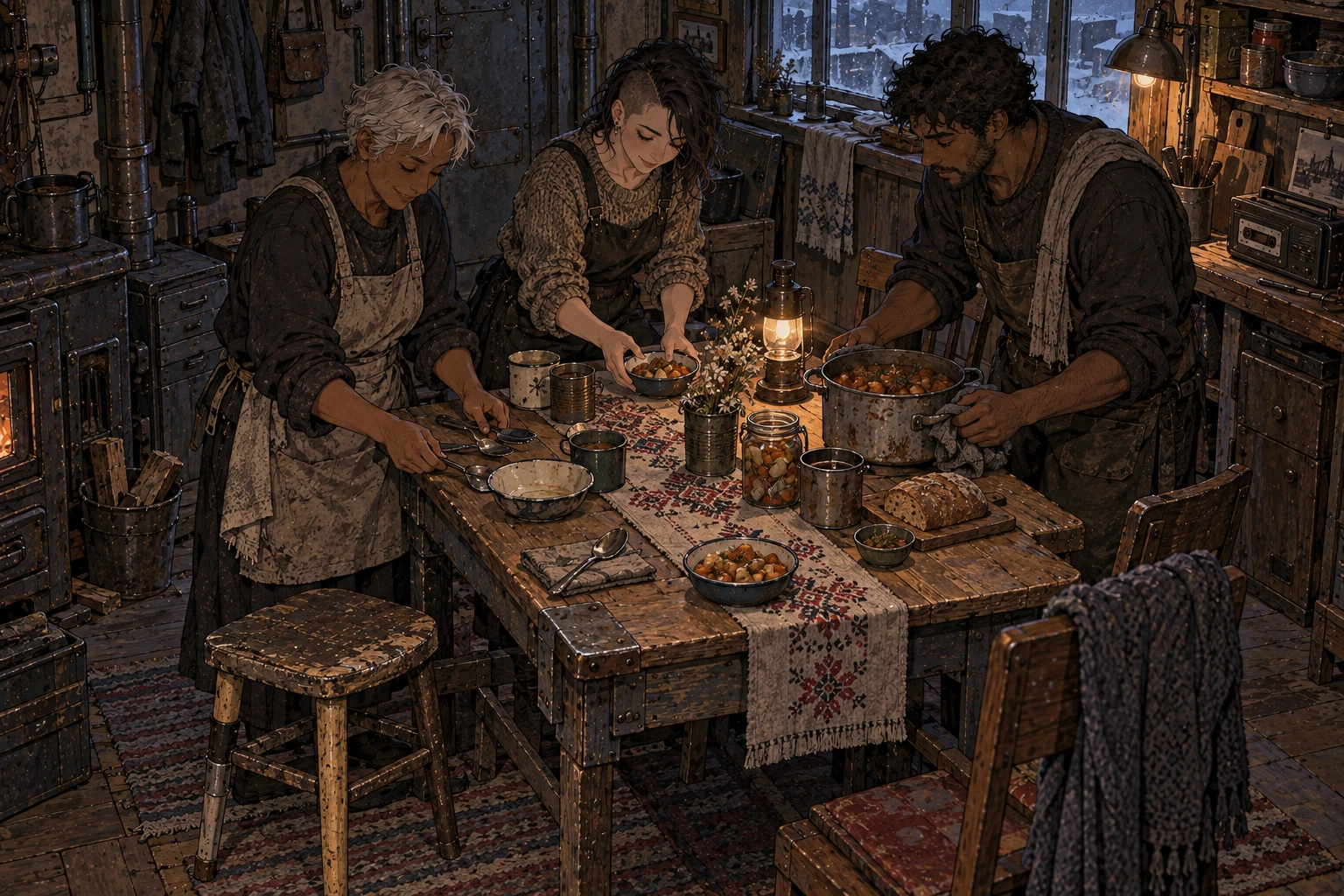
Mended furniture, mismatched spoons and a carefully kept table strip give a modest shared meal its own beauty.
Open full-size illustration ↗People in this picture · 3
Ilma Ravelin
left, setting down the bowl · Goes by Ilma
Residence: Northbank, Stavenbruck. Ilma is a retired washhouse worker who maintains the household’s table linen. She likes a table to look intentional even when supper is modest. Janna is her daughter; Yusuf is Janna’s partner.
Janna Ravelin
centre, arranging the meal · Goes by Jan
Residence: Northbank, Stavenbruck. Jan cleans clinic rooms and keeps a few careful household rituals after work. Setting the table is one she enjoys rather than merely owes. Ilma is her mother and Yusuf her partner.
Yusuf Ravelin
right, carrying the serving pot · Goes by Yus
Residence: Northbank, Stavenbruck. Yus is a boiler-shop porter who does the heavy lifting at home but is learning the cooking as well. Jan is his partner; they share their home with Ilma.
Protected cultivation
Growing food is dangerous because of the glowing rain. Gardens must be fully enclosed overhead and on all sides in transparent polyurethane or plastic greenhouses that keep the rain off the plants. This includes food and flower gardens. .