Four lives through the same region
These illustrative day-and-week sketches show different possible lives. Their purpose is to show how home, work, travel, relationships and pleasure connect.
A junior city worker with a room of their own
A junior clerk at Old Exchange rents a Rook Court room and holds the ordinary resident meal allocation. Their cash resembles the single-income budget: rent and heat are secure only while wages arrive, and a broken pair of boots matters. Before work they leave a collection arrangement with their registered household contact. At the counter they process transfers they cannot instantly verify because another office's cassette batch is late. That uncertainty can be an honest delay rather than an attempted fraud.
After work they walk to save a fare, collect a repaired cuff from Maren and attend a low-cost listening programme. A friend offers to share rooms. The choice involves affection, money, privacy and what each expects the arrangement to mean. A campaign could follow their professional advancement or involvement in a municipal dispute; an ordinary scene could end with music and a decision to think about the offer. The clerk does not need prison connections to have meaningful stakes.
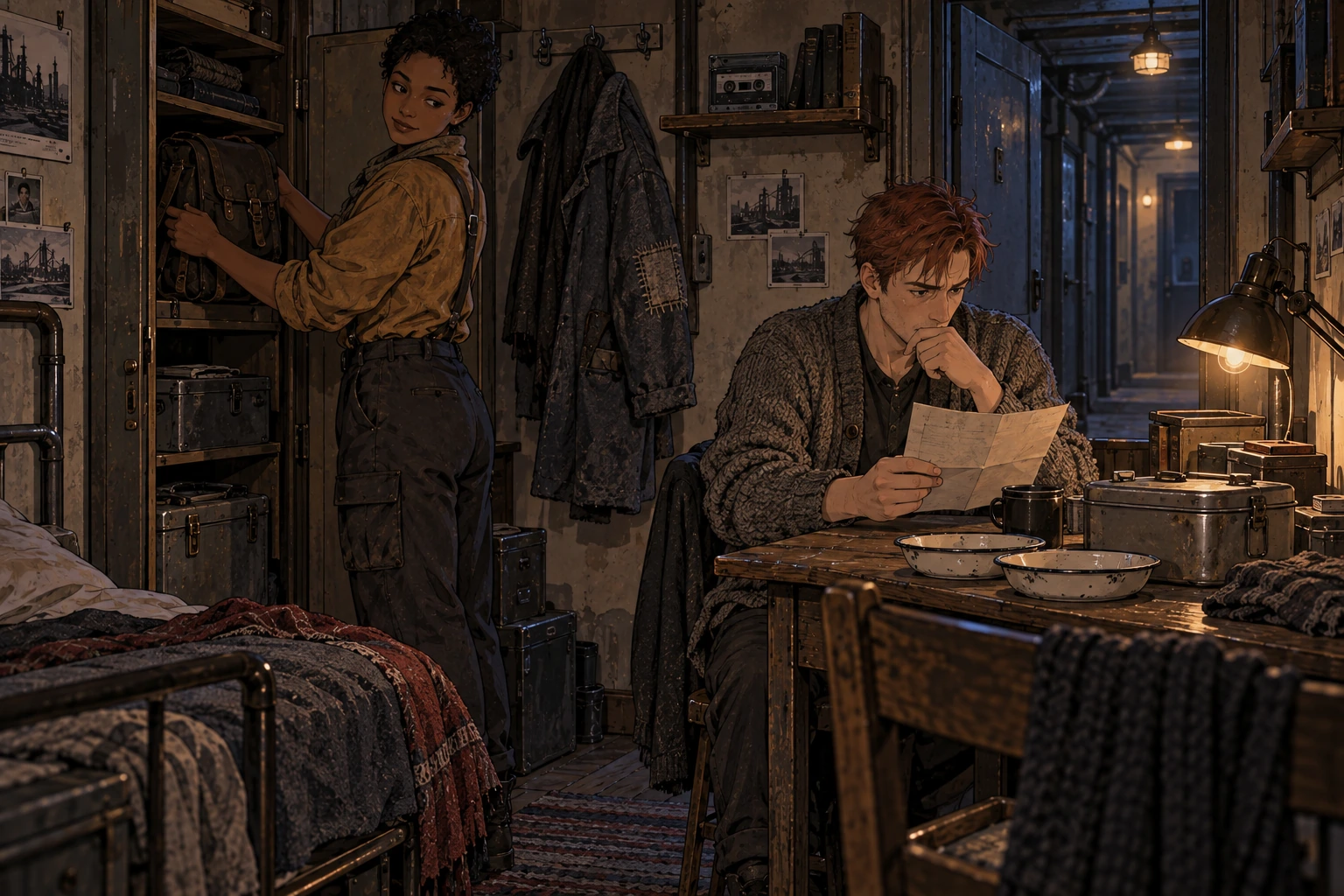
An illustrative life can hold work, practical choices and hopes beyond a crisis.
Open full-size illustration ↗People in this picture · 2
Amal Kerven
left, putting away the satchel · Goes by Amal
Residence: a shared lodging room in Freight Ward, Stavenbruck. Amal is a local document courier who wants a room worth returning to after a long route. Risa is her friend and room-mate; their work is separate.
Risa Holm
right, reading the folded notice · Goes by Ris
Residence: a shared lodging room in Freight Ward, Stavenbruck. Ris is a print-room assistant considering a posted training opportunity. She wants to choose with more than next week’s rent in mind. Amal is her friend and room-mate, not her employer.
A Tarnfeld household that owns tools but little cash
A cooperative member begins with the drainage condition, not the city's clock. Their household has rural disc supplies and some access to food it produces, yet owes cash for metal parts and transport. Someone takes a crate to Roven Ferry while another stays to work. An apprenticeship offer in Stavenbruck is good news that would remove useful labour and require a lodging deposit.
The family supper can include ingredients a city clerk would consider a luxury, served in a cold room with a leaking roof. An elder wants the young person to stay until a major repair is complete; the young person fears another year of postponement. The cooperative may offer a genuine compromise or defend its own convenience. A story can concern a contract, an invention, an inheritance dispute or the movement between rural skill and urban certification. Neither city nor countryside automatically represents freedom.
A skilled foundry household
An experienced Brackenzell worker has better wages than a casual city porter and access to employer-linked heat. They can afford occasional entertainment and repair savings. They also know that losing the job could threaten several household arrangements at once. A proposed shutdown would allow necessary plant maintenance while stopping pay under a contested contract clause.
Oda Kern asks for support at a committee meeting. The worker's partner worries about a child's training costs and believes the owner might negotiate privately. At the workshop procession they admire objects made by people they are furious with. That pride is not false consciousness imposed by the narrator; it is a real attachment alongside criticism. A useful campaign follows bargaining, evidence, workplace loyalties and changing production rather than treating every industrial dispute as a prelude to inevitable massacre.
A Kaltbruch staff household in Stavenbruck
A newly recruited custody employee leaves a shared city household for a duty rotation. At home, steady wages have made rent less precarious. At work, they encounter tolerated theft, dismissive senior personnel and orders that make prisoners' ordinary needs harder to meet. They may cooperate, object selectively, withdraw into routine or seek a different posting.
Their partner hears other residents criticise the prison and wants an honest answer about the job. An outside supplier recognises the uniform and offers a favour. A prisoner asks for something the employee can actually provide without overturning an order. Those situations reveal character through choices. The household has recreation, affection, bills and ambitions beyond the prison, while the prison's institutional reality remains present in what its income and silence cost.
Stories with several legitimate interests
Each opportunity below offers a specific pressure, multiple participants, evidence or resources to work with, and a completion that can matter. Causes and deadlines are selected before a scenario begins. These are possibilities, not events scheduled to happen.
| Opportunity | People and competing interests | What characters can actually pursue |
|---|---|---|
| The platform roof account | Vesk residents paid for their shelter; the railway claims it as grounds for a higher charge | Establish contributions, negotiate ownership or win a defined access arrangement |
| The casting that passes twice | Cinderbank and a city workshop use different acceptance criteria | Compare specifications and tests, assign costs fairly, or find an altered contract |
| A place in the workshop | Rika wants open repair drawings; Pavel fears loss of customers and investors | Build a compensated teaching arrangement or negotiate limited publication |
| The downstream samples | Hollenmere wants testing; Tarnfeld needs drainage work; the city wants reliable water | Obtain comparable observations and agree a working restriction or repair |
| The missing listening copy | A performer objects to commercial copying; the Reading Exchange has a disputed loan | Trace actual copies, establish permissions and recover or replace a specific item |
| Rooms for two shifts | A proposed reassignment ignores an unusual care and work arrangement | Document household reality and obtain a workable tenancy decision |
| The appointment beyond the crossing | A care referral, family work and ferry conditions pull against one another | Arrange transport, temporary care and costs without inventing medical success |
| A band for First Open Crossing | Musicians need wages, instruments and a route; organisers have a fixed fund | Assemble a programme and get people paid, with room for an enjoyable performance |
| The meal discrepancy | A Kaltbruch room group's received issue differs from its record | Establish the actual cause and improve the concrete allocation or accountability |
| The survey berth | Institute trainees, a military sponsor and an experienced rural repairer seek places | Build a credible team and briefing, negotiate credit and define what the survey will establish |
Crime without a universal criminal master plan
The Loose Ledger is a proposed loose network of fences, debt intermediaries and transport contacts, a name used more consistently by investigators than by its supposed members. Some people knowingly trade stolen goods; others buy without asking enough questions. A repair part can pass through legitimate and illicit hands before reaching a plant that urgently needs it. The same clerk who helps with one dishonest invoice may refuse another.
Crime stories can concern a theft, extortion, an injury concealed by paperwork or a misplaced accusation. Establish what happened and who knows what before investigation. A stolen recording may be valuable because it proves an ordinary debt, not because every cassette contains world-changing secrets. Recovering wages or preventing a neighbour's exploitation can be an important outcome without exposing the state.
Military, scientific and Rift opportunities
The civilian region supplies recruits, specialists, transport and equipment for established military and Rift campaign subjects. A military repair section may recruit Oda for a consultation; institute students may compete for a survey post; ferry knowledge may matter to an expedition's preparation. These connections broaden the campaign rather than making ordinary people irrelevant once uniforms arrive.
Rift operations still require a separately established mission, sponsor knowledge, crossing conditions and return arrangements. Characters can prepare, learn, refuse, negotiate or advance in their work before any crossing occurs.
What a completed story can leave behind
Before a civilian remedy is available, establish the concrete obstacles: who holds the records, which appointment or inspection is needed, what time or income pursuing it costs, and who can help. Use only obstacles that follow from the case; do not add a fresh procedural barrier whenever the residents satisfy the previous requirement. A repair order may need follow-through, and a hearing may be delayed or fail, but sufficient evidence and effective action must be capable of changing the result.
A repaired service, an enforceable local agreement, a household that stays together, a better apprenticeship, a successful recording or a reliable sampling practice can endure. The region remains harsh without demanding their destruction. Equally, failure can leave a specific debt, damaged relationship or lost opportunity rather than erasing every other aspect of a person's life. The almanac supplies enough ordinary structure for those outcomes to have somewhere to remain.