Military aerial transport follows the same worldwide rule as civilian travel: Zeppelins alone. High-power engines cause ion buildup, with direct strikes and a ball-lightning effect capable of bypassing lightning rods and striking a positively charged main body. See Zeppelins and the charged sky.
The armoured carrier
Heavy enclosed carriers protect passengers and equipment against weather and road debris. Their weight is also a presence beside people moving on foot. An escorted prisoner column feels the machine through its size, engine noise and the space guards keep around it. Worn armour and repaired fittings show a vehicle expected to remain useful.
A protected side communications cabinet brings a recessed CRT, cassette cartridge drive, analogue meters and corded handset within an operator's reach. Inside, radio racks and cartridge caddies compete with knees and shoulders. A soldier going to relief, a repair worker and a person under escort can watch the same door with very different hopes.
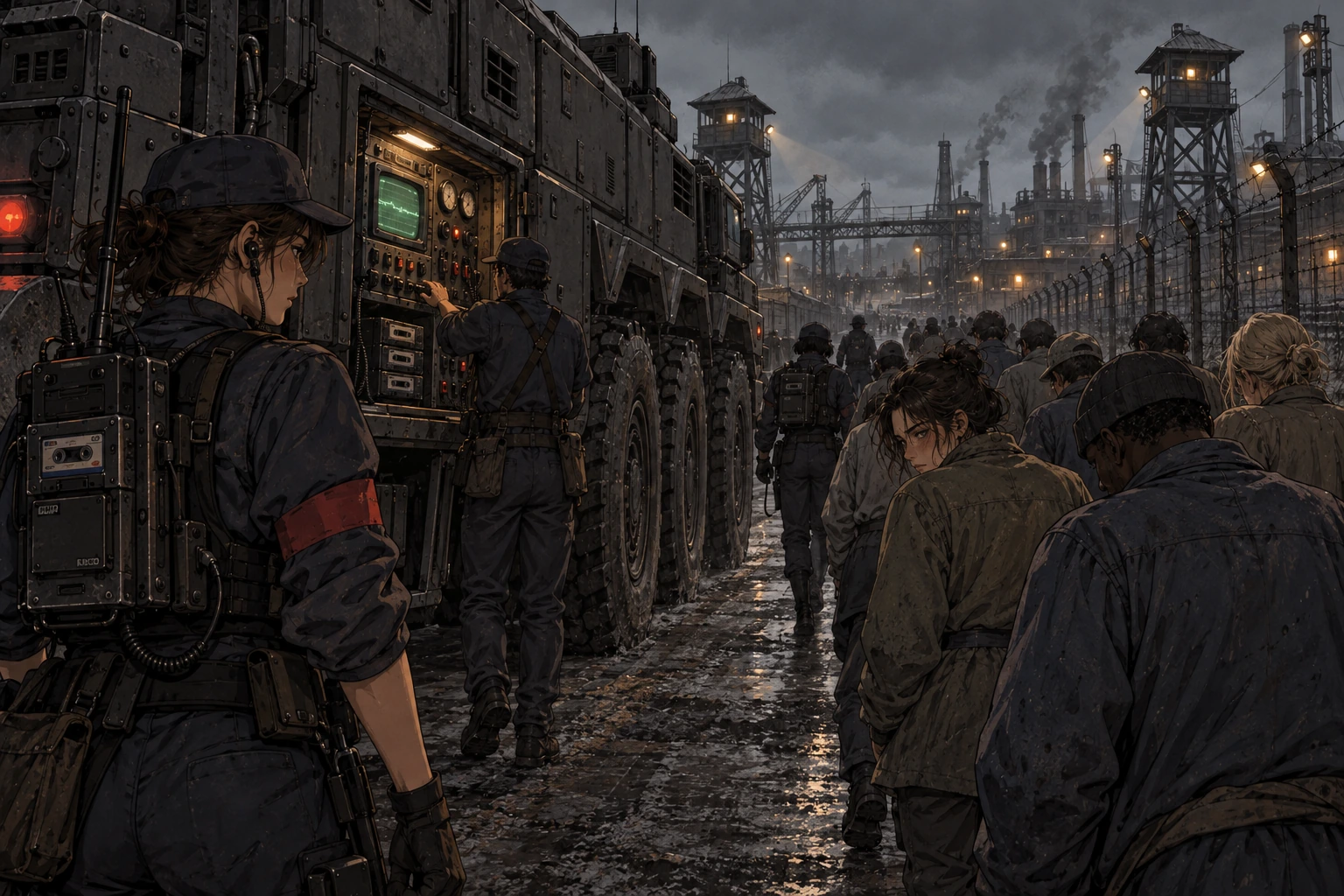
A heavy enclosed carrier accompanies an escorted movement through Kaltbruch.
Open full-size illustration ↗People in this picture · 3
Elsa Krav
left foreground, beside the carrier equipment · Goes by Elsa
Military rank: Korporal
Residence: Kaltbruch service barracks. Elsa leads a custody escort team. She checks the movement list and communications before allowing a column to advance. Kesa and Ruman are prisoners in the escorted group, not her subordinates as soldiers.
Kesa Vern
right of centre, looking back from the column · Goes by Kes
Kaltbruch ID: A00030192
Residence: Kaltbruch adult shared housing. Kes is an inmate assigned to materials sorting. She tries to learn the day’s work before somebody else claims the easiest place. Ruman is another prisoner on this movement; Elsa is supervising the escort.
Ruman Olt
nearest the right foreground, bent forward · Goes by Rum
Kaltbruch ID: B00015837
Residence: Kaltbruch adult shared housing. Rum is an inmate assigned to yard cleaning who repairs the seams of his own work coat. He prefers a clear instruction to shouted hints. Kes is a fellow work-detail member; they have no family connection.
Laundry and stores
The laundry-and-stores truck handles the recurring traffic that keeps an institution inhabitable. Beside its bundles and containers, a loading terminal combines a recessed CRT, tape-cartridge unit, analogue indicator and corded dispatch handset. Paper acknowledgements still accompany the load. Electronic equipment does not settle a disagreement about what was actually handed over.
Edda dislikes bundles described only as “miscellaneous.” The label makes unloading somebody else's problem. Her truck's return in Mik's story begins as a changed transport movement. Its consequences grow when the movement of goods becomes confused with the movement of a person.
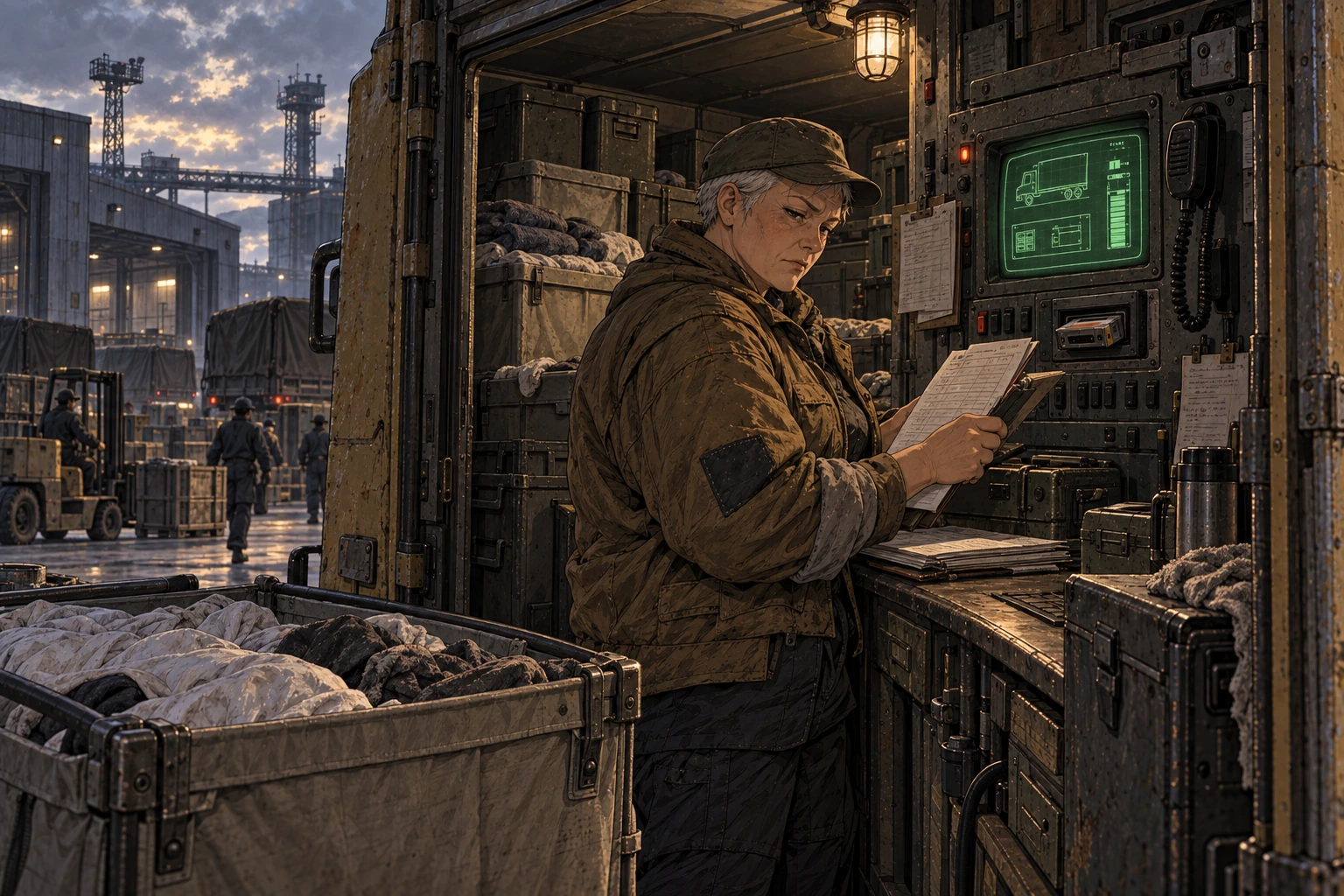
Unremarkable loads connect military duty to prison life.
Open full-size illustration ↗People in this picture · 1
Edda Kest
beside the truck’s dispatch terminal · Goes by Edda
Military rank: Oberstrazhnik
Residence: the basin-road military barracks. A military transport driver, Edda knows vehicles by their bad habits. She takes pride in returning with the people and load entrusted to her. She is checking the stores return against the load entrusted to her.
Recovery work
A recovery vehicle carries the machinery needed to bring a failed vehicle back. Its protected control station has large analogue dials, physical switches, cable housings and a cassette fault-logging module. Sen brings a separate diagnostic case with its own recessed CRT. Weather protection and room to work matter as much as the machines' strength.
Sen approaches recovery as part of diagnosis. He wants to know what happened before the engine stopped, including the warning somebody hoped was unimportant. The person answering may fear blame. Getting a useful account can require more patience than getting the vehicle back.
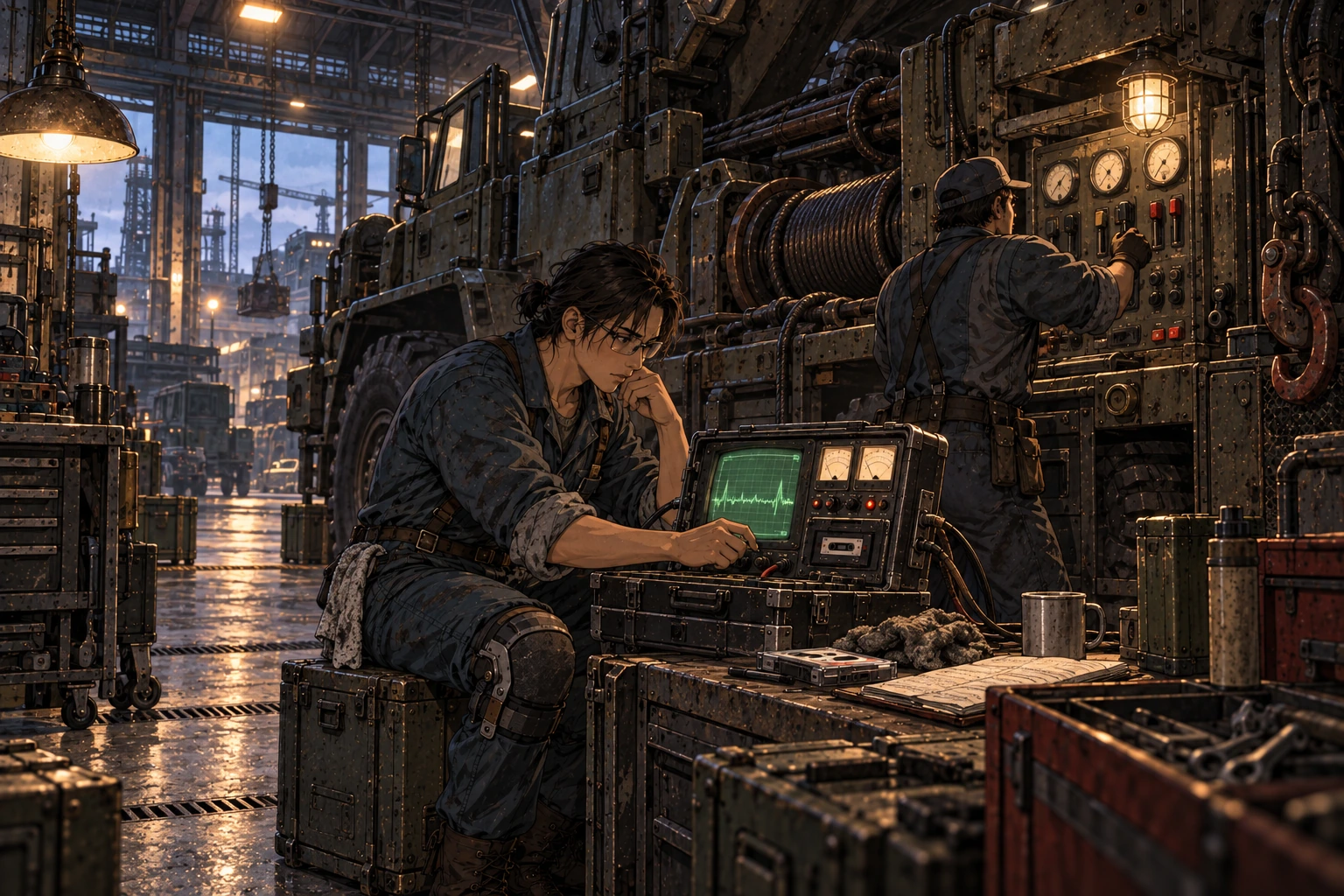
A disabled vehicle creates work before it creates a story of rescue.
Open full-size illustration ↗People in this picture · 2
Sen Ravel
left foreground, at the diagnostic case · Goes by Sen
Military rank: Korporal
Residence: the basin-road military barracks. A recovery mechanic, Sen tests a repair before trusting it. He arranges work around his right-knee brace without making a ceremony of it. Pavel Orven is the recovery operator working with him.
Pavel Orven
right, at the recovery vehicle’s external controls · Goes by Pav
Military rank: Oberstrazhnik
Residence: the basin-road military barracks. Pav is an enlisted recovery operator who waits for a clear signal before moving equipment near a colleague. Sen is the mechanic directing this part of the repair.
Medical transport
Medical transport protects a person whose condition makes an ordinary journey unsuitable. A secured monitoring rack carries a green CRT, analogue meters, tethered controls and a cassette event-recorder. Cleanable housings and shock mounts need maintenance. The vehicle still depends on fuel, a driver and an available route.
Priority does not erase delay. A crew may wait for clearance while a receiving room waits for the crew. Staff must exchange enough information for care to continue. To the passenger, the chain can be experienced as a succession of strangers asking the same question.
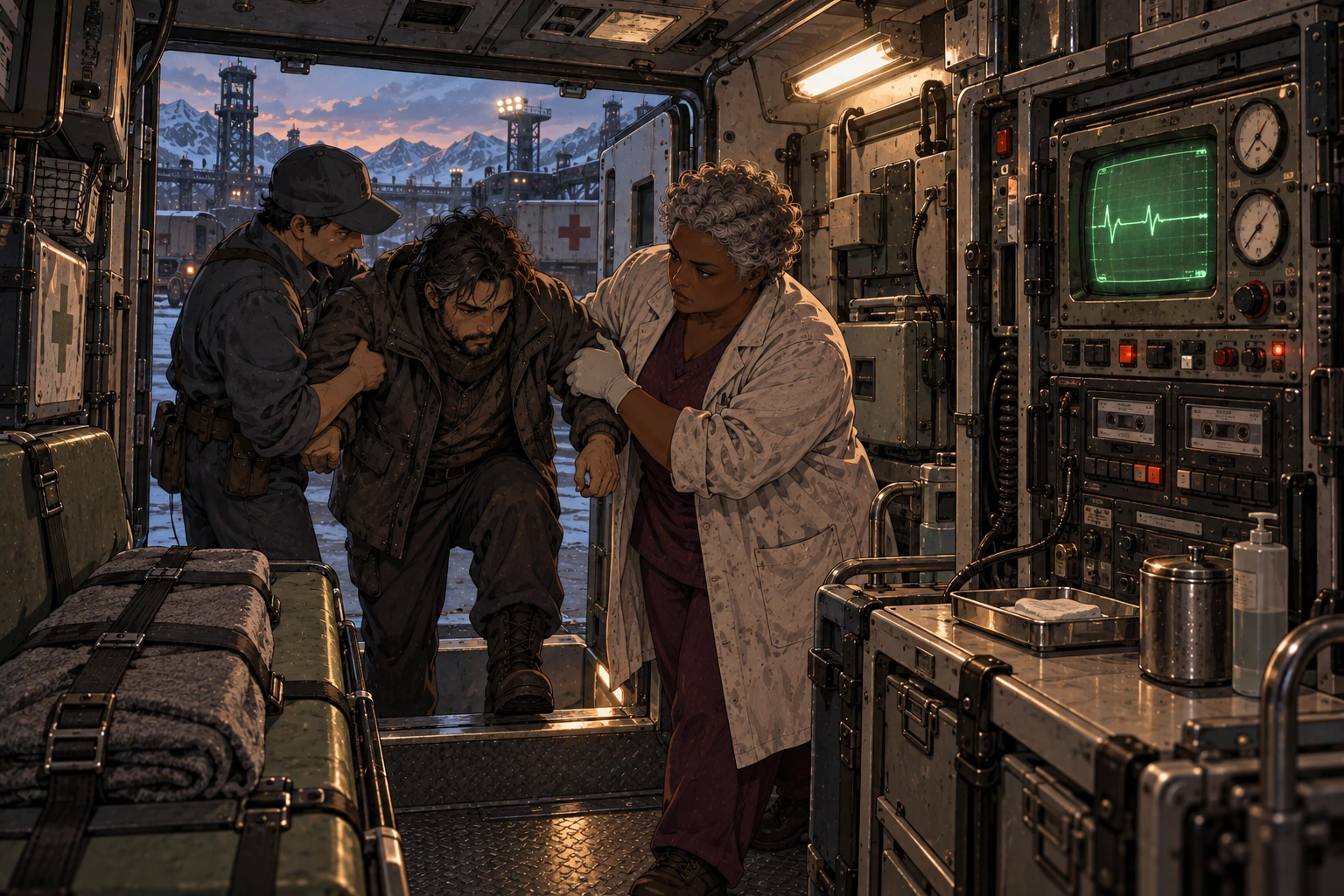
Transport time is part of access to care.
Open full-size illustration ↗People in this picture · 3
Nemi Arven
right, supporting the patient · Goes by Nemi
Residence: staff lodging beside Kaltbruch’s clinic. A civilian prison nurse, Nemi is direct and observant. She attends to the patient while knowing that custody may misuse a care note. Milan is the military orderly assisting her; Deren is the patient.
Milan Selt
left, the capped orderly supporting the patient · Goes by Mil
Military rank: Strazhnik
Residence: the basin-road military barracks. Mil is a military medical orderly who checks a passenger’s footing before worrying about the timetable. Nemi is the civilian nurse working with him; Deren is their patient.
Deren Gask
centre, stepping into the medical transport · Goes by Deren
Kaltbruch ID: A00029418
Residence: Kaltbruch adult shared housing. Deren is a prisoner normally assigned to the packing room and is travelling for care. He wants the return arrangements explained before departure. Nemi and Milan are assisting him; neither is a family member.
Communications on wheels
The communications body is crowded with differently sized CRTs, tape drives, large removable cartridges, patch sockets, rotary selectors and wired headsets. Cables pass between cooling grilles and spare-module cases. Nera works inside the machinery's reach. Notes remain necessary because a message heard once in noise may not survive accurately in memory.
Nera likes the equipment best when a fault can be reproduced. An intermittent failure attracts opinions. She writes down the circumstances so that a later success cannot be used to claim nothing happened. The record is useful only if someone reads it before relying on the set again.
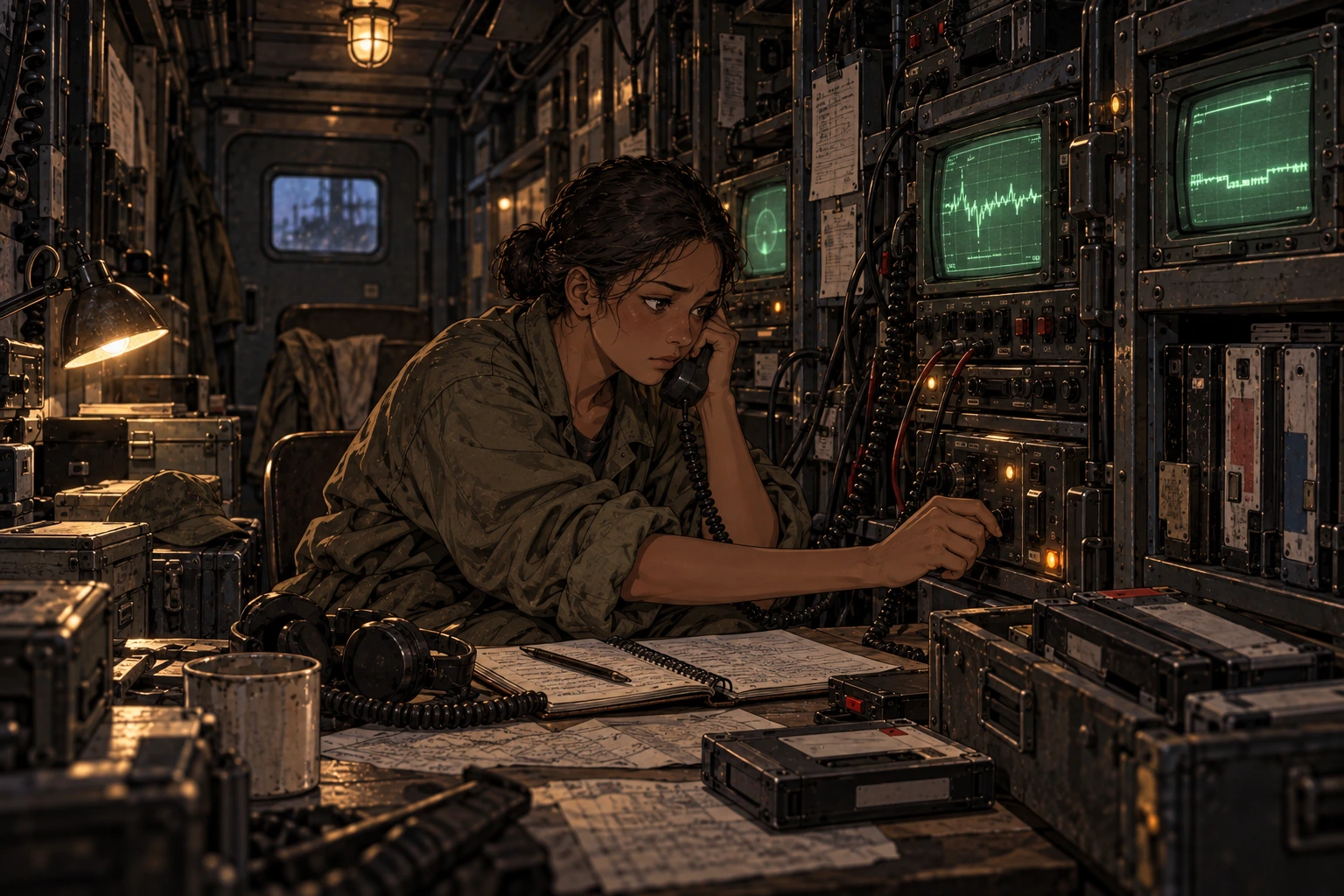
Messages need a vehicle, an operator and a working connection.
Open full-size illustration ↗People in this picture · 1
Nera Tavin
inside the communications vehicle · Goes by Nera
Military rank: Strazhnik
Residence: the basin-road military barracks. A signaller, Nera is quick at diagnosing faults and impatient when seniority substitutes for an explanation. She is the duty signaller; the people on the other end of the connection are off scene.
A driver's morning
Edda enters the cab before passengers bring their stories. A deep dashboard holds a vehicle-status CRT, cassette data modules, analogue gauges and banks of physical switches. She checks the panel and the day's work. Controls are worn where hands repeatedly find them; a loose object announces itself at the first uneven stretch.
Drivers develop habits that look eccentric until another person takes the seat. Edda knows which noise belongs to the bodywork and which requires stopping. She is less tolerant of someone talking over the second kind.
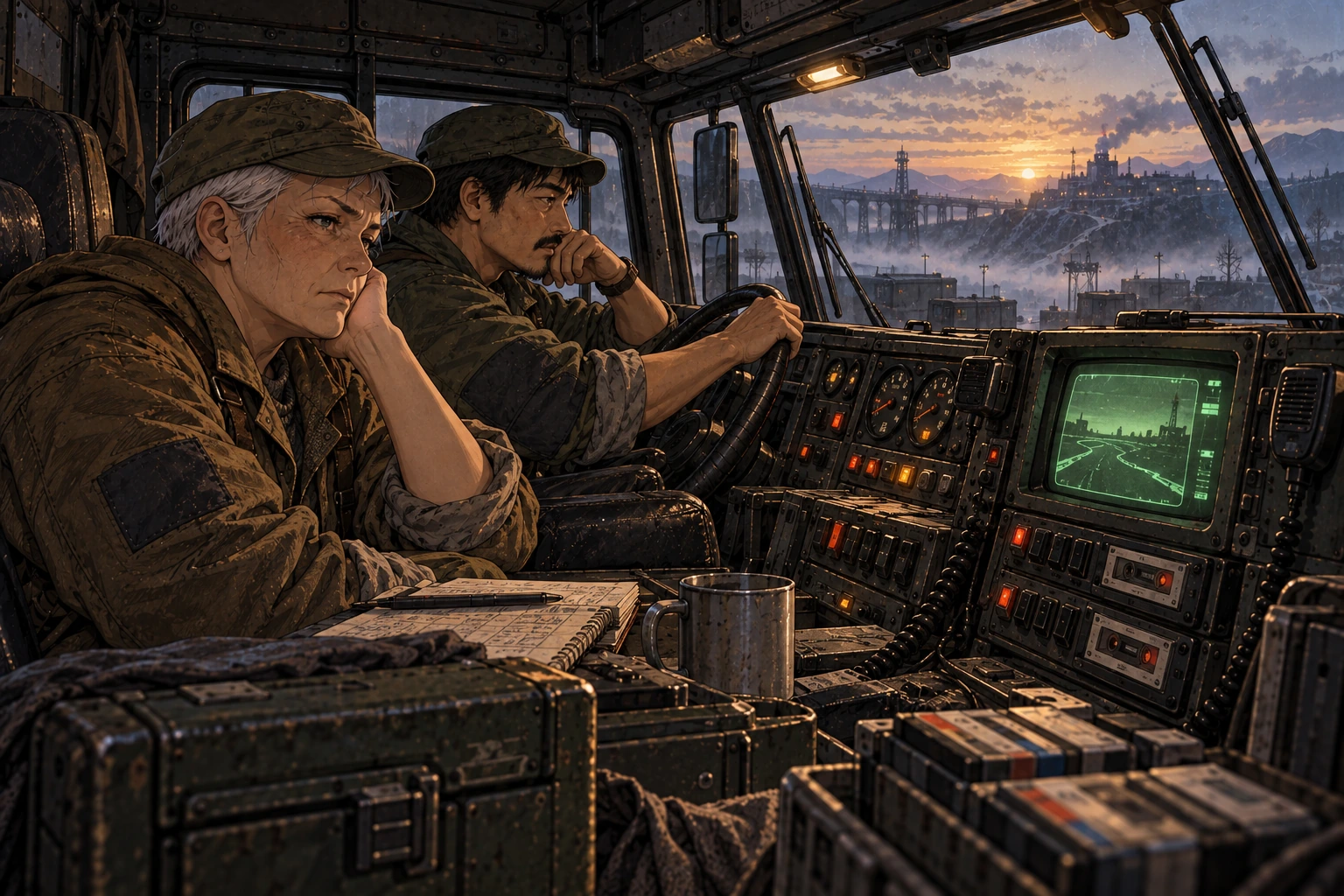
A long duty begins before the road looks welcoming.
Open full-size illustration ↗People in this picture · 2
Edda Kest
left foreground in the cab · Goes by Edda
Military rank: Oberstrazhnik
Residence: the basin-road military barracks. A military transport driver, Edda knows vehicles by their bad habits. She takes pride in returning with the people and load entrusted to her. Aron is a fellow service member sharing the early journey, not her partner.
Aron Pell
right, at the cab controls · Goes by Aron
Military rank: Serzhant
Residence: the basin-road military barracks. A section leader, Aron uses humour to keep tired people working. His protectiveness can slip into favouritism. Edda is the transport driver working alongside his section.
The halted column
A group of vehicles stopped along a road creates a temporary society of waiting. Orders travel unevenly through cabs and radios. People near the cause know something those farther back do not, and speculation fills the distance.
Personnel remain protected from hazardous weather. A driver cannot make the route safe through impatience, and a passenger's urgent purpose does not repair the vehicle ahead. There are still decisions worth making: whom to inform, whose condition needs attention, and which delay must be recorded honestly when the movement resumes.
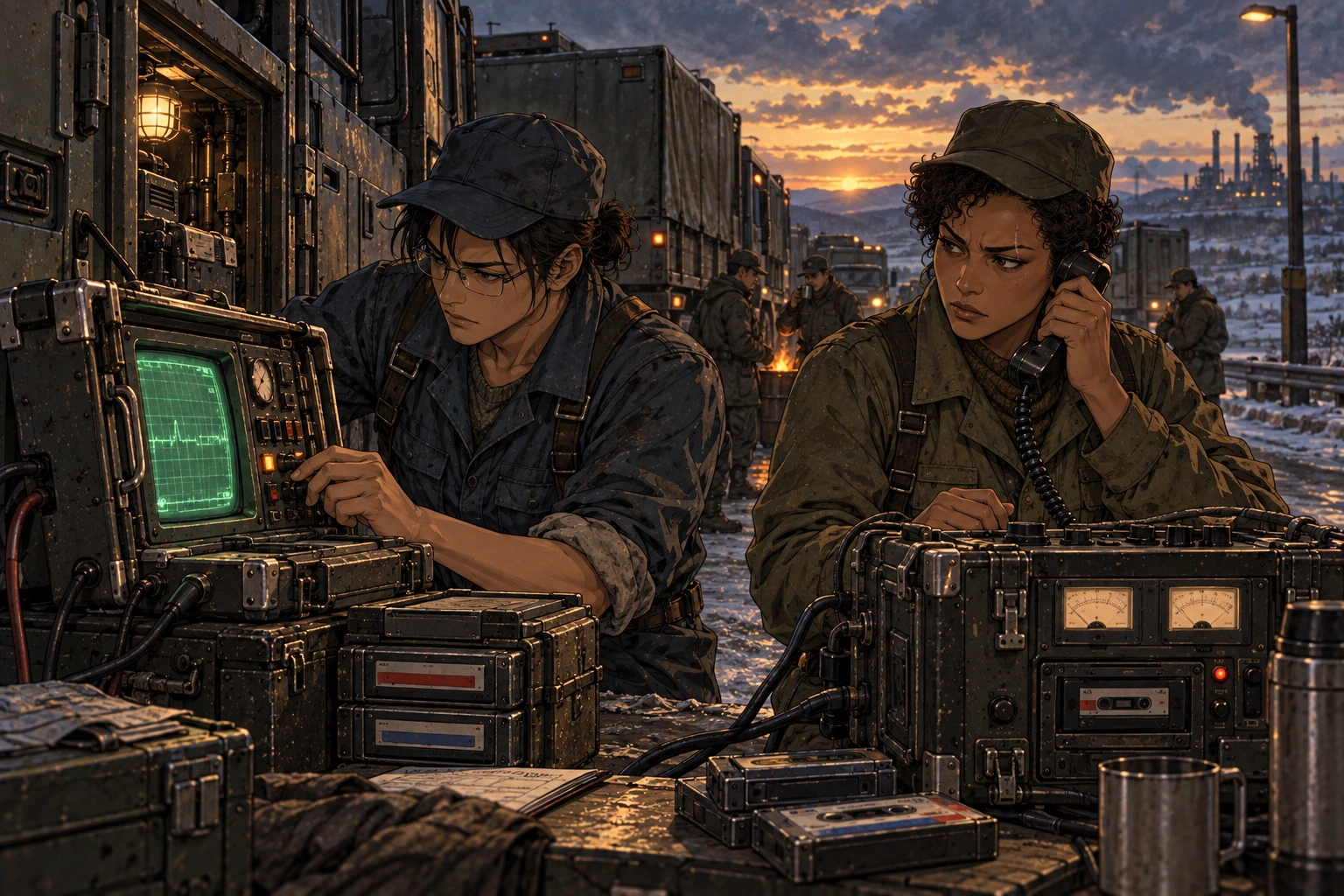
Stopping for a fault changes the work of everyone waiting.
Open full-size illustration ↗People in this picture · 2
Sen Ravel
left, adjusting the diagnostic set · Goes by Sen
Military rank: Korporal
Residence: the basin-road military barracks. A recovery mechanic, Sen tests a repair before trusting it. He arranges work around his right-knee brace without making a ceremony of it. Vesa is coordinating the halted movement while he investigates the fault.
Vesa Dravik
right, making the wired call · Goes by Vesa
Military rank: Leutnar
Residence: the basin-road military barracks. The transport duty officer wants orders that account for drivers, loads and return journeys. Her loyalty to her unit has limits and costs. Sen is the recovery mechanic whose assessment she needs before moving the vehicles.
What comes back
Return is work. Equipment must be accounted for, faults described and the vehicle left ready for whoever inherits it. The desire to go off duty competes with the next driver's need to know what happened.
Sen reads these accounts alongside the machine. Edda supplies details that would disappear in a bare statement of completion. Their cooperation is neither effortless nor affectionate every day. It allows ordinary reliability to accumulate, one returned load and one properly described fault at a time.
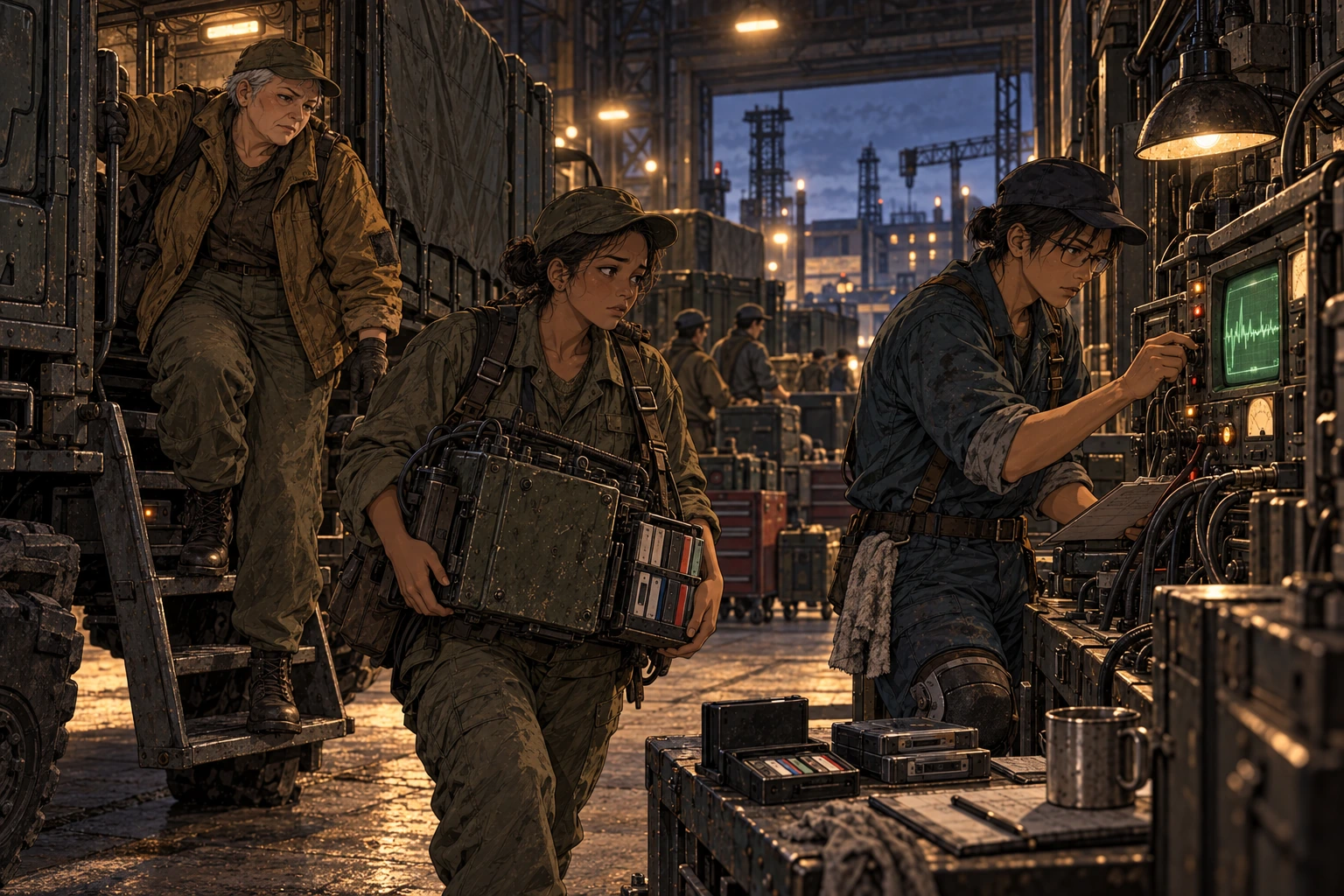
A return carries wear, unfinished paperwork and people who still need rest.
Open full-size illustration ↗People in this picture · 3
Edda Kest
left, stepping down from the truck · Goes by Edda
Military rank: Oberstrazhnik
Residence: the basin-road military barracks. A military transport driver, Edda knows vehicles by their bad habits. She takes pride in returning with the people and load entrusted to her. Nera and Sen are service colleagues handling the returned equipment.
Nera Tavin
centre, carrying the field set · Goes by Nera
Military rank: Strazhnik
Residence: the basin-road military barracks. A signaller, Nera is quick at diagnosing faults and impatient when seniority substitutes for an explanation. Sen checks the equipment she is returning; Edda has brought the vehicle back.
Sen Ravel
right, checking the rack · Goes by Sen
Military rank: Korporal
Residence: the basin-road military barracks. A recovery mechanic, Sen tests a repair before trusting it. He arranges work around his right-knee brace without making a ceremony of it. Nera is returning the field set and Edda the transport; both are colleagues.