New Frostmarch is a cold militarised territory on Vardrask, on alternate Earth #0239. Prison life, military life, STEM (science, technology, engineering and mathematics), conflict and Rift expeditions remain its primary campaign subjects. Civilian communities supply their people, resources and stakes. Scarcity, institutional cruelty, dieselpunk and cassette futurism shape daily experience.
The Rift physically rewrote approximately 70 percent of Vardrask, with worldwide climatic consequences. Early transformation affected the primary basin in 72 hours, spread along connected faults and watersheds over 18 months, and reached the stated extent through the following eleven years.
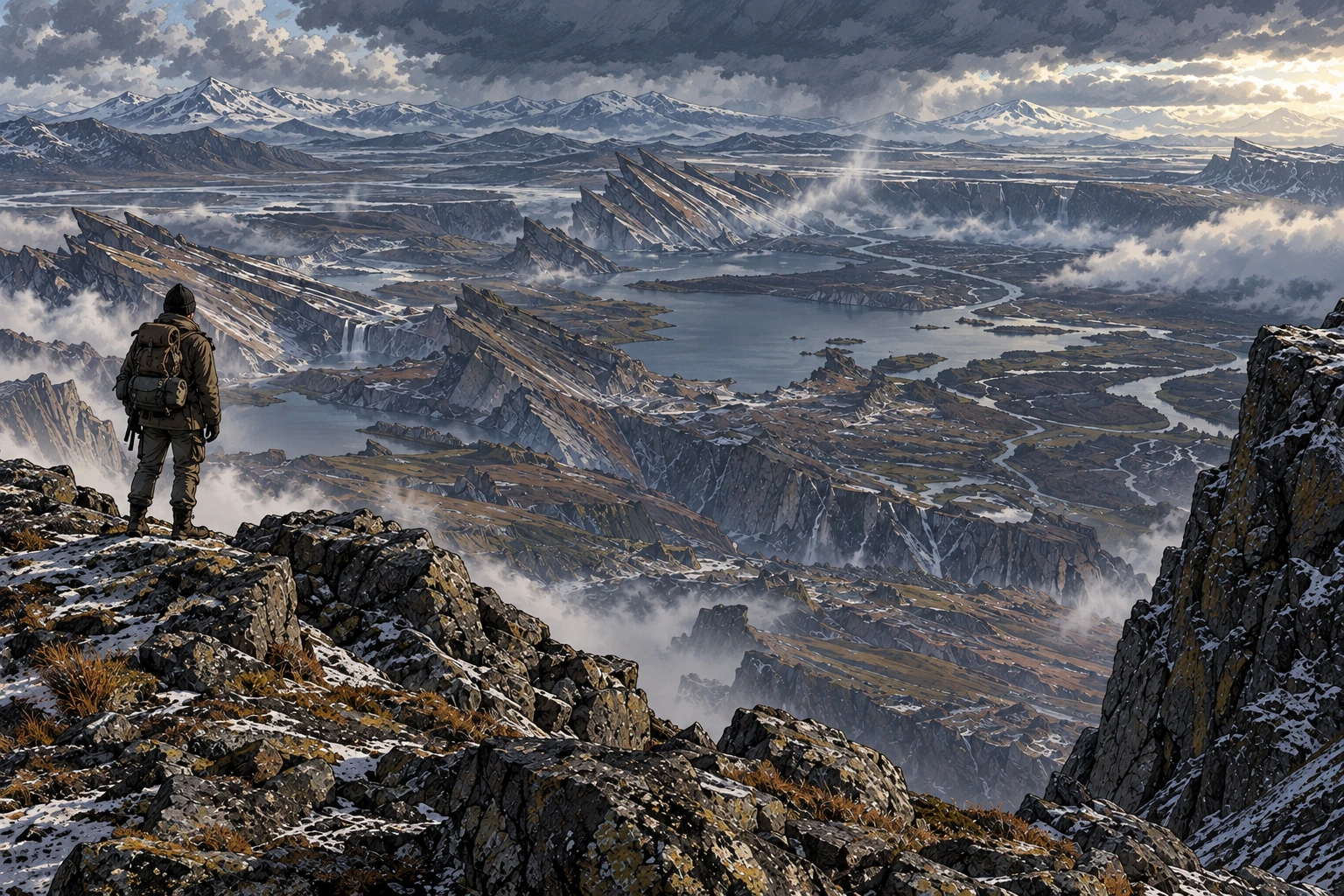
People in this picture · 1
Toren Haskel
lone figure overlooking the altered basin · Goes by Tor
Residence: lodging at the basin survey station. Tor is a civilian terrain observer who records changes from assigned observation points. He wants routes judged by current evidence, not remembered confidence. He is alone in this view; his work does not give him an explanation for everything beyond the ridge.
Kaltbruch occupies a repeatedly checked null shelf overlooking the altered basin. Its visible atmospheric distortion does not put the prison at the aperture's edge.
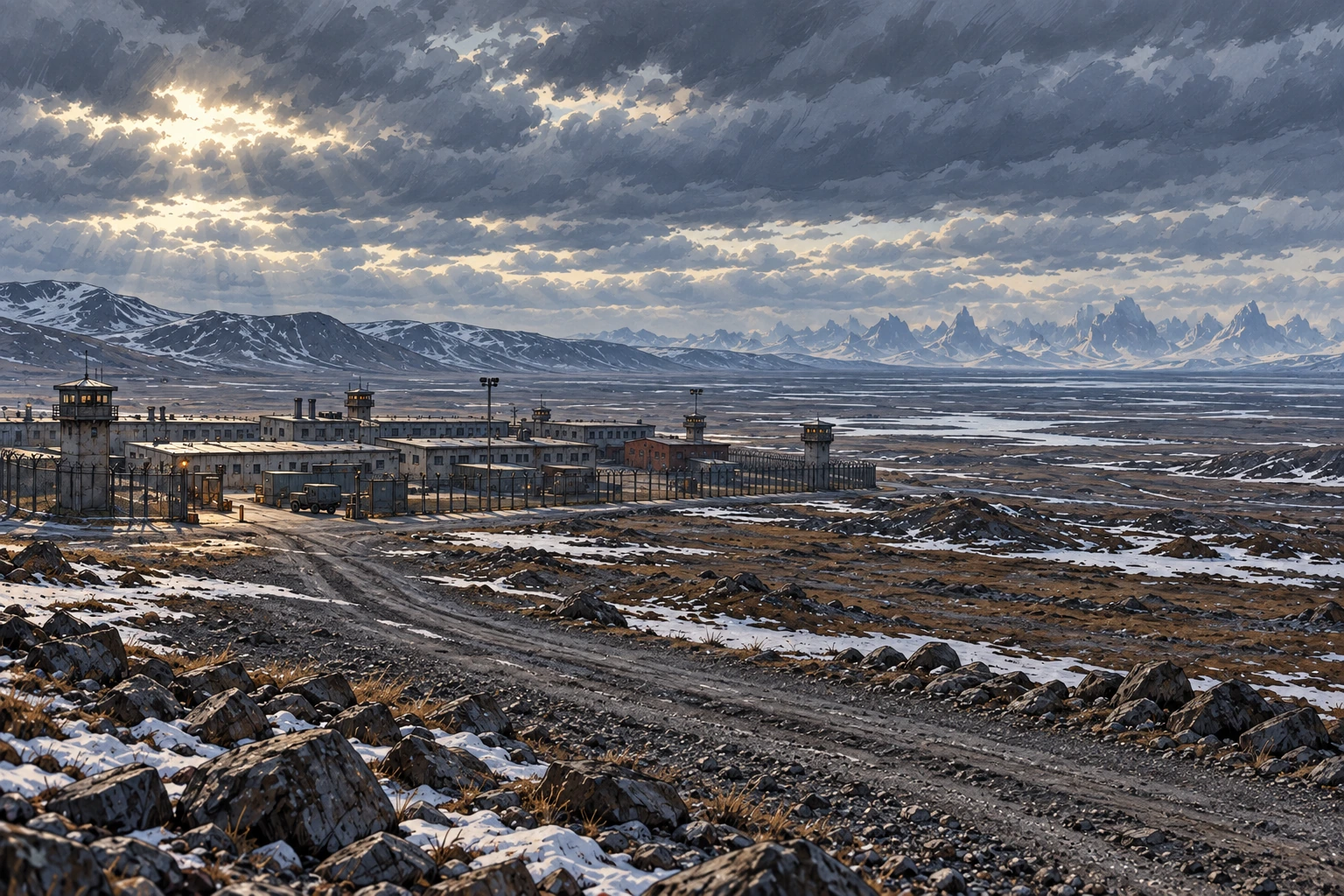
Rapid initial propagation was followed by slow present boundary creep. There is no numerical geological rate. The present-day baseline is Event Day 12,000.
| Administrative unit | Duration |
|---|---|
| Mark | Six minutes |
| Cycle | 24 Marks, or 144 minutes |
| Day | Ten Cycles, or 24 hours |
Event-day numbering suffices; month names and leap rules are deferred. Precise prison founding dates remain unspecified.
The five continental systems remain Vardrask, Caldrune, Orsava, Drezhova and Selkavren. In particular, Selkavren retains the actual relative sizes of Japan, New Zealand, the UK (United Kingdom), Madagascar and Hawaii joined by natural bridges in a compressed S.
Why the Valkrisch-speaking establishment holds power
Trade first, conquest second, institutions afterwards
The dominant public culture of New Frostmarch grew from a network of Valkrisch-speaking river ports and charter towns. Their early advantage was their position at navigable rivers, coastal outlets and the scarce dependable crossings of Vardrask's great canyons. They did not possess most of the continent's people or all of its productive land. They controlled places through which other people's goods had to pass.
Merchant houses accumulated influence by providing warehouses, convoy protection, credit and recognised contracts. Producers could prosper through this network, but dependence on its loans and market access also made refusal costly. Its commercial language and documentary conventions spread farther than its settlers did.
Many centuries before the Rift Event, rival rulers tried to break the crossing monopolies. The resulting War of the Crossings ended with a coalition of charter towns and allied landholders controlling the principal passages of the region that would later include New Frostmarch. Commercial revenues supported organised supply and hired troops; alliances and control of transport mattered more than a continent-wide numerical majority. The settlement secured toll rights, property claims and privileged access to public office for the victors and their partners. This was a regional victory, not conquest of the planet.
Later industrialisation reinforced the arrangement. Established houses financed foundries, rail connections and technical schools. The families and institutions that recognised contracts increasingly supplied the people who certified qualifications, maintained land records and staffed the officer corps. Successor governments changed their constitutions and political language while inheriting much of that machinery. Present military rule uses an older structure of power; it did not create every inequality after the Event.
A dominant culture is not a single ancestry
The historic river-port establishment was drawn disproportionately from lighter-skinned northern and central communities. That ancestry remains conspicuous in old elite family networks and some institutions, and can be locally common without being the planetary majority. No numerical ethnic census is established here.
The commercial network was nevertheless mixed from its beginnings. Southern trading families, sailors, craftspeople, soldiers and households became lasting parts of the region. Some entered the establishment; others remained excluded by property requirements, patronage, language expectations or prejudice. Darker-skinned people include established local families as well as later arrivals, and occur among officials, owners and skilled professionals as well as labourers. Valkrisch speech, dress or institutional membership does not identify one skin colour or prove loyalty.
The equatorial and warmer southern regions have longstanding darker-skinned populations in this Earth-like human history. Trade, family movement and later displacement connect them to northern districts. Their societies possess their own institutions, conflicts and sources of influence. They are not a single defeated people or a demographic supply for somebody else's story.
The legacy of unequal power
- Public buildings, uniforms, documents and technical education largely express the dominant institutional culture, even when their users have different ancestries.
- Old family connections and recognised credentials can confer advantages without making every lighter-skinned resident wealthy or powerful. Many remain ration-dependent workers and prisoners.
- Communities differ in their composition. A neighbourhood, office or military unit need not reproduce a planetary population ratio.
- Trade partners, rival states and southern producers retain their own power. This history does not establish global Valkrisch rule.
Exact dates, casualty totals, demographic percentages, named ethnic groups, detailed war boundaries and the complete genealogy of the ruling families remain unspecified.