The offices a resident actually encounters
The Joint March Commission sits above a more complicated daily map of authority. Stavenbruck's Municipal Chamber sets service priorities, tenancy policy and local budgets under emergency powers. It contains appointed departmental members and district representatives chosen through local nomination and confirmation, a proposed arrangement that provides some representation without declaring a full national constitution. Working residents can influence a district representative and still be unable to challenge a military requisition through the same route.
The District Counter is where most people meet government: ration registration, housing forms, service complaints and referrals. Leva Dorn, a senior counter clerk in Northbank, prides herself on finding the form that actually fits a case. She also resents applicants who assume her ability to bend a queue means she can alter a ministry's order. She has relatives who expect favours and a supervisor who measures performance by completed entries. Her choices matter without making her either a secret ruler or a powerless automaton.
Municipal justice and its limits
The proposed Civic Claims Bench hears tenancy, wage, small-debt and local service disputes. Hearings rely on documents, testimony and practical inspection; they can order repayment, a revised account, a repair priority or another local remedy. A claimant needs time, transport and evidence, and obtaining all three is itself a substantial obstacle. Intake appointments are limited; incomplete files can be returned for correction, requiring another journey and lost paid time. Witnesses may hesitate when their employer or landlord is involved. The Advocate Desk has too few appointments to accompany every claimant; it can help assemble a case but cannot guarantee a place or protect a resident from every consequence of complaining. A favourable decision may still require follow-up with the office responsible for repayment or repair. An organised file, credible testimony and sustained collective attendance can nevertheless secure a result; the obstacles do not make every hearing a pretence. The Neighbour Advocate Desk, supported by several mutual-aid organisations, helps people present cases without claiming authority to decide them.
Ordinary policing belongs to the City Watch, dealing with theft, assaults, market disputes and public order. Military patrols and restricted-site security have different chains of command. A Watch officer can recognise that a requisition seems abusive while lacking authority to cancel it. A forged stamp may concern the Watch; the classified cargo underneath it may be taken away by another office. Institutions overlap without every conflict becoming a gunfight.
These civilian remedies do not extend into Kaltbruch as an inmate-compellable appeal. That boundary is part of the established premise. A prisoner's family may seek information, press a sponsor or contest a household charge outside the prison while remaining unable to secure review of the confinement itself. The distinction gives families things they can attempt without promising a legal rescue the setting does not provide.

Evidence, time and collective attendance can secure civilian remedies, although access is difficult.
Open full-size illustration ↗People in this picture · 4
Sera Kavel
left, presenting the organised folder · Goes by Sera
Residence: Rook Court, Northbank, Stavenbruck. Sera is a workshop records clerk helping assemble her building’s complaint. She wants each damaged fitting tied to a dated request. Idan is her neighbour and fellow complainant; Nel is helping present their case.
Idan Selv
centre, holding the damaged fitting · Goes by Idan
Residence: Rook Court, Northbank, Stavenbruck. Idan is a laundry mechanic who has kept the failed heater part rather than merely describing it. Sera lives in his building; Nel is their chosen advocate.
Nel Ovek
centre-right, listening beside the complainants · Goes by Nel
Residence: Northbank, Stavenbruck. Nel is a paid civilian case assistant who helps residents organise repair disputes. She refuses to promise an outcome before a hearing. Sera and Idan are the residents she is accompanying.
Arvid Tem
right, seated behind the desk · Goes by Arvid
Residence: Old Exchange, Stavenbruck. Arvid is a municipal adjudicator who asks what remedy the evidence supports and who has authority to provide it. He is hearing the residents’ case; Nel speaks as their advocate.
A service dispute in ordinary circumstances
A tenant first asks the caretaker about a failing shared heater. The caretaker checks whether the problem lies inside the building's responsibility or on a municipal main and submits the relevant work request. Residents may gather signatures if the request stalls. The district representative can ask for a written explanation or raise a budget conflict. Collecting those signatures and obtaining a review may take repeated visits; residents can struggle to attend together without losing wages. A written explanation can identify who controls the next decision but does not itself release a part or fund a crew. Following the request through inspection, allocation and scheduling is often necessary. A successful complaint might obtain a repair, temporary provision or a corrected charge. This is an illustrative civilian route, not a guarantee.
Corruption can enter at identifiable points: a contractor bills for a part it did not install, a clerk moves a relative's request ahead, a landlord charges heat it did not purchase. Honest disputes exist too. A repair crew may genuinely have one compatible valve and two serious failures. Publishing that fact can help residents understand a decision or reveal who has been prioritised, but does not create another valve.
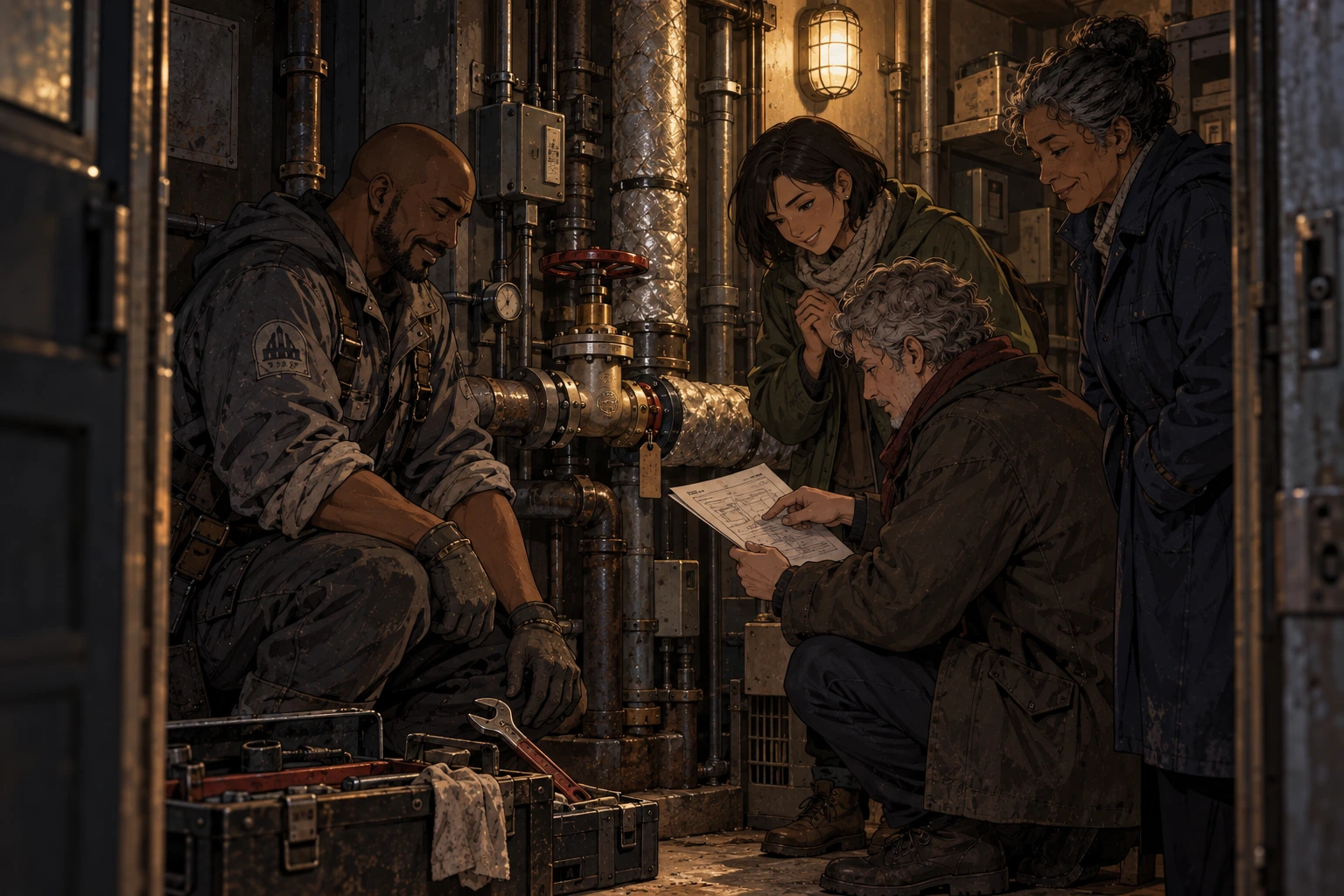
A civilian complaint can lead to a practical result without settling every larger injustice.
Open full-size illustration ↗People in this picture · 4
Rashid Velt
left, resting beside the repaired valve · Goes by Rash
Residence: Pump Ward, Stavenbruck. Rash is a municipal heating technician who wants the completed work tested with residents present. Nord is the building caretaker; Eline and Zora are tenants inspecting the repair.
Nord Kalen
centre-right, crouching with the work paper · Goes by Nord
Residence: Rook Court, Northbank, Stavenbruck. Nord is a caretaker who keeps a copy of the request until the repair has been checked. He dislikes losing evidence when a job is marked closed. Rash performed the repair; Eline and Zora live in the affected building.
Eline Vorsk
centre, looking down at the valve · Goes by Eline
Residence: Rook Court, Northbank, Stavenbruck. Eline works in a school kitchen and helped record when the room lost heat. She wants the result to survive the next cold spell. Zora is her neighbour; Nord maintains their building.
Zora Aven
right, standing beside the tenants · Goes by Zora
Residence: Rook Court, Northbank, Stavenbruck. Zora is a garment finisher who followed the complaint through despite missed work time. She wants the work order kept with the receipts. Eline is a fellow tenant, and Nord their caretaker.
Organising, patronage and resistance
Workplace committees negotiate practical demands; tenants' groups arrange evidence and collective attendance; congregations, secular clubs and mutual funds offer support without agreeing politically. Oda Kern wants reliable injury leave and apprentice equipment. Vera Senk wants publication rights. Sera Anvek wants transparent ferry deductions. They may cooperate over an administration practice while disagreeing on strikes, military authority or who should bear a shutdown's cost.
Resistance ranges from lawful petition and public criticism to concealed testimony, refusal, illicit publishing and organised opposition. The almanac does not presume that every kind person belongs to a resistance cell or that every critic has the same programme. A clerk may preserve an inconvenient record while remaining loyal to the state. An organiser may treat allies badly. A person who refuses a risky action may have dependants, doubts or different aims rather than a lack of courage.

Organising can bring people together without giving them identical aims.
Open full-size illustration ↗People in this picture · 4
Samira Veln
left, making her argument · Goes by Samira
Residence: Pump Ward, Stavenbruck. Samira is a senior machine fitter seeking paid training time for newer workers. She wants the petition to name a practical demand. The other three are workshop colleagues organising with her.
Tomas Kren
centre-left, speaking with an open hand · Goes by Tom
Residence: Pump Ward, Stavenbruck. Tom is an assembly worker who wants a workable shift rotation. He worries that an ambitious petition may lose the immediate improvement. Samira, Dena and Vasil are colleagues with partly different priorities.
Dena Morsk
centre-right, holding a pencil · Goes by Dena
Residence: Pump Ward, Stavenbruck. Dena is a workshop tally clerk who gathers the rota records for the group. She checks each claim before putting her name beneath it. She is organising with Samira, Tom and Vasil.
Vasil Brenek
right, listening with folded arms · Goes by Vas
Residence: Pump Ward, Stavenbruck. Vas is an experienced operator who wants replacement equipment but doubts a promise made without a budget. The others are his colleagues; listening does not mean he agrees with every proposal.
Reputation and advancement
Promotion depends on competence, sponsorship, vacancies and a record other people recognise. A capable technician who can keep an essential plant running has leverage, but a supervisor may claim the credit. Military service can offer training, steadier pay and travel alongside orders and danger. Some people seek it willingly. Employers compete for veterans' practical skills while avoiding responsibility for injuries they did not cause.
Public officials attend concerts, borrow money, care for children and have old friendships. Institutions feel larger when their members have ordinary lives as well as official functions. An illustrative campaign might follow a district service inquiry that grows into a labour alliance, or a young official trying to deliver one promised improvement without becoming dependent on a corrupt patron. A successful compromise can be worth keeping even if it does not settle the region's politics.
Cultural dominance and human diversity
Control of river trade, credit and canyon crossings preceded regional political dominance. An ancient coalition victory secured toll rights, property claims and access to office; later industrial investment and recognised qualifications reinforced those advantages. Present martial authority inherits parts of this older system. Numerical majority is not the explanation, and this regional history does not establish planetary rule.