Cold is persistent; blizzards are not. Clear frozen days, wind, light snow, dirty slush, industrial fog and still intervals belong. Contaminated rain varies regionally. Charged storms can interrupt transport, communications and exposed work. Protective clothing and instruments do not establish universal safety, and glowing rain is not a calibrated danger scale.
Municipal civil defence combines weather-station and works-crew reports into warnings through the exchange, street lamps, sirens and notices. Military facilities issue their own operational orders. Messages can conflict, but do not always do so.
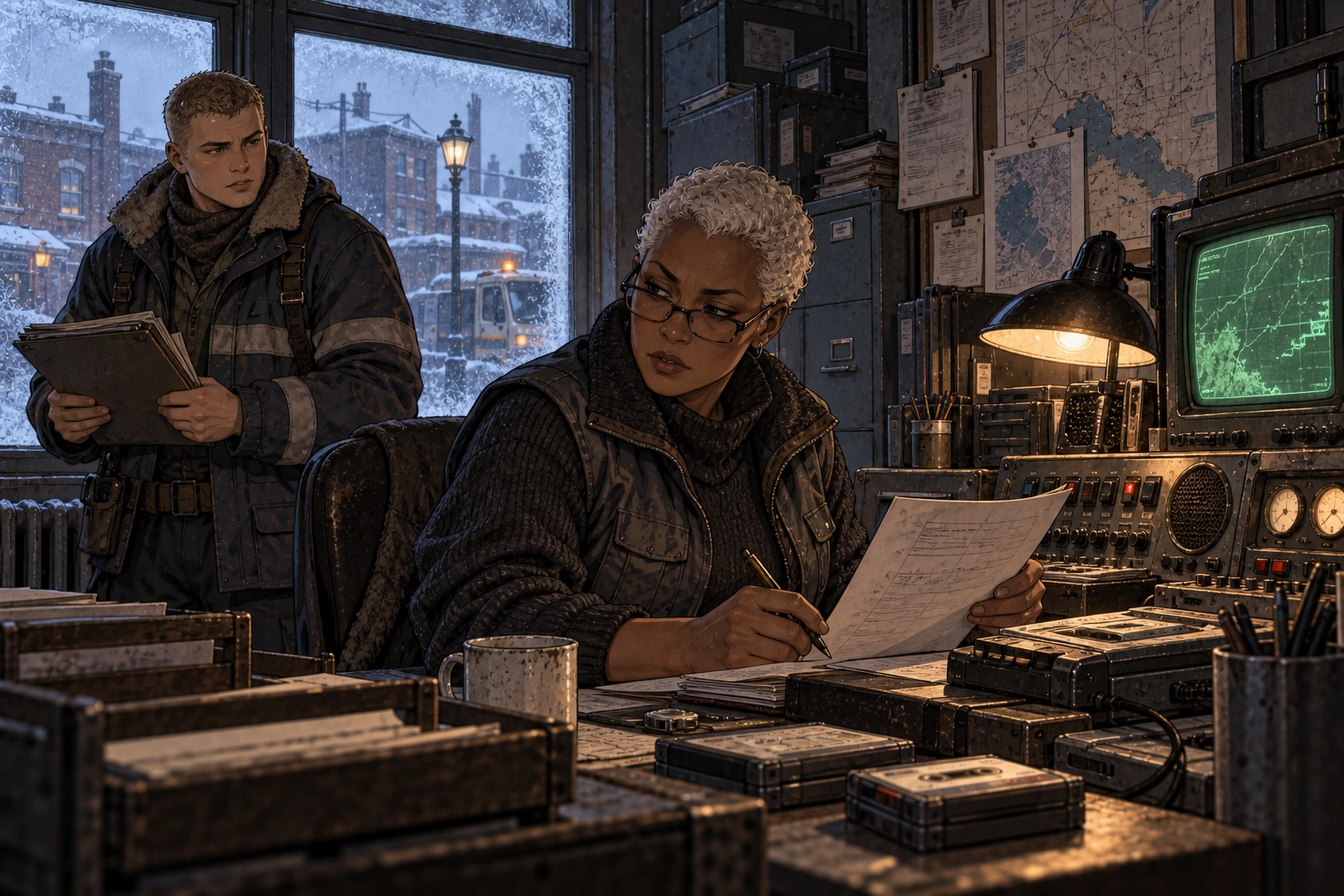
A municipal warning desk brings weather-station and works reports together. Clear cold, industrial fog and changing conditions all belong to the region.
Open full-size illustration ↗People in this picture · 2
Lotte Saven
right foreground, comparing reports · Goes by Lot
Residence: Old Exchange, Stavenbruck. Lot is a municipal weather-desk operator who compares station reports before issuing an update. She would rather name uncertainty than disguise a gap. Arno is the field-report runner bringing another observation.
Arno Veldin
left, standing with the clipboard · Goes by Arno
Residence: Pump Ward, Stavenbruck. Arno is a municipal weather-station attendant and report runner. He notes where the weather changed on the journey as well as at the station. Lot receives his observations at the warning desk.
Public municipal shelters admit people while space remains without requiring a ration book. Works and military shelters require credentials. Capacity, damage and discretionary enforcement can exclude people; universal exclusion is not assumed. Hazardous-duty employers issue minimum job equipment and replacement filters through stores. Civilian equipment comes through purchase, barter, repair and relief allocations. Delayed or corrupt stores create specific vulnerabilities.
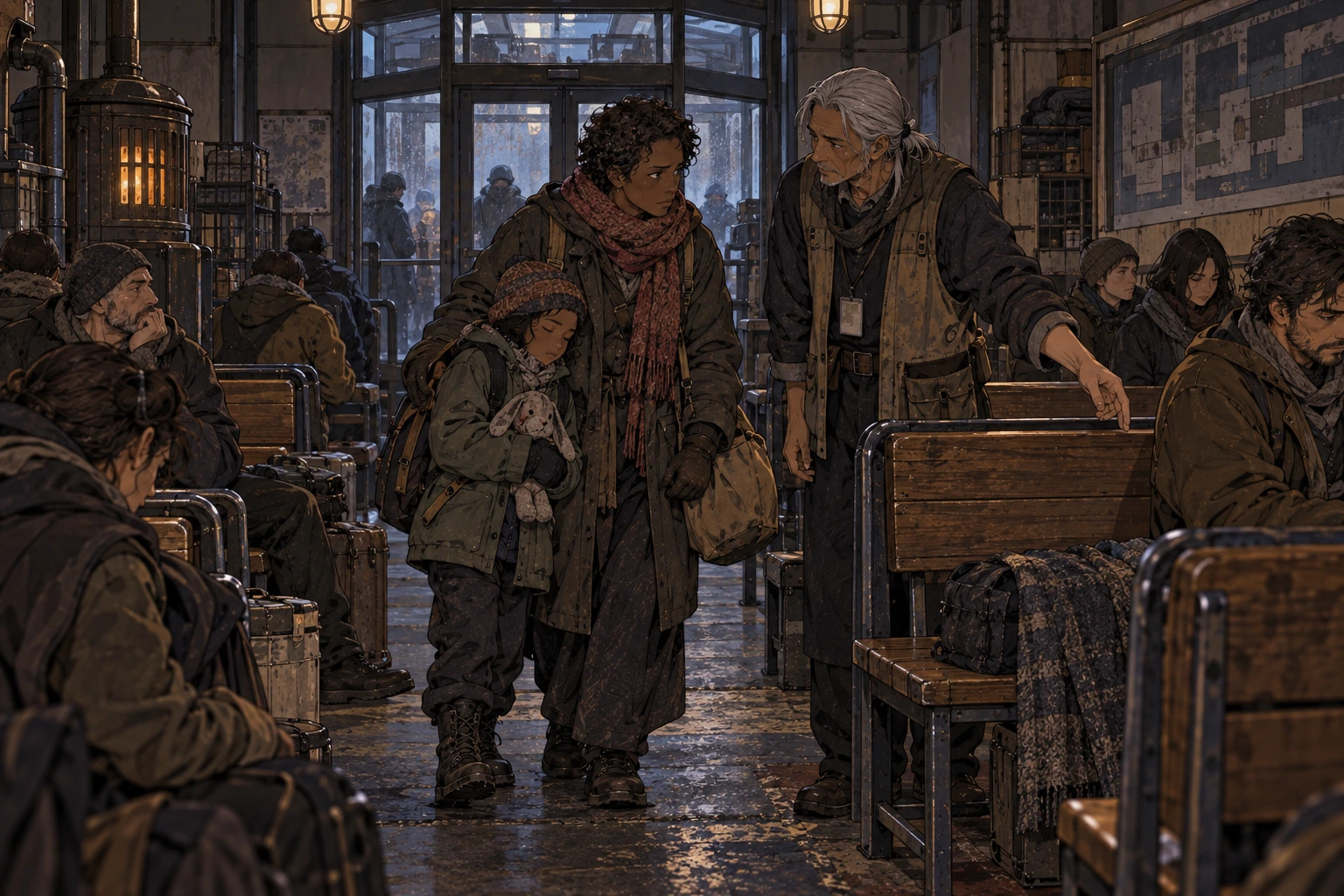
People enter a municipal refuge while space remains. A ration book is not a condition of public shelter access; pressure from missed work can persist.
Open full-size illustration ↗People in this picture · 3
Sana Korenek
centre, entering with the child · Goes by Sana
Residence: Northbank, Stavenbruck. Sana is a garment worker caught away from home by hazardous weather. She wants a dry place for her child before calculating what the missed time will cost. Miri is her daughter; Oskar is the shelter attendant.
Miri Korenek
child beside Sana, holding a toy · Goes by Miri
Residence: Northbank, Stavenbruck. Miri is a school pupil without a paid job. She has brought a small toy into the refuge and is watching for somewhere to sit. Sana is her mother; Oskar is helping them find space.
Oskar Vennel
right, directing them toward a bench · Goes by Osk
Residence: Northbank, Stavenbruck. Osk is a municipal refuge attendant who works with the space still available. He gives directions without making shelter depend on a ration book. Sana and Miri are arriving residents, not his relatives.
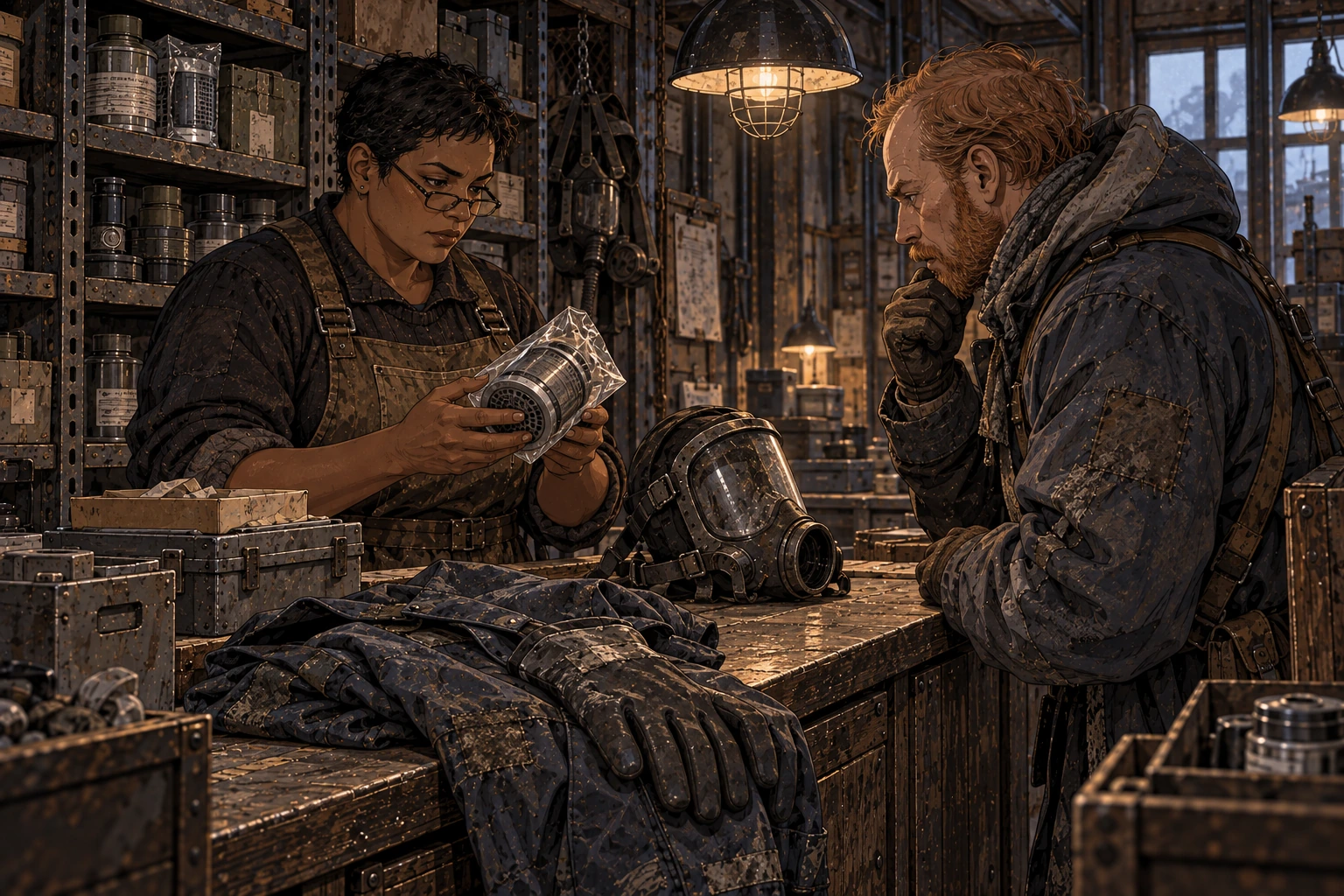
A worker examines replacement protective equipment at a worn stores counter. Supply, compatibility and delay matter; no equipment guarantees universal safety.
Open full-size illustration ↗People in this picture · 2
Neli Varn
left, examining the replacement filter · Goes by Nel
Residence: Pump Ward, Stavenbruck. Nel is a protective-equipment stores worker who checks the fitting before issuing a replacement. A sealed package alone does not prove compatibility. Gregor is the worker bringing the used breather.
Gregor Ost
right, leaning toward the counter · Goes by Greg
Residence: Pump Ward, Stavenbruck. Greg repairs outdoor pipework and has brought his used breather to compare its connection. He wants equipment he can actually wear on the next assignment. Nel is the stores worker helping him select a replacement.
A worker can reach a public shelter without food papers yet still worry about missing a shift. That separates access to immediate refuge from employment and provisioning pressures. Actual weather and consequences would be established when a scene is used.
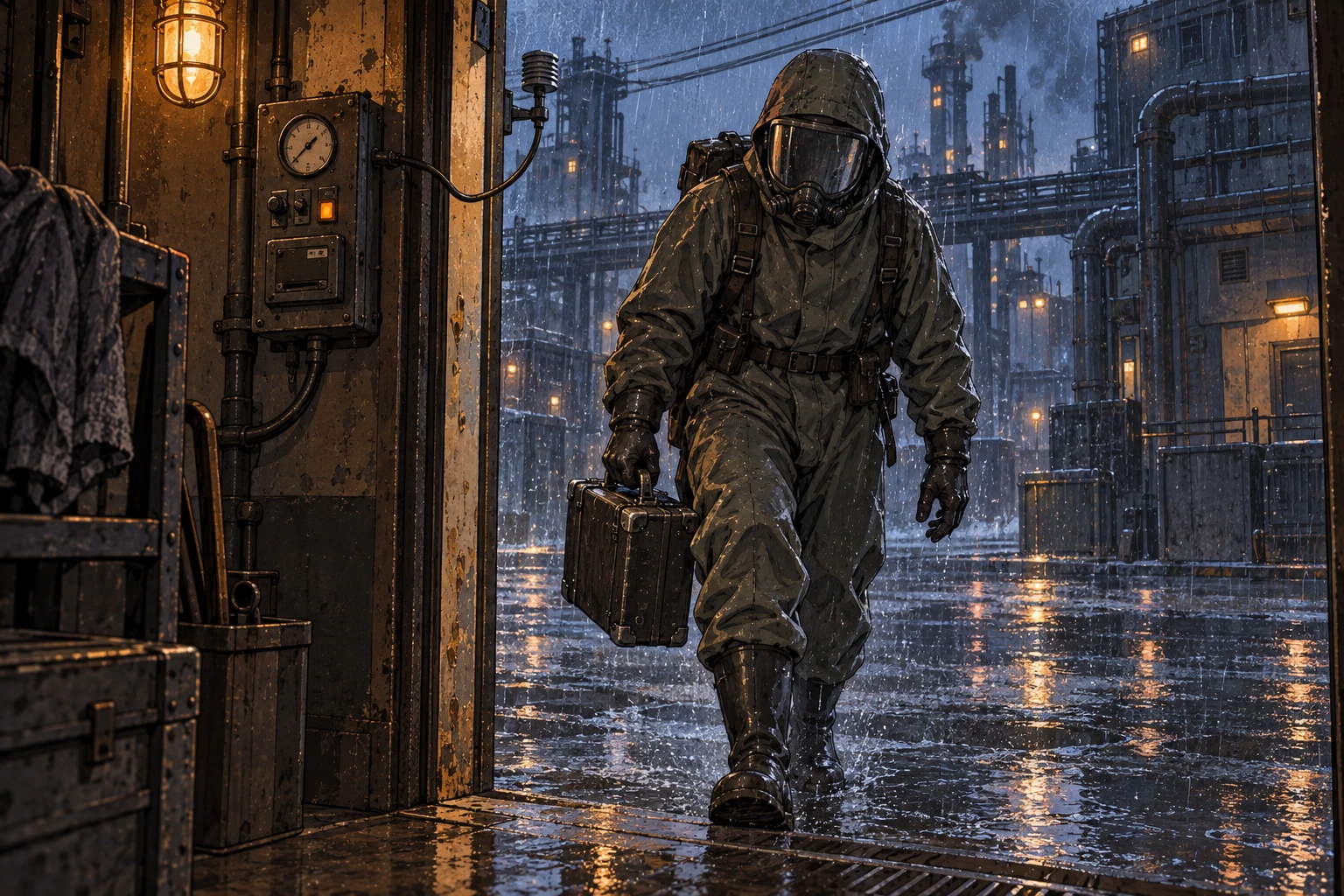
A fully covered worker approaches refuge through contaminated rain, with skin sealed beneath hood, visor and breather, rainwear, gloves and rubber boots.
Open full-size illustration ↗People in this picture · 1
Vren Talik
the fully enclosed worker approaching the doorway · Goes by Vren
Residence: Freight Ward, Stavenbruck. Vren is a communications maintenance runner carrying a protected instrument case. Reaching refuge takes precedence over arriving neatly or on time. No companion is foregrounded; the person’s rain enclosure remains fully closed.
Protected cultivation
Growing food is dangerous because of the glowing rain. Gardens must be fully enclosed overhead and on all sides in transparent polyurethane or plastic greenhouses that keep the rain off the plants. This includes food and flower gardens. .
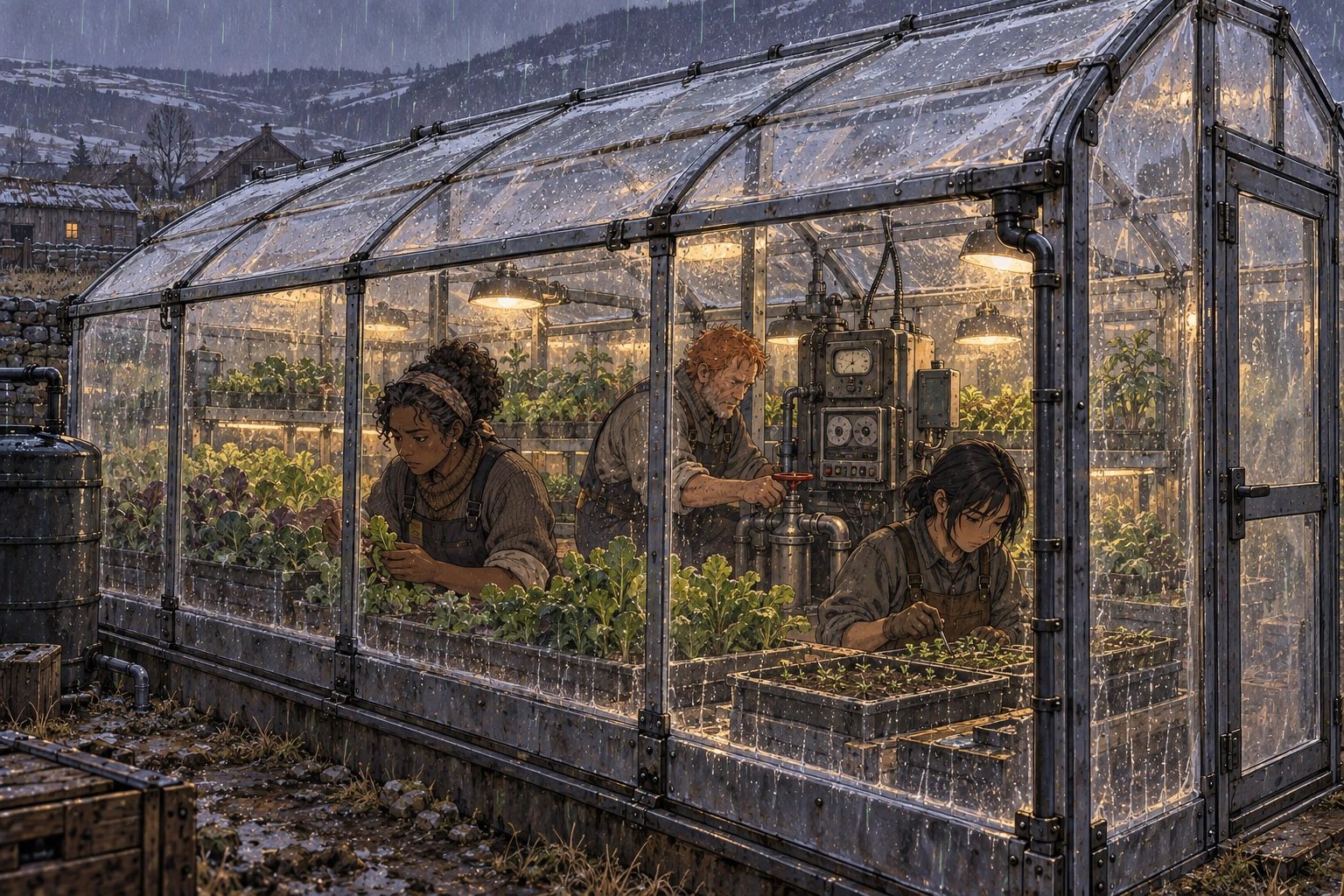
Crops and workers remain inside a fully enclosed transparent greenhouse while contaminated rain falls outside. This is an illustrative enclosure, not an engineering specification.
Open full-size illustration ↗People in this picture · 3
Nadia Terrek
left, tending plants inside the glass · Goes by Nad
Residence: Tarnfeld. Nad is a cooperative greenhouse grower who checks the enclosure before tending the beds. A crop is not safe merely because it is sheltered today. Tomas is her pump-maintenance colleague; Mila is a fellow grower.
Tomas Velnik
centre, at the greenhouse pump controls · Goes by Tom
Residence: Tarnfeld. Tom maintains greenhouse pumps and watches for faults that would waste a season’s permitted growing space. Nad and Mila tend the crop that depends on his equipment.
Mila Orven
right, tending the near planting bench · Goes by Mila
Residence: Tarnfeld. Mila works on the cooperative growing crew and records losses as well as healthy trays. She wants the fragile harvest divided honestly. Nad is her growing colleague; Tom maintains the shared pump.