Spoolline is the local institutional store-and-forward service using wired links, scheduled radio and courier cassettes. Civilians submit paid messages at public counters; official traffic has priority. Clerks may read or transcribe for senders. Private household access is uncommon, not impossible.
Institutional links support 9,600 bits per second at 2,400 baud; fast data-cassette recording is 19,200 bits per second. These remain nominal capabilities, not guarantees of delivery, compatible media or useful throughput. Cassette copying and sequential access take time.
Service Valkrisch governs local administration. Other home languages and variable literacy remain possible. Walking and local road transport serve the city; rail carries routine bulk freight; controlled road services reach the basin. Zeppelins serve suitable longer routes and are not assumed to shuttle between Stavenbruck and Kaltbruch. A timed journey needs route-specific duration and weather before its deadline is used.
Zeppelin safety advertisements conceal publicly unreported losses, with private notices to affected people. Advertising is not a safety guarantee. Valkrisch's High, Service and Street registers remain established; VERBOT is the clipped institutional sign form.
A clerk accepts a message and gives the sender evidence of submission. The destination may receive it later, and the intended reader may learn of it later still. None of these stages proves agreement or a reply. Delays vary with the circumstances.
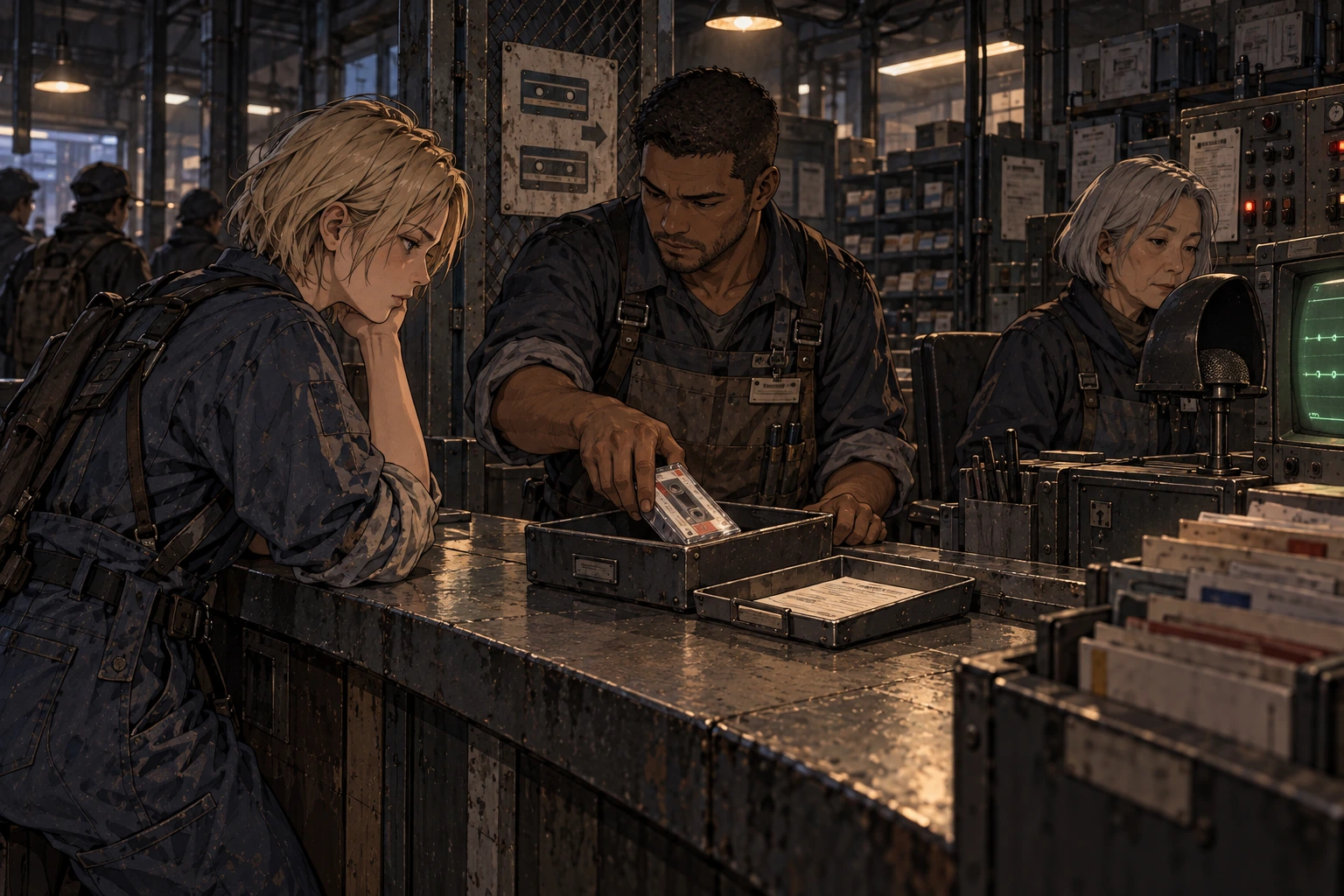
A public message counter records submission; delivery, reading and agreement remain separate.
Open full-size illustration ↗People in this picture · 3
Elsa Rem
left, waiting at the message counter · Goes by Elsa
Residence: Freight Ward, Stavenbruck. Elsa is a travelling garment cutter sending a recorded message home. She wants the receipt kept separate from the hope of a quick answer. Adil receives the submission and Greta handles transcription.
Adil Nors
centre, placing the cassette in the tray · Goes by Adil
Residence: Old Exchange, Stavenbruck. Adil is a public-message clerk who checks the destination and gives a receipt for submission. He does not promise that a recipient has heard it. Elsa is his customer; Greta is his colleague.
Greta Mahn
right, beside the hooded microphone · Goes by Greta
Residence: Old Exchange, Stavenbruck. Greta is a message transcriber who confirms unfamiliar names before recording them. She treats private correspondence as work, not conversation material. Adil handles the counter submission she may be asked to transcribe.
Buying a journey and receiving a place
Stavenbruck's City Transit Office coordinates municipal tram service and licensed road operators. A fare buys the stated trip, not priority through a closed military checkpoint. Shift tickets can cover a named work route at a discount; passengers without the appropriate registration buy ordinary fares. Conductors know regulars, but recognising somebody is not the same as having authority to waive every rule.
The Roven Road Cooperative owns a mixed fleet of covered passenger and goods vehicles. Drivers have opinions about each engine, where a spare part can be found and which depot actually keeps its promises. A departure board separates booked seats from cargo space; a consignment may displace passengers only under a specific priority order, not because the narrator needs another delay. On a good journey, people exchange news, sleep, watch familiar country and arrive.
Vesk Halt is the transfer point where rail loads become road consignments and people discover that their two bookings were made under different assumptions. A clerk's apparently trivial correction can prevent a stranded passenger. Nell's canteen sells meals and temporary warmth while travellers wait, but it does not owe unlimited credit to everyone whose employer forgot an allowance. Long routes are budgeted through actual vehicle, stop and weather choices rather than an invented universal speed.
Couriers and the value of arrival
Emil Sarn, an independent registered courier, carries sealed business packets and cassette copies between the city, ferry and cooperative offices. He wants a predictable contract that still allows him to choose his own route order. Customers pay for accountable carriage, not omniscient protection. He records handover and delivery, while acknowledging that the recipient may not yet have read the material. A broken seal prompts a dispute; an intact one is not proof that the sender told the truth.
Public message counters sell ordinary dispatches and higher-priority services with limited scope. There is no promise that paying extra overrides every military queue or repairs a broken link. A household may send a short message electrically and place a longer recording with a traveller. That traveller might be a trusted friend, paid courier or unreliable relative. Communication therefore has social geography: the person with relatives along a route has options the isolated newcomer lacks.
Zeppelins and the charged sky
Zeppelins are the only mode of aerial transport throughout the world. High-power engines create ion buildup, generating direct strikes and a ball-lightning effect that bypasses lightning rods and can strike the positively charged main body of an object.
Zeppelins are preferred, with trains and steamships remaining alternatives on the routes they serve. The Zeppelin-only restriction applies specifically to aerial transport.
Zeppelin use is not a guarantee of safety. Weather and the gap between advertised safety and privately reported losses still shape a journey. The electrical hazard also belongs to the world of engines and infrastructure.
Longer travel
Zeppelin departures on suitable routes use a separate mooring and booking system. Their passenger rooms can offer a memorable view, comfort and a sense of occasion; poor weather and advertised safety claims remain consequential. The established suppression of public loss reports does not make every flight a disaster. A family may save for one journey and remember it fondly.
Travel styles reveal means. A worker takes a bundled berth, a merchant buys predictable baggage handling, and a senior official expects someone to carry the luggage. A wheelchair, a young child, a sick relative or bulky work tools change what access requires. Operators can make accommodations well, poorly or not at all, depending on equipment, policy and individuals. A completed trip can be the start of a better job or a pleasant visit rather than only the scene before an ambush.

Longer travel brings practical preparation and unequal comforts.
Open full-size illustration ↗People in this picture · 4
Vera Dalen
left foreground, carrying her own bag · Goes by Vera
Residence: Freight Ward, Stavenbruck. Vera is a travelling instrument fitter who packs only what she can carry to the next connection. She hopes this contract will pay for overdue repairs at home. Balen is her colleague travelling on the same contract.
Balen Orsk
beside Vera, with the shoulder bag · Goes by Bal
Residence: Freight Ward, Stavenbruck. Bal installs workshop relays and checks each travel document before leaving the lodging room. He dislikes buying comfort on credit. Vera is his coworker, not his partner.
Zora Vannik
centre, waiting beside luggage being handled · Goes by Zora
Residence: Old Exchange, Stavenbruck. Zora is a senior purchasing clerk whose employer pays for assisted baggage. She wants the case counted before boarding. The porter, Rem, is handling her luggage in his working role.
Rem Darvik
right of centre, bending over the luggage · Goes by Rem
Residence: staff lodging near the Stavenbruck zeppelin mooring. Rem is a civilian mooring porter who moves bags for a living. He asks owners to identify a case before he takes its weight. Zora is his passenger customer; Vera and Bal are waiting travellers.
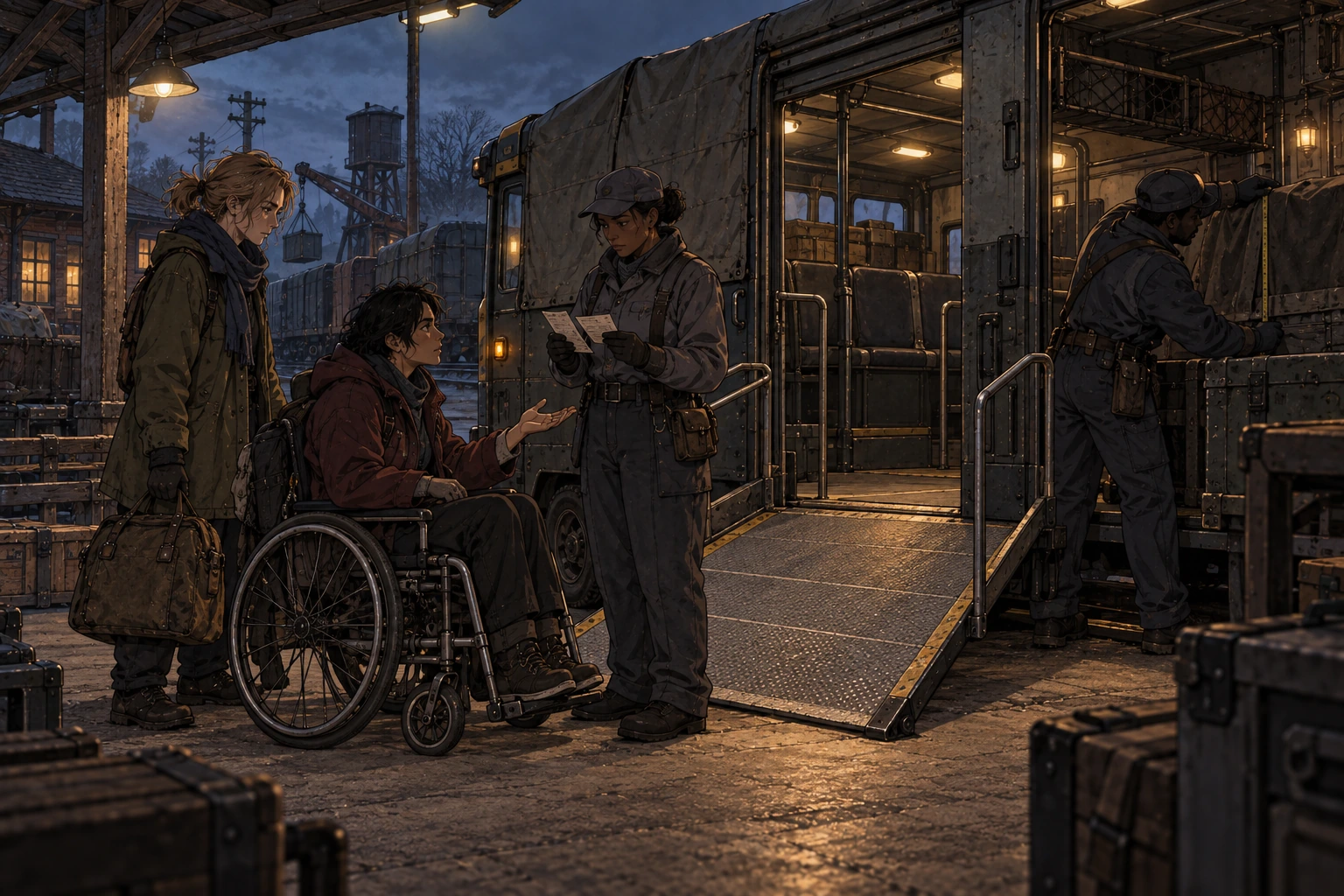
At Vesk Halt, passenger needs and cargo bookings must be reconciled.
Open full-size illustration ↗People in this picture · 3
Mina Verov
centre, using the wheelchair · Goes by Mina
Residence: Vesk Halt. Mina is a paid accounts copyist travelling for work. She wants the booking to describe the boarding arrangement as carefully as the destination. Tomas is her partner; Niko is the booking worker.
Tomas Verov
left, standing beside Mina · Goes by Tom
Residence: Vesk Halt. Tom repairs luggage and is accompanying Mina on this journey. He waits for her to speak for her own travel requirements. Mina is his partner; they are discussing the booking together.
Niko Jerv
right, holding the booking slips · Goes by Nik
Residence: Vesk Halt. Nik is a passenger-and-cargo booking worker who must reconcile space promised on paper with the stopped vehicle in front of him. Mina is the passenger explaining her needs; Tom accompanies her.
Illustrated scenes
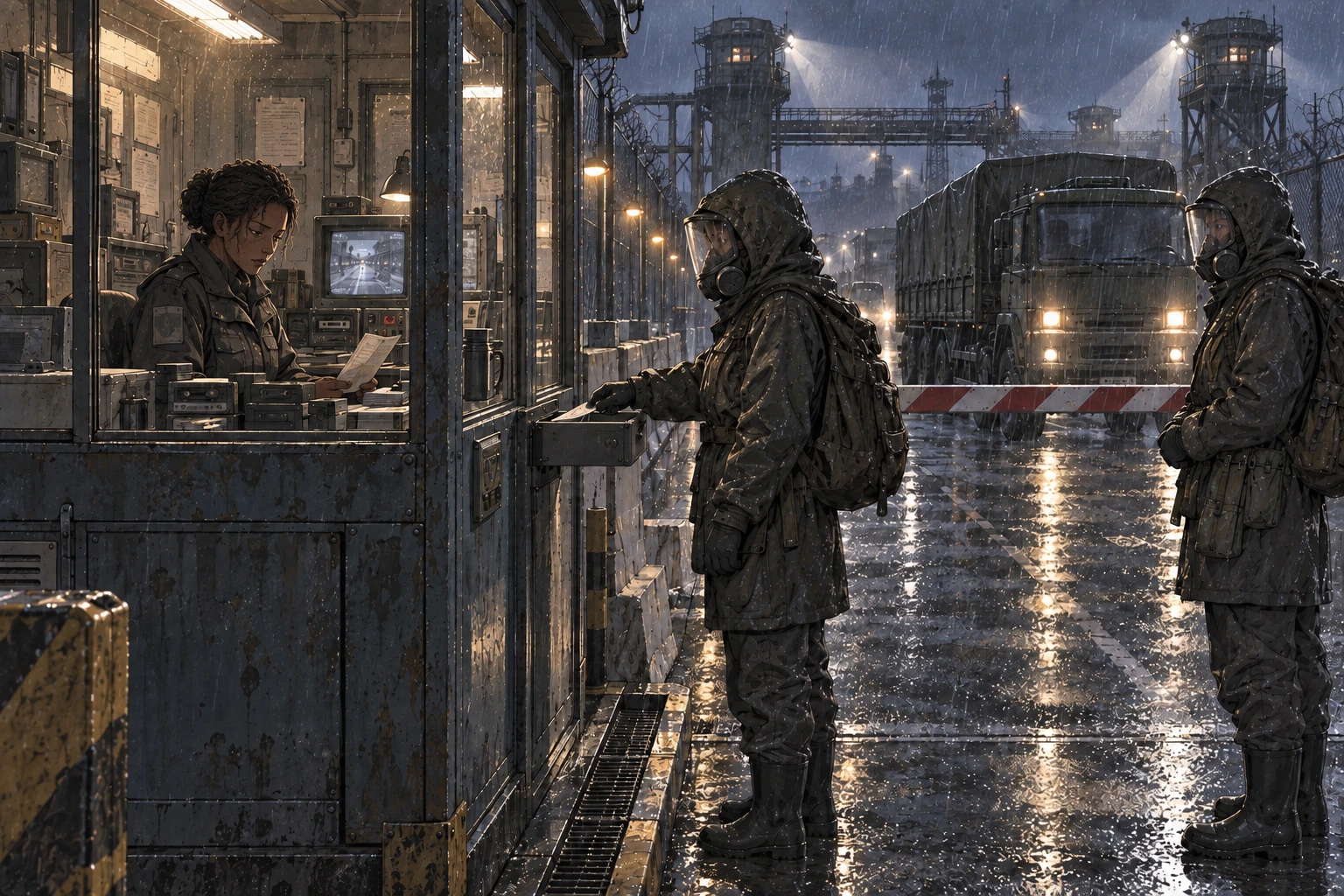
People in this picture · 3
Rena Vosk
left, inside the checkpoint booth · Goes by Rena
Military rank: Oberstrazhnik
Residence: the basin-road military barracks. Rena is a military-police counter sentry who checks the papers presented at the basin-road barrier. Shelter gives her an easier hearing than those outside. Milena and Iven are the travellers waiting for her decision.
Milena Torv
centre, presenting papers from sealed rainwear · Goes by Mila
Residence: Pump Ward, Stavenbruck. Mila is a contract repair courier who wants her work errand acknowledged before the rain worsens. Her sealed equipment makes speaking difficult. Iven is her work partner; Rena is the checkpoint sentry.
Iven Torv
right, waiting in sealed rainwear · Goes by Iven
Residence: Pump Ward, Stavenbruck. Iven is a repair-shop porter travelling with the same consignment. He keeps the spare wrapping dry while his sister handles the papers. Mila is his sister and coworker; Rena is checking their passage.