The owners of the warm pipe
Stavenbruck runs on overlapping systems rather than one central switch. The Municipal Works Directorate owns much of the water network and district heating mains. Industrial firms own boilers, generators and process equipment on their premises. Contracts let waste heat enter selected municipal loops, with meters and arguments at the boundary. A factory closure can reduce a neighbourhood's heat without shutting down every district. Better-off streets tend to have maintained isolation valves and spare connections; poorer ones wait longer for a crew qualified to work on a troublesome section.
The Roven Fuel Board purchases and allocates bulk fuel for municipal services, drawing on regional depots and outside consignments. It is a purchasing and allocation body, not a new monopoly over every stove. Private sellers, farm supplies and reclaimed materials remain in the economy. Fuel differs by machine and contract. An engine owner cannot simply substitute whatever burns in a household stove. Fuel quality, storage, matching parts and trained operators make apparently identical equipment perform differently.
A city of machines with biographies
Station Nine, a municipal generating and switching works, combines maintained main equipment with older reserve machinery. Operators know the sound that precedes a bearing problem and the discrepancy between the original diagram and an authorised modification. The red book records temporary changes, their author and the reason they were made. A change omitted from that book can make the next crew's otherwise competent decision unsafe.
Workshop Dren & Daughter maintains small motors, domestic players and some instrument mechanisms. It cannot manufacture every scarce component. At Cinderbank Foundry, a replacement casting still needs machining, fitting and inspection before becoming useful. Repair skill gives people bargaining power because a thing can be owned without its owner knowing how to keep it running. Rika Dren wants to publish interchangeable repair drawings; investors worry that openness will help competitors while leaving her shop to pay for development.
| System | Ordinary operator | Who controls access | A consequence beyond the machine |
|---|---|---|---|
| District heat | Works crews and contracted plant operators | Municipal allocation and industrial supply contracts | Housing advantage follows pipe condition and contract priority |
| Drinking water | Pump crews, laboratories and treatment staff | Municipal works, with requisition pressure | Closing an intake protects one risk while creating shortages elsewhere |
| Local electricity | Station staff and building electricians | Utility accounts, building wiring and emergency priorities | A room can contain a device its circuit cannot reliably support |
| Factory power | Employer technicians | Plant ownership and operating budget | A maintenance shutdown changes wages, orders and neighbourhood heat |
| Signals | Exchange operators and line crews | Departmental permissions and public counters | Possession of a terminal does not grant access to every record |
| Household equipment | Owners, repairers and shared facilities | Cash, compatibility, parts and practical skill | A working player or sewing machine can become a household livelihood |
Engine power and ion buildup
High-power engines create ion buildup. Direct strikes and a ball-lightning effect can bypass lightning rods and hit the positively charged main body of an object. The danger helps define the world’s transport: Zeppelins are its only aerial transport.
Recordings are objects people handle
The fast cassette rate remains 19,200 bits per second; the maintained institutional link remains 9,600 bits per second. Higher nominal tape speed does not turn sequential media into instant random-access storage. A large data job occupies a machine, an operator and a queue, while a physical courier may deliver an original sooner than a congested chain of links transmits a copy.
Data, music and instrument tapes need compatible readers. The familiar cassette shape is not a guarantee. A clerk marks a packet with its intended machine family, recording date and whether it is an original, a working copy or a copy checked against another copy. Wealthy offices can keep spare machines and compare records; a small cooperative might have one deck and a trusted person who knows its habits.
Privacy is physical as well as cryptographic. Who can take the cassette home? Who hears dictation through a thin office wall? Who controls the cupboard key and knows where a paper index points? A sealed packet proves that a particular seal was present, not that the content is true. The Veythari receive no automatic access to all these objects. Institutions can be powerful while also losing things.
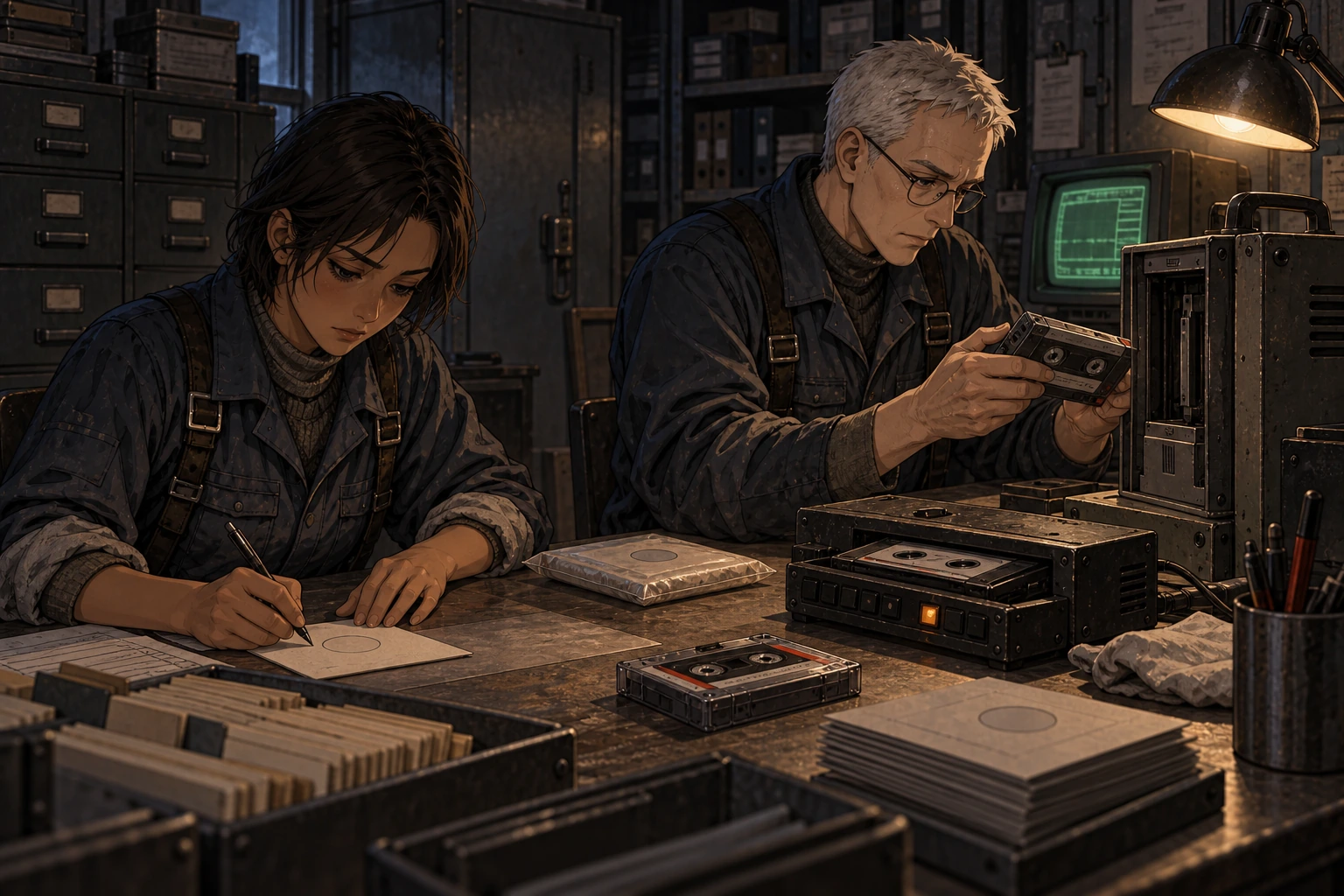
Cassette shape alone does not establish compatibility, authenticity or permission.
Open full-size illustration ↗People in this picture · 2
Nika Severin
left, writing on the paper sleeve · Goes by Nika
Residence: Pump Ward, Stavenbruck. Nika is a technical records clerk who notes the reader required for each physical copy. She dislikes labels that say only compatible. Viktor is the technician testing the cassette.
Viktor Keren
right, examining the cassette housing · Goes by Vik
Residence: Pump Ward, Stavenbruck. Vik services industrial readers and checks the mechanism before trusting a familiar-shaped cartridge. Nika is his records colleague; they share responsibility for this copy’s handling.
The devices worth saving for
A household cassette player is a significant purchase, often bought used and kept in a cloth cover. A hearth receiver gives broadcasts without recording capability; a better set adds a timer that lets a shift worker catch a scheduled programme. Mechanical sewing machines, hand tools, insulated carriers, pressure gauges and small electric lamps have more everyday reach than sophisticated terminals. Some affluent households own elegant lacquered players and a private message line; good taste and conspicuous waste can look similar to a neighbour paying for heat.
Shared appliances make domestic politics: a sewing-machine owner receives alterations, a reliable receiver draws visitors, and the person who can repair either may prefer being paid in quiet rather than endless favours. A failure is not automatically sinister. It can begin a romance, postpone a concert, require a costly decision or provide an apprentice's first chance to demonstrate competence.
Pollution belongs to the system too. Soot settles downwind, waste water has destinations, and cleaning a production process requires labour and money. A wealthy institution's clean frontage can depend on locating dirty work near households with weaker bargaining power. Engineers disagree about what can be improved now, what requires investment and which claimed technical limitation is actually a budget decision. Those disagreements give science and infrastructure a place in society beyond decorative machinery.
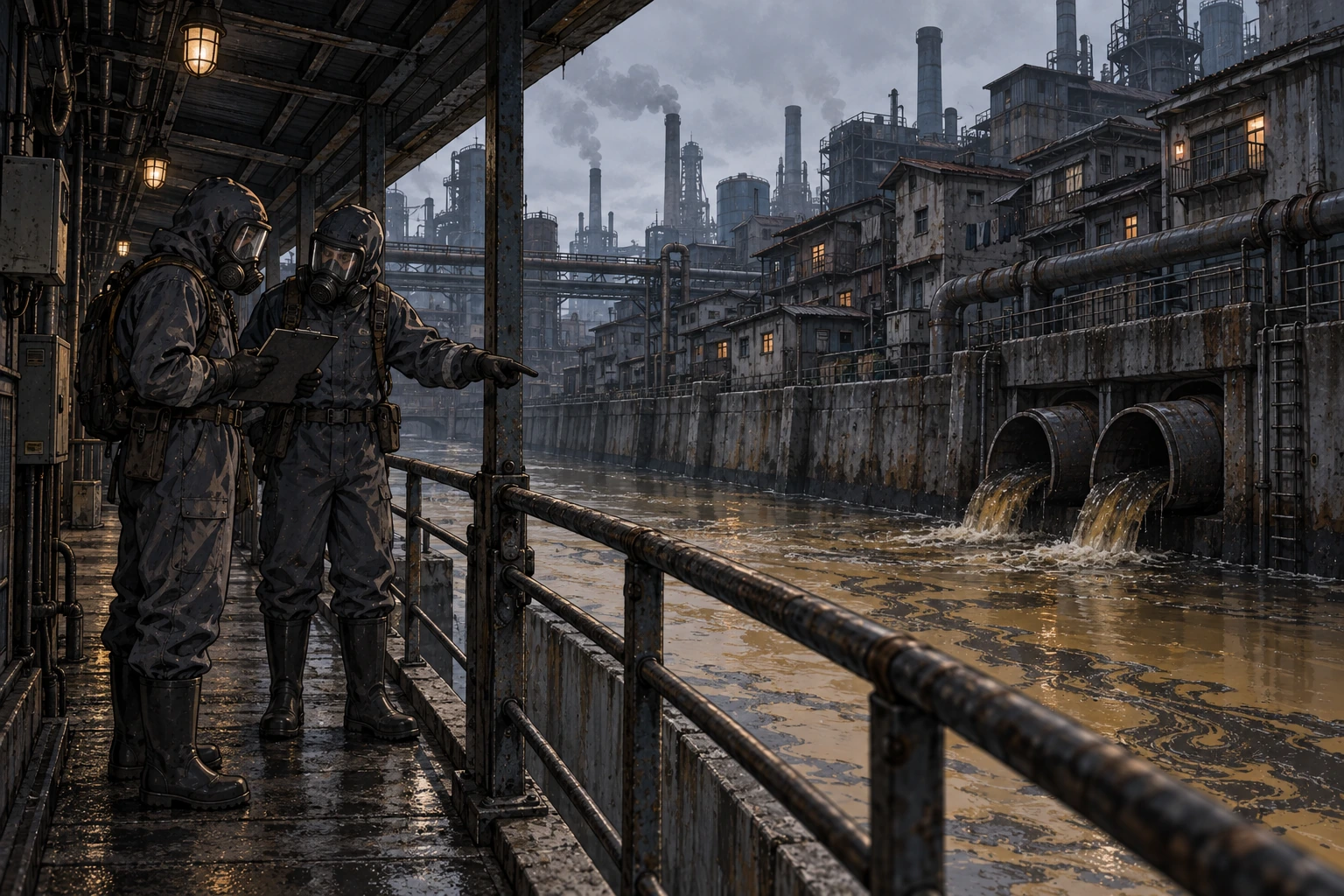
Clean frontages can depend on dirty work beside households with less influence.
Open full-size illustration ↗People in this picture · 2
Marta Senek
left, writing on the covered walkway · Goes by Mart
Residence: Pump Ward, Stavenbruck. Mart is a wastewater inspector who records conditions at the outfall, including which observations could not be made safely. Davor is her sampling colleague; neither controls the factory’s output.
Davor Retvik
right, pointing toward the water · Goes by Dav
Residence: Pump Ward, Stavenbruck. Dav maintains sampling equipment and helps collect discharge observations. He wants the residents beside the canal represented in the report. Mart is the inspector working alongside him.
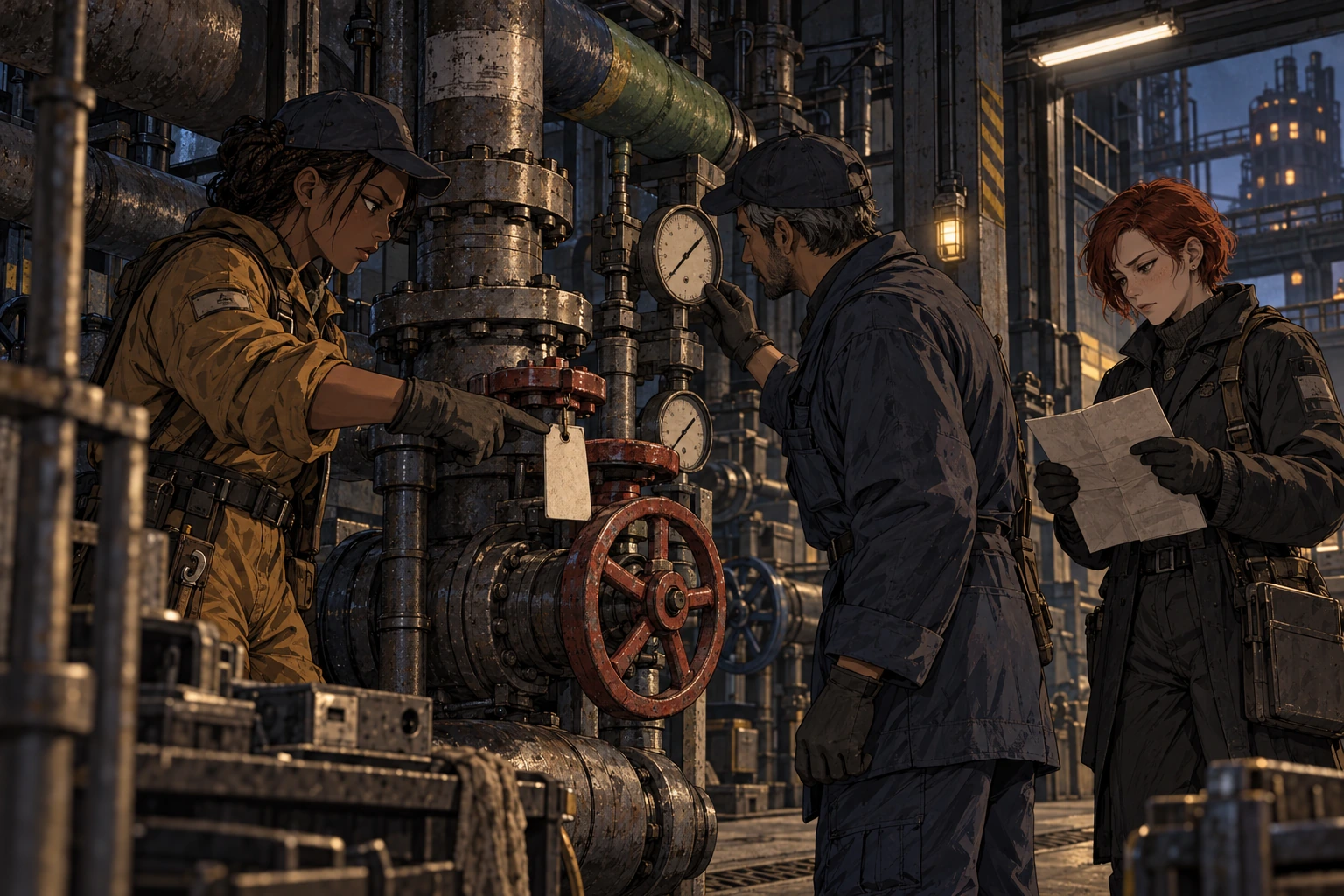
Heat crosses boundaries of ownership, contracts and maintenance.
Open full-size illustration ↗People in this picture · 3
Luka Orenik
left, indicating the valve tag · Goes by Luk
Residence: Pump Ward, Stavenbruck. Luk is a heat-service technician who checks where responsibility changes hands before taking a plant apart. Sven is the plant operator; Ilona supervises the requested work.
Sven Harvik
centre, checking the gauge · Goes by Sven
Residence: Pump Ward, Stavenbruck. Sven is a plant operator who knows the sound of normal circulation and keeps a written account when it changes. Luk is the visiting service technician, and Ilona is the works supervisor.
Ilona Ves
right, holding the work request · Goes by Ila
Residence: Old Exchange, Stavenbruck. Ila is a works supervisor who must fit repairs around occupied homes as well as production schedules. She is coordinating the handover between Luk and Sven.
Illustrated scenes

People in this picture · 2
Rena Savel
left, keeping the shift record · Goes by Rena
Residence: Pump Ward, Stavenbruck. Rena is a night-shift control-room clerk. She wants the record to show what the crew could actually see under failing lights. Bashir is the operator sharing her shift.
Bashir Kalt
right, working at the control equipment · Goes by Bash
Residence: Pump Ward, Stavenbruck. Bash is a plant operator who distrusts a quiet alarm more than a noisy one when a circuit has been unreliable. Rena records his observations; they are colleagues, not household partners.