A road becomes a posting
Military presence in New Frostmarch grew around the need to keep movements, supplies and damaged places under control. A temporary road detail needed shelter, communications and relief. Once those arrived, a posting could remain after the particular emergency that established it. People born later inherited the barrier as part of the road.
The service is visible in transport, repair, patrol, signals, requisition and custody support. A uniform may belong to someone controlling a queue or someone trying to keep its vehicles moving. Those jobs share an institution without giving their occupants identical powers or interests.
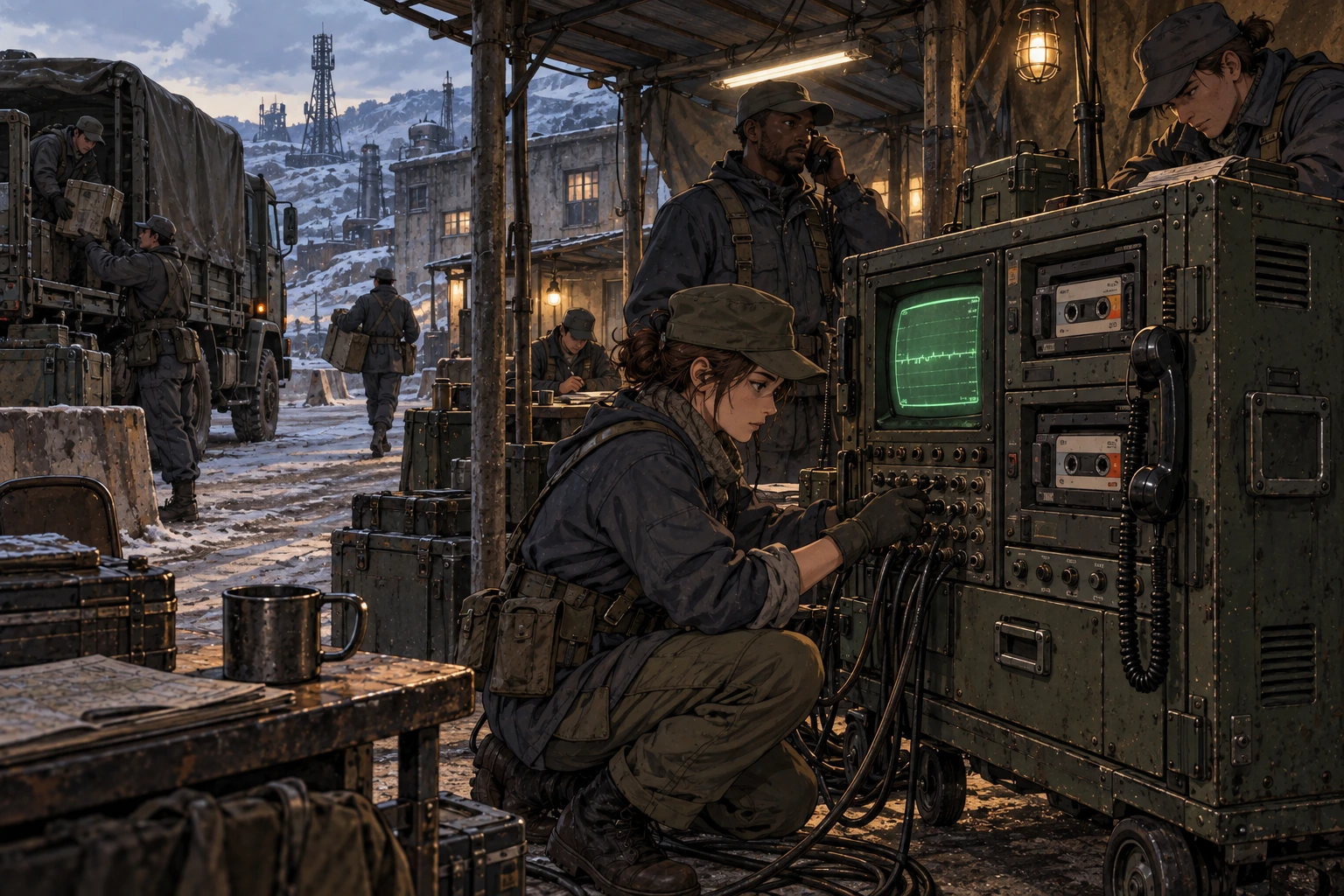
Emergency service leaves permanent traces along the basin approach.
Open full-size illustration ↗People in this picture · 3
Jana Vehr
foreground, kneeling at the posting console · Goes by Jana
Military rank: Strazhnik
Residence: temporary basin-road military billets at the time shown. Jana is an enlisted signals technician helping establish the roadside posting. She records each working connection before adding another. Rafi leads this work party; Oskar is her fellow technician.
Rafi Koren
centre, standing with the handset · Goes by Raf
Military rank: Serzhant
Residence: temporary basin-road military billets at the time shown. Raf is a signals section leader responsible for turning delivered equipment into a usable service post. Jana and Oskar serve in his installation party.
Oskar Drent
right, working above the console · Goes by Osk
Military rank: Oberstrazhnik
Residence: temporary basin-road military billets at the time shown. Osk is an enlisted equipment fitter who would like a proper bench before the temporary post becomes permanent. Jana is his technical colleague; Raf supervises the assignment.
Equipment before appearances
Morning preparation begins with equipment heavy enough to change how its wearer stands. Field-radio packs have shoulder harnesses, removable battery blocks, cassette modules and wired headsets. A recessed control has to remain usable by a gloved hand. Worn uniforms and repaired leads show uneven supply; an immaculate inspection appearance can conceal a fault that becomes obvious outdoors.
Sergeant Aron Pell wants the fault named before departure. He can be brusque about the way a younger soldier names it, especially before an officer. His section learns both lessons: report the problem, and notice who is listening. The second lesson sometimes undermines the first.
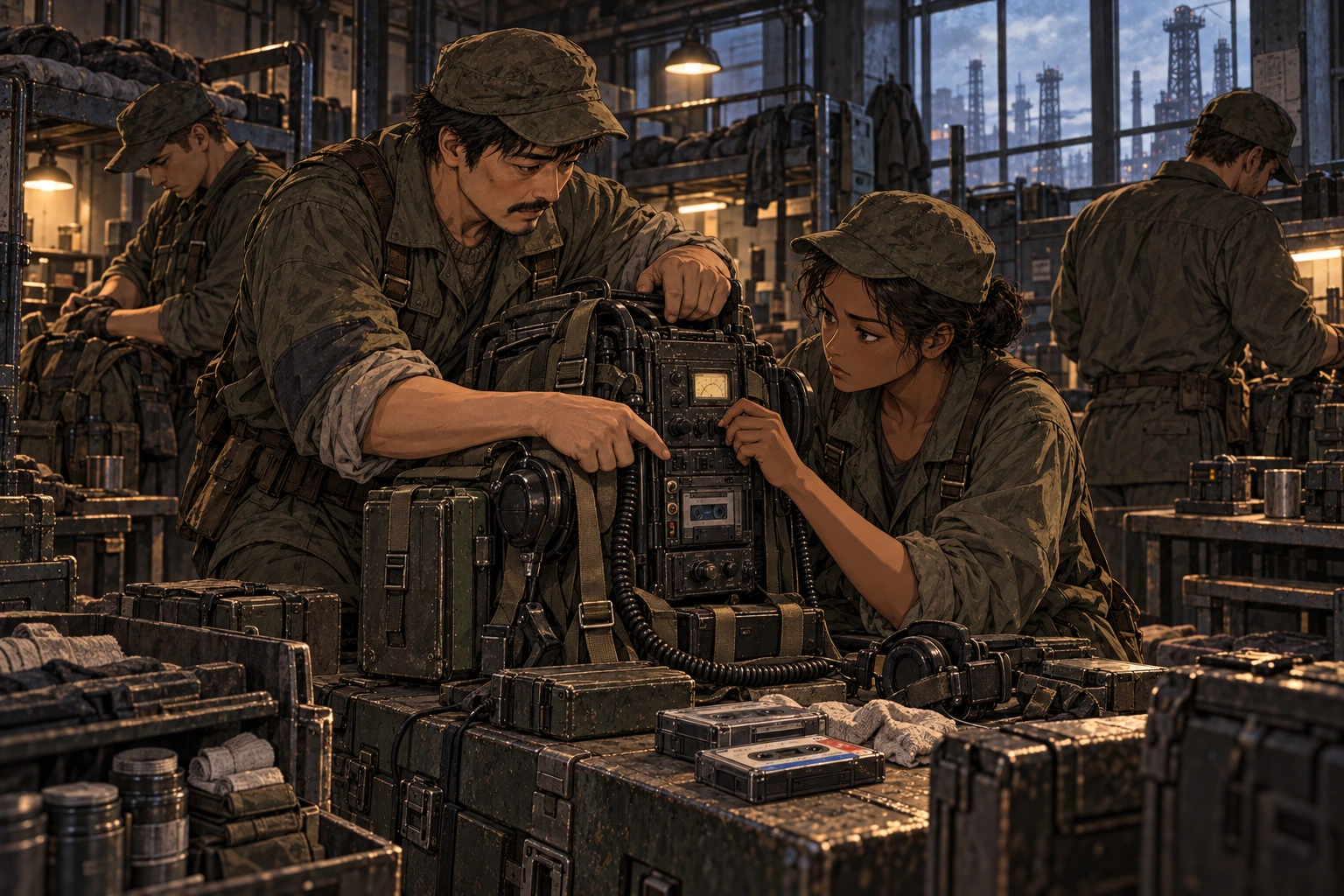
Readiness begins with the things a section can actually use.
Open full-size illustration ↗People in this picture · 2
Aron Pell
left, working over the radio · Goes by Aron
Military rank: Serzhant
Residence: the basin-road military barracks. A section leader, Aron uses humour to keep tired people working. His protectiveness can slip into favouritism. Nera serves in his section and is helping check the set.
Nera Tavin
right, examining the radio connection · Goes by Nera
Military rank: Strazhnik
Residence: the basin-road military barracks. A signaller, Nera is quick at diagnosing faults and impatient when seniority substitutes for an explanation. Aron is her section leader; their shared task leaves room for a technical disagreement.
Living where duty leaves you
Service accommodation offers a bunk, a place for kit and whatever privacy its inhabitants can arrange. Shared charging racks crowd issued radio packs beside protected tape cases. Status lamps remain visible after people want darkness. The shelter may be more dependable than a civilian household's while remaining cramped and badly maintained.
People write home, mend clothes, argue over sound from a tape player and wait for someone else's alarm to stop. Nera Tavin misses being able to leave a small possession where she likes it. Older personnel miss different things and sometimes make a competition of whose absence counts as hardship.
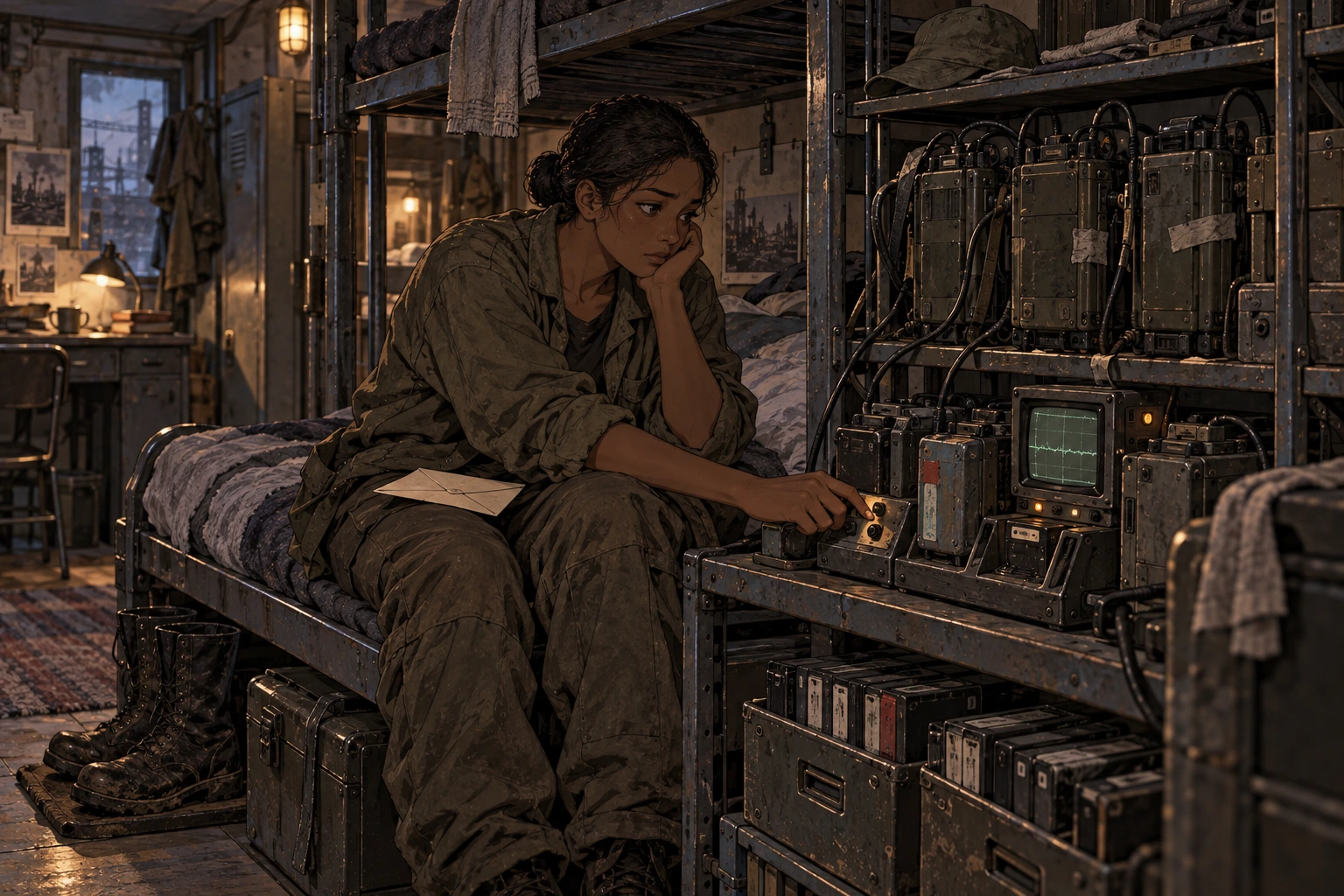
Service accommodation holds private lives beside posted duties.
Open full-size illustration ↗People in this picture · 1
Nera Tavin
seated beside her bunk · Goes by Nera
Military rank: Strazhnik
Residence: the basin-road military barracks. A signaller, Nera is quick at diagnosing faults and impatient when seniority substitutes for an explanation. No companion is foregrounded. Her closed personal letter remains private.
The order and the observation
Lieutenant Vesa Dravik works between paper orders and a transport console with a hooded CRT, tape-cartridge drive, physical selectors and corded handset. The machinery helps organise movements other people must carry out. Road condition, weather and available vehicles still determine what her desk can accomplish.
Vesa values observations precise enough to act on. She also wants her unit to appear reliable. When those aims conflict, she must choose what to report and what to try to fix before it becomes visible above her. Her subordinates form opinions from those choices, rather than from a single speech about duty.
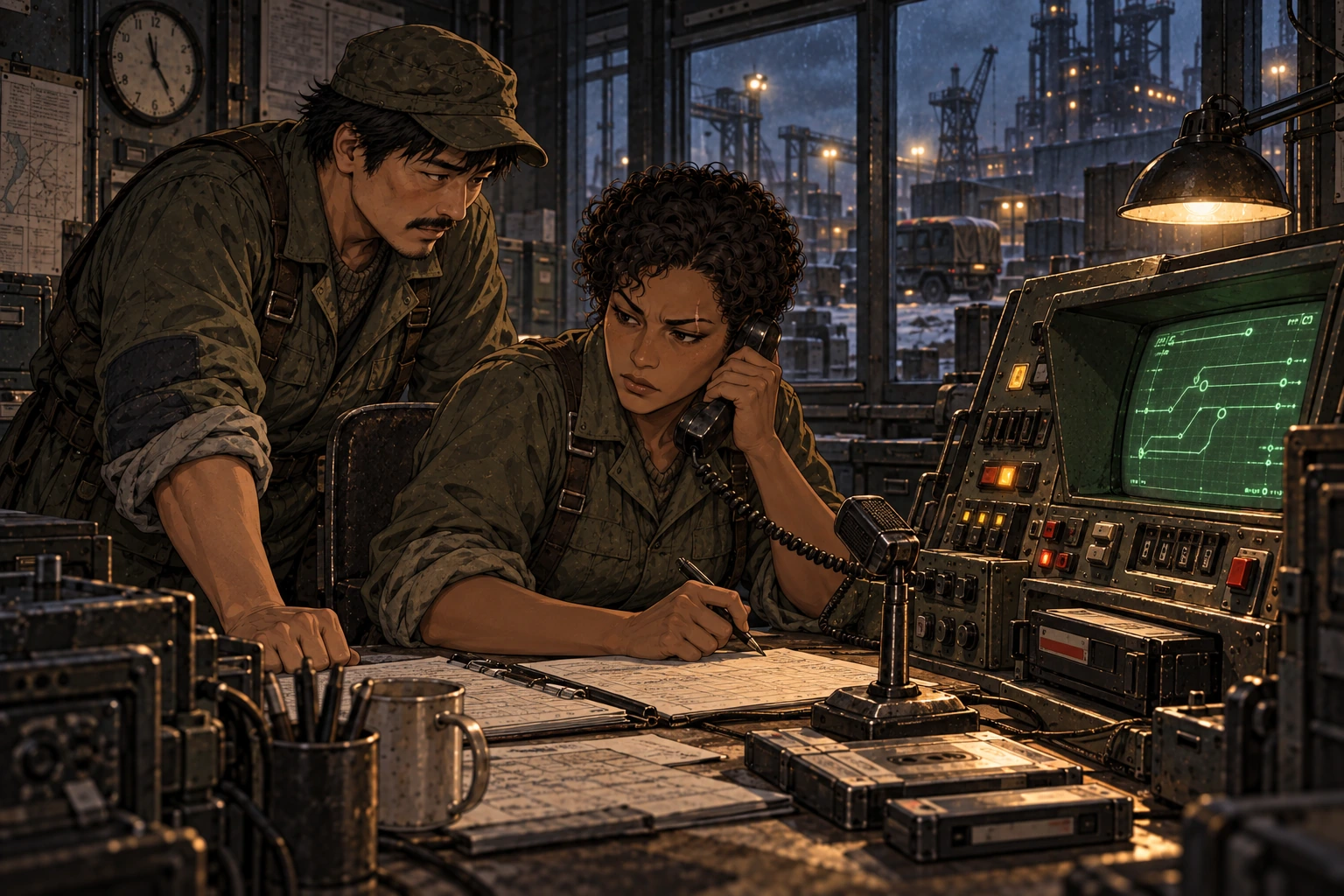
A briefing and a ground report can disagree.
Open full-size illustration ↗People in this picture · 2
Aron Pell
left, indicating the paper order · Goes by Aron
Military rank: Serzhant
Residence: the basin-road military barracks. A section leader, Aron uses humour to keep tired people working. His protectiveness can slip into favouritism. Vesa is the duty officer comparing his report with the dispatch information.
Vesa Dravik
right, at the handset · Goes by Vesa
Military rank: Leutnar
Residence: the basin-road military barracks. The transport duty officer wants orders that account for drivers, loads and return journeys. Her loyalty to her unit has limits and costs. Aron is bringing observations from his section; she must account for the wider movement.
Long hours at the boundary
A night posting reduces the world to lamps, the green recess of a field terminal and noises approaching through weather. An operator listens through a wired earpiece beside the terminal's analogue meter. Fatigue makes reassurance attractive and an ordinary discrepancy feel threatening when someone wants the shift finished.
Protective clothing is practical equipment. Glowing rain requires covered skin, sealed cuffs and ankles, gloves, rubber footwear, eye protection and a full-face breather beneath a suitable hood or cover. A soldier getting soaked to look resolute is an injured soldier waiting to happen. Gear dries badly in crowded quarters, bringing the previous shift into the next one.
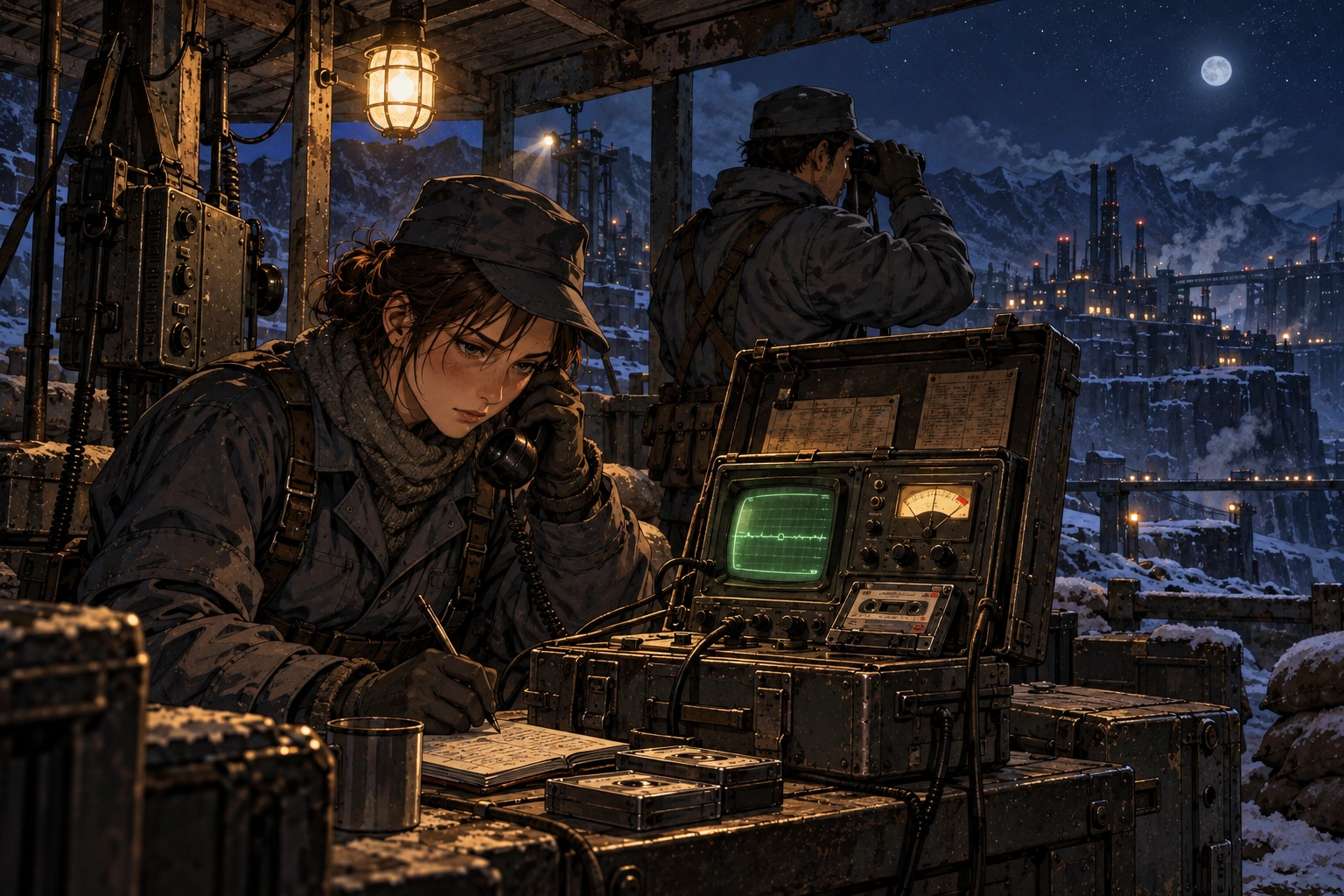
A night watch carries boredom, responsibility and uncertainty.
Open full-size illustration ↗People in this picture · 2
Vela Kharn
foreground, operating the field set · Goes by Vela
Military rank: Strazhnik
Residence: the basin-road military barracks. Vela is a military signaller assigned to the night watch. She marks an uncertain report as uncertain rather than dressing it as a sighting. Sten is the sentry sharing her watch.
Sten Vesko
behind Vela, using binoculars · Goes by Sten
Military rank: Oberstrazhnik
Residence: the basin-road military barracks. Sten is an experienced sentry who alternates observation with small movements to stay alert in the cold. Vela handles the watch’s communications; they are duty partners.
After duty
Military households participate in civilian life under unequal conditions. An institutional wage or supply connection can help relatives; service can also remove a caregiver, consume time and make a family answer for conduct they did not witness. People disagree about what loyalty to a serving relative requires.
Off duty, personnel remain recognisable. A neighbour may welcome help with a heavy container and remember being delayed at a checkpoint. A soldier may be tender with a child and harsh with a traveller later. The region's militarisation lives through these ordinary relationships as well as its formal orders.
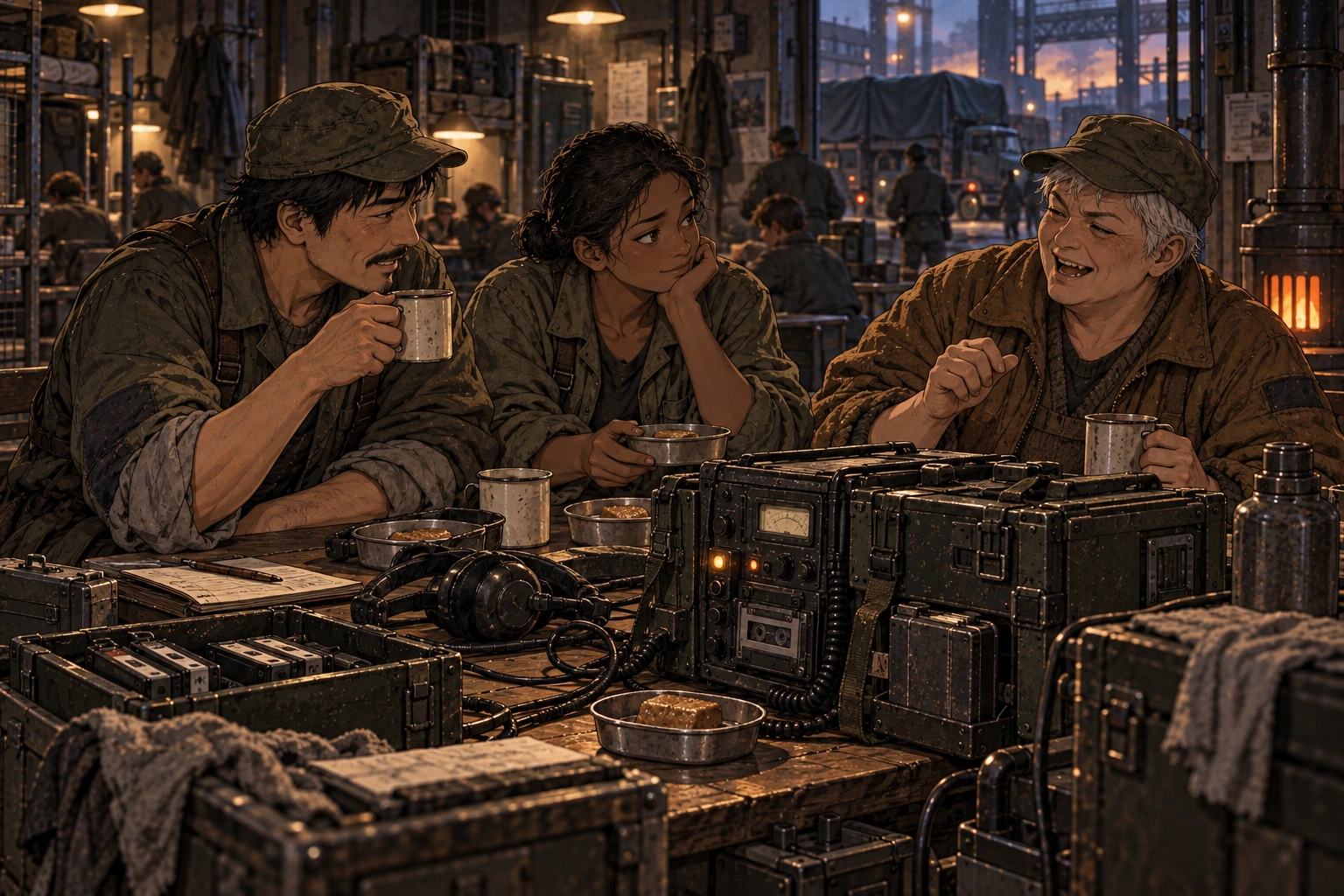
An ordinary joke can survive an exhausting posting.
Open full-size illustration ↗People in this picture · 3
Aron Pell
left, holding a mug · Goes by Aron
Military rank: Serzhant
Residence: the basin-road military barracks. A section leader, Aron uses humour to keep tired people working. His protectiveness can slip into favouritism. The three are service colleagues sharing an off-duty meal, not a household or family.
Nera Tavin
centre, beside the returned radio · Goes by Nera
Military rank: Strazhnik
Residence: the basin-road military barracks. A signaller, Nera is quick at diagnosing faults and impatient when seniority substitutes for an explanation. The three are service colleagues sharing an off-duty meal, not a household or family.
Edda Kest
right, speaking across the table · Goes by Edda
Military rank: Oberstrazhnik
Residence: the basin-road military barracks. A military transport driver, Edda knows vehicles by their bad habits. She takes pride in returning with the people and load entrusted to her. The three are service colleagues sharing an off-duty meal, not a household or family.
Rank, work and appointment
The service ladder used here runs from Rekrut to General. Rank indicates military seniority; it does not identify every job a person can perform. A driver, signaller or mechanic still has a rank. A civilian nurse or records clerk does not acquire one by working beside soldiers.
| Category | Valkrisch rank | Reading equivalent |
|---|---|---|
| Enlisted | Rekrut | Recruit / trainee |
| Enlisted | Strazhnik | Guard or soldier / private |
| Enlisted | Oberstrazhnik | Senior guard or soldier |
| Enlisted leadership | Korporal | Corporal / small-team leader |
| Enlisted leadership | Serzhant | Sergeant / section leader |
| Enlisted leadership | Oberserzhant | Senior sergeant / platoon-level enlisted leadership |
| Enlisted leadership | Stabsserzhant | Senior establishment sergeant / duty coordination |
| Commissioned officers | Leutnar | Lieutenant |
| Commissioned officers | Oberleutnar | Senior lieutenant |
| Commissioned officers | Hauptar | Captain / company or major duty element |
| Commissioned officers | Major | Major / senior staff |
| Commissioned officers | Oberstleutnar | Lieutenant-colonel |
| Commissioned officers | Oberstar | Colonel |
| General officers | Brigadar | Brigadier general |
| General officers | Generalmajor | Major general |
| General officers | Generalleutnar | Lieutenant general |
| General officers | General | General |
Kommandar means commander and describes an appointment. Kaltbruch’s warden, Severine Holt, holds the military rank Oberstar. Wachtar is an occupational term for a guard officer rather than an additional rung in the ladder. Military-police service is a function carried by personnel of different ranks, not a rank by itself.
In formal address, use the Valkrisch rank and surname; in a personal conversation, the familiar name may be appropriate. An English equivalent elsewhere in the Almanac is a reading aid, not a second promotion.