The basin junction
The junction separates movements whose destinations carry different kinds of authority: ordinary civilian travel, containment work and custody traffic. Barriers, shelters, lamps and waiting vehicles have accumulated around the practical job of deciding what goes where.
Travellers experience it through delay and uncertainty. A familiar face may make a passage easier; a changed detail may undo that familiarity. The people in the queue cannot see every reason a vehicle ahead of them has stopped. Rumour often arrives before an explanation.
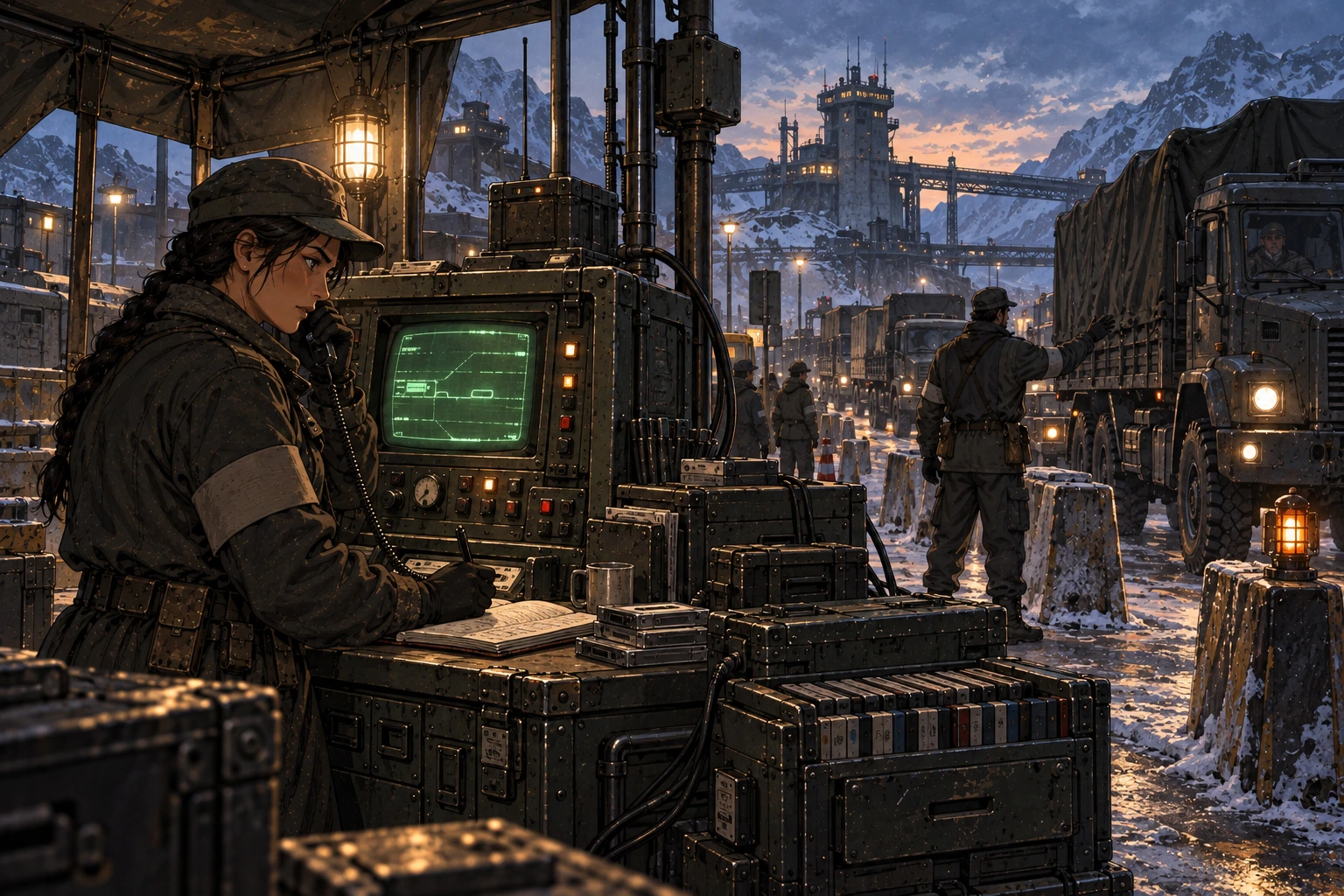
Military, custody and contractor traffic separate before their destinations.
Open full-size illustration ↗People in this picture · 1
Mela Vorst
left foreground, at the checkpoint kiosk · Goes by Mela
Military rank: Serzhant
Residence: the basin-road military barracks. A military-police post supervisor, Mela records disagreements and resists promises her post has no authority to keep. She supervises the personnel directing traffic beyond her desk.
Papers and the person holding them
Jorin checks a pass beside a local-record terminal with chunky keys, a recessed monochrome CRT and a tape-cartridge bay. Its wired intercom connects him to another voice. The traveller watches his expression. A missing detail can be an innocent omission with serious consequences.
His questions take place in public. Embarrassment changes how people answer, and exhaustion can look like hostility. A competent check requires attention to the actual discrepancy. A poor one becomes a contest over tone, with one participant controlling how long it lasts.
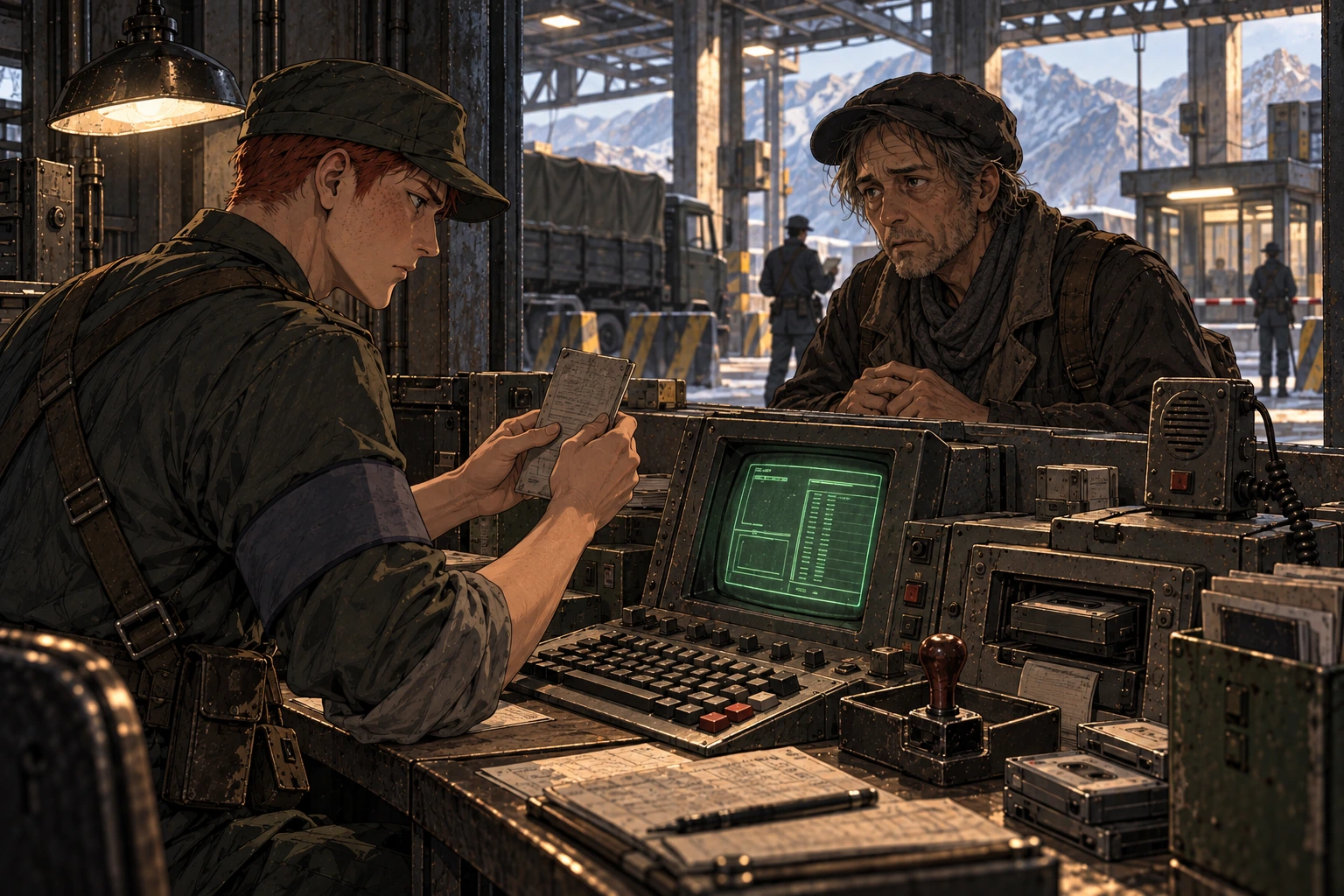
Knowing a traveller does not settle the authority of their documents.
Open full-size illustration ↗People in this picture · 2
Pavel Rents
right, presenting papers across the counter · Goes by Pav
Residence: Vesk Halt. Pav is a retired track inspector who still travels to see old workmates. Familiar routes have not made their checkpoints predictable. Jorin is examining his passenger papers.
Jorin Skell
left, examining the passenger’s papers · Goes by Jorin
Military rank: Korporal
Residence: the basin-road military barracks. A military policeman, Jorin studies papers closely and dislikes appearing uncertain before a queue. Public challenges can make him unnecessarily rigid. Pav is the traveller before him; recognising a face does not settle the documents.
Waiting with something perishable
A delayed load can lose value while its papers remain perfectly legible. Warmth, cold, damp and missed connections affect food, medical supplies and repaired equipment differently. The driver knows what delay will do to the cargo; the post may be concerned with another priority.
Civilian carriers bargain through explanations, contacts and the evidence they have brought. Institutional traffic can receive preference. A family's need may be urgent without carrying an official category that moves it forward. The cost of the queue spreads far beyond those physically waiting.
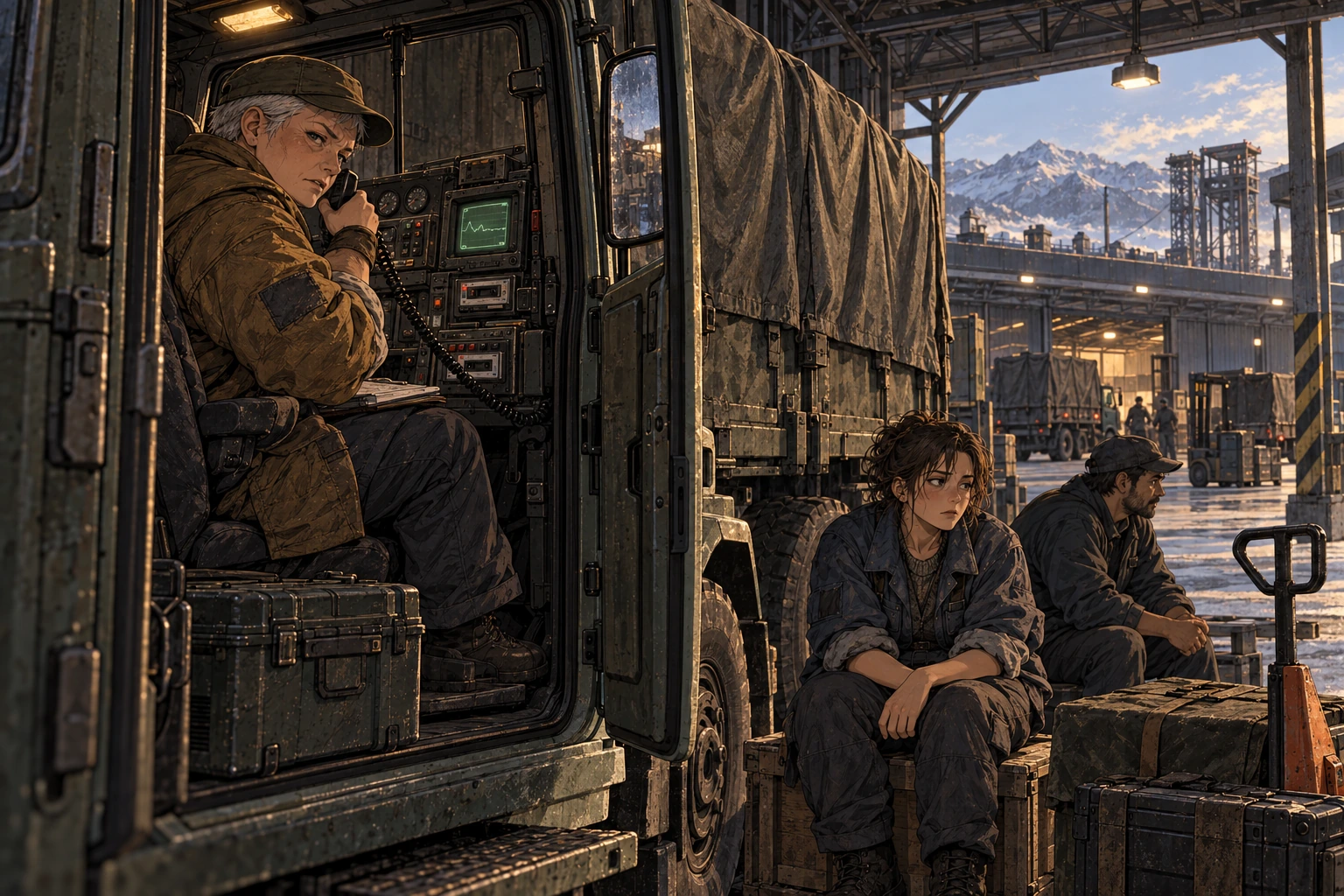
A cargo hold becomes time lost by people beyond the vehicle.
Open full-size illustration ↗People in this picture · 3
Edda Kest
left, using the handset in the truck cab · Goes by Edda
Military rank: Oberstrazhnik
Residence: the basin-road military barracks. A military transport driver, Edda knows vehicles by their bad habits. She takes pride in returning with the people and load entrusted to her. Her delayed passengers are freight workers Lena and Rolan.
Lena Darsen
right foreground, seated beside the load · Goes by Len
Residence: Freight Ward, Stavenbruck. Len is a packing checker who has already finished the consignment’s paperwork. Waiting for clearance consumes time she cannot charge to the job. Rolan is her work partner for this load; Edda is their driver.
Rolan Besk
seated behind Len, wearing a cap · Goes by Rol
Residence: Freight Ward, Stavenbruck. Rol is a freight handler who would like to reach home before the common kitchen closes. He is carrying no authority to hurry the barrier. Len is his colleague; Edda is transporting them with the load.
When the rain begins
Glowing rain changes the work immediately. The control cabinet's CRT sits behind protective glass; covered cartridge slots and large buttons accommodate gloves. Fully covered personnel handle documents under shelter. Hoods, sealed rain clothing, rubber boots, eye protection and full-face breathers make small tasks slower. Nobody should have to expose skin to demonstrate cooperation.
Drivers try to keep their passengers and loads protected. A shelter's capacity can become another source of unequal treatment. Lamps pick out the rain against the dark, leaving faces visible behind protection and making gestures more important. An impatient command is harder to understand through machinery and a breather.
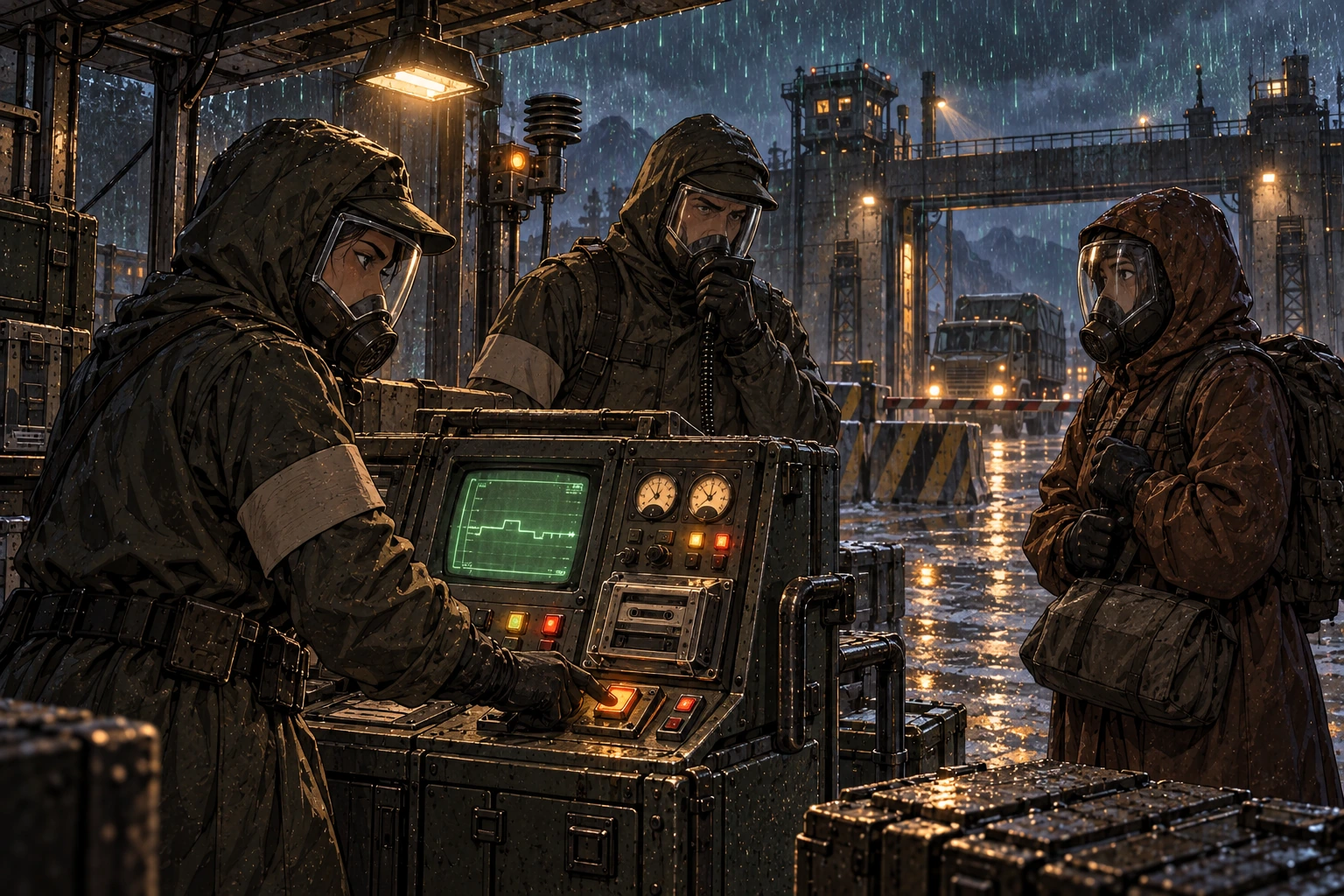
Protection changes how a conversation can be heard and seen.
Open full-size illustration ↗People in this picture · 3
Anya Kerv
left, operating the detector console · Goes by Anya
Military rank: Strazhnik
Residence: the basin-road military barracks. Anya is a military-police equipment operator who keeps her questions short enough to be heard through sealed breathers. Hald is her patrol colleague; Zerin is the traveller they are checking.
Hald Vorren
centre, holding the communications set · Goes by Hald
Military rank: Korporal
Residence: the basin-road military barracks. Hald is a military-police patrol leader who checks that an order has been heard before treating delay as refusal. Anya works under his patrol supervision; Zerin is waiting for their decision.
Zerin Halek
right, the protected traveller · Goes by Zer
Residence: Pump Ward, Stavenbruck. Zer is a contract instrument courier who has kept the parcel dry through a difficult journey. She wants the check completed before the next closure. Anya and Hald are the checkpoint personnel questioning her.
Whose decision is it?
Military police supervise military conduct and the movements assigned to their post. Their presence does not turn every municipal dispute into a military matter or give them unlimited command inside Kaltbruch.
Mela sometimes stops a subordinate from promising a remedy the post cannot provide. She also challenges another function's attempt to leave an awkward decision with her. These disputes affect waiting people, who may care less about the correct chain of responsibility than about finding someone willing to act.
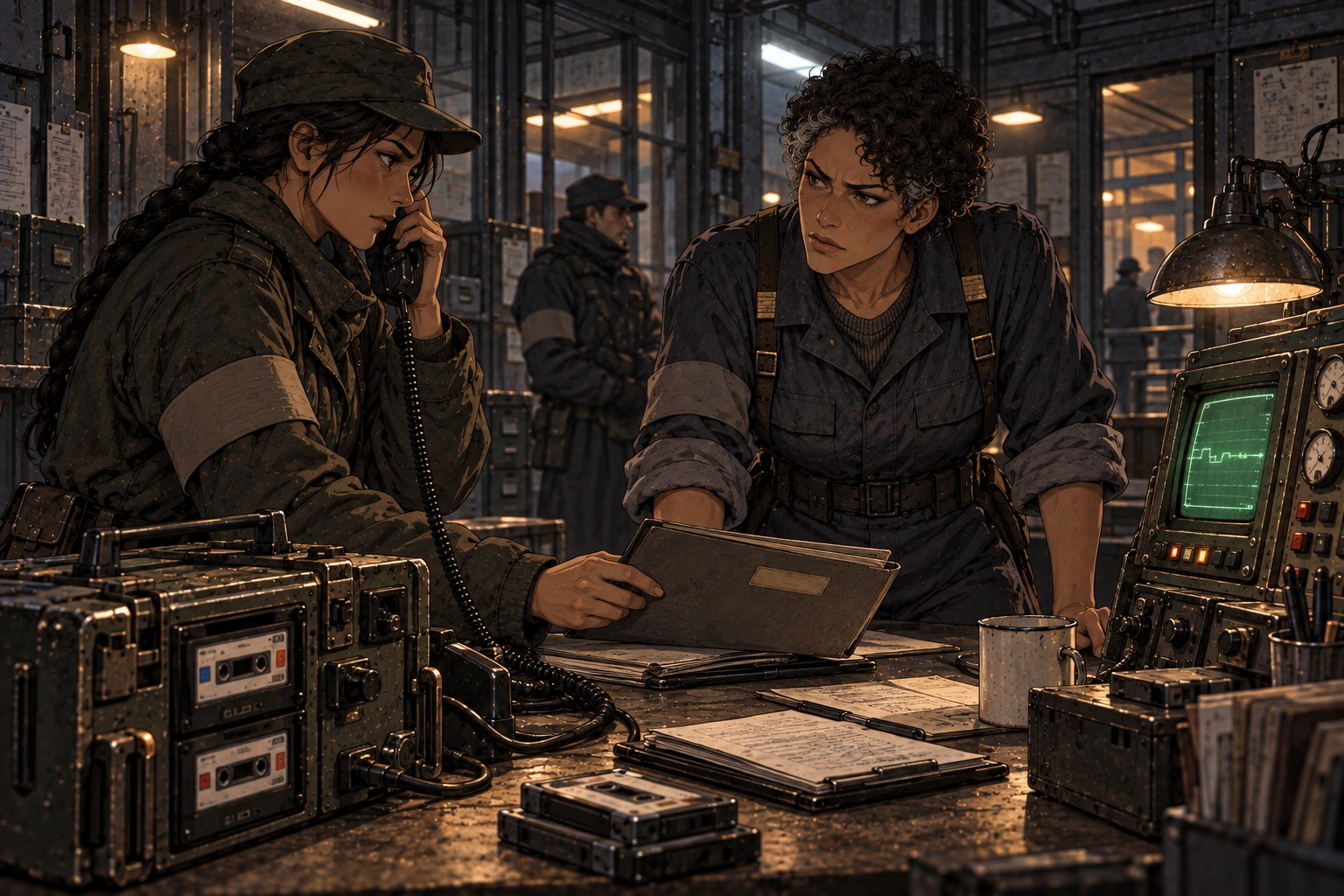
Military police and custody staff do not answer every question for each other.
Open full-size illustration ↗People in this picture · 2
Mela Vorst
left, holding the field telephone · Goes by Mela
Military rank: Serzhant
Residence: the basin-road military barracks. A military-police post supervisor, Mela records disagreements and resists promises her post has no authority to keep. Ivara is her custody counterpart; their organisations have different responsibilities.
Ivara Hest
right, leaning over the closed folder · Goes by Ivara
Military rank: Hauptar
Residence: Kaltbruch service barracks. The prison duty officer values a quiet completed shift. She will permit a precise correction when leaving an error creates greater trouble. Mela commands the checkpoint post rather than Ivara’s prison duty staff.
Recording a return
A returned vehicle brings its load, occupants and paperwork back into the post's account. A note made at that moment can later settle an argument nobody present knows is developing. Its value depends on ordinary accuracy: what returned, why, and who received the information.
The receipt in Mik's story matters because it accounts for a batch that physically came back. Mela's entry gives the discrepancy a place outside the prison's internal copies. It supplies evidence without becoming an order about the prisoner's fate.
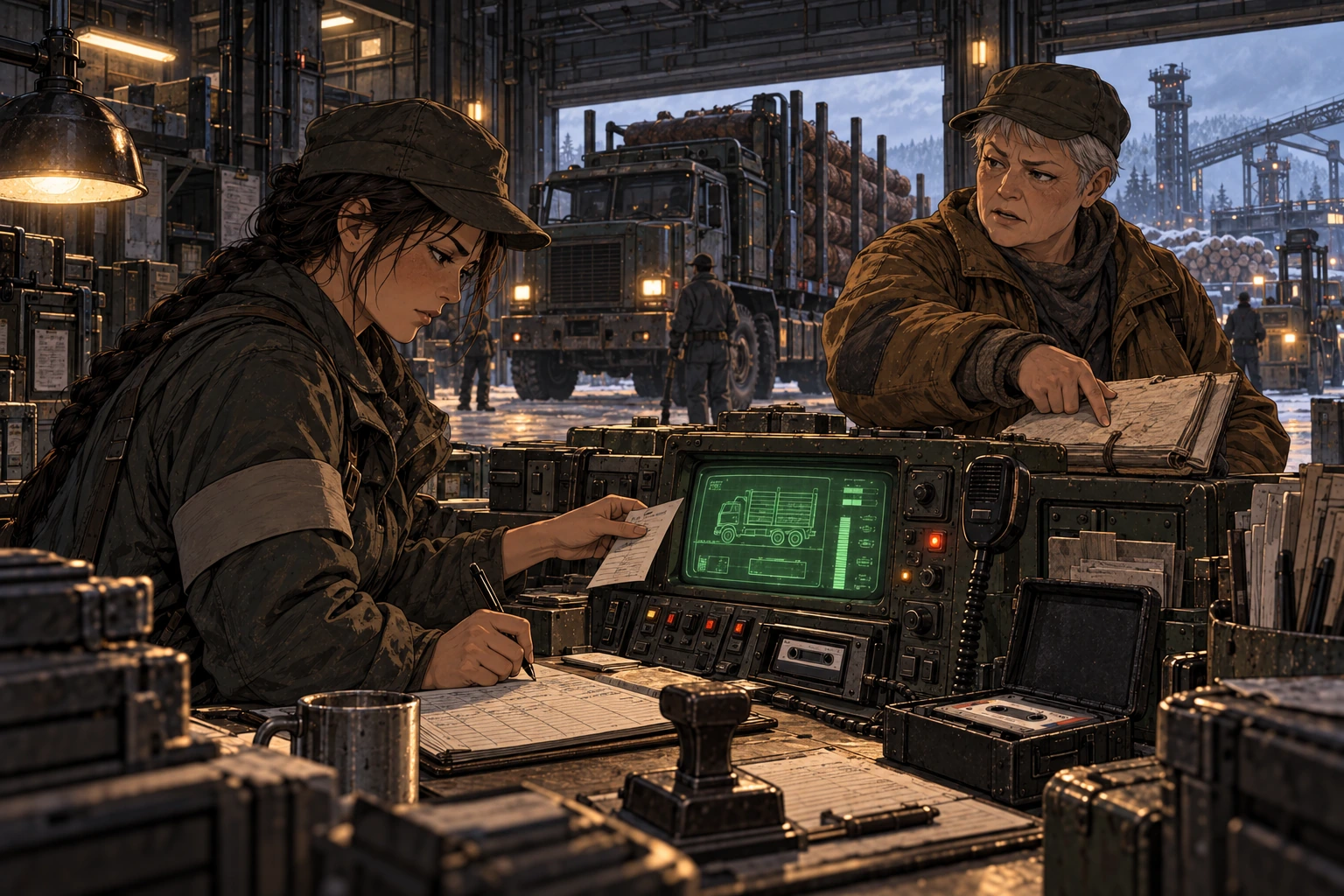
A discrepancy can be written down without becoming a promised remedy.
Open full-size illustration ↗People in this picture · 2
Mela Vorst
left, writing at the terminal · Goes by Mela
Military rank: Serzhant
Residence: the basin-road military barracks. A military-police post supervisor, Mela records disagreements and resists promises her post has no authority to keep. Edda is reporting a vehicle return that the post can record.
Edda Kest
right, indicating the return paper · Goes by Edda
Military rank: Oberstrazhnik
Residence: the basin-road military barracks. A military transport driver, Edda knows vehicles by their bad habits. She takes pride in returning with the people and load entrusted to her. Mela is the military-police supervisor receiving her account.
The last vehicle
Near the end of a shift, a routine arrival can feel like an interruption of an ending already imagined. Personnel want relief; travellers want a destination. Both may have waited through a day the other has not seen.
Sometimes the check is completed competently and the vehicle passes. That ordinary success matters. A checkpoint can be intimidating, unjust in its priorities and still staffed by people capable of doing a particular task properly. Tomorrow's traveller will have to discover which parts of that experience repeat.
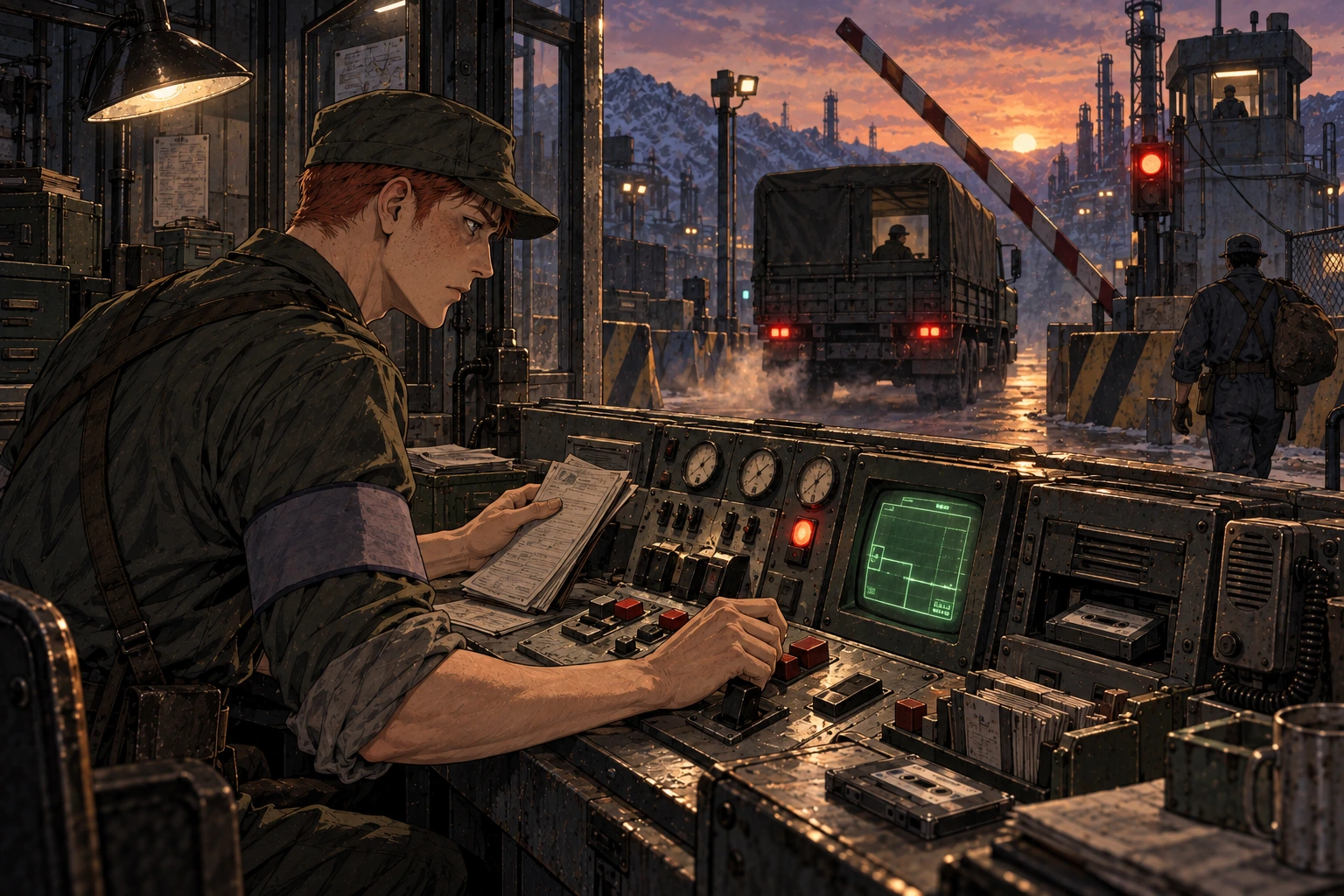
A cleared passage leaves different people with different costs.
Open full-size illustration ↗People in this picture · 1
Jorin Skell
foreground left, at the barrier lever · Goes by Jorin
Military rank: Korporal
Residence: the basin-road military barracks. A military policeman, Jorin studies papers closely and dislikes appearing uncertain before a queue. Public challenges can make him unnecessarily rigid. He is completing the post’s check on the departing vehicle.