Inside Kaltbruch
Follow the institution through its history, first arrivals, daily work and the people who live under its authority.
The Joint March Commission is a joint containment jurisdiction delegated by Vardrask's three governments. One prison governor handles ordinary command, supported by deputy, custody, stores and works, medical, records and security liaison functions.
Stavenbruck retains municipal responsibility for housing, services and ordinary disputes under emergency requisition powers. Civilian complaints can obtain uneven practical remedies. Sponsors may inspect or intervene in Kaltbruch for political or operational interests.
Prisoners cannot compel meaningful external recourse. Kaltbruch holds dangerous offenders, political prisoners, inconvenient witnesses and useful or unusual detainees. Abuse is institutional and routine; petty power, theft, neglect and boredom matter without every act serving a conspiracy. Admission has no age or sex exemption. Adult inmate housing is co-ed.
Adult shared rooms have individual bunks and small personal storage. Screens or curtains give limited changing privacy where available. Washing uses stalls or screens, scheduled by block rather than a universal sex division. Provision and maintenance vary.
Children occupy a dedicated care group separate from the general adult population and not divided by sex by default. A detained caregiver may be placed with them by a specific decision. Medical need and immediate custody risk warrant separate accommodation. These arrangements neither exempt children from detention nor promise reliable institutional care.
Warm Bench, Hooks, Ash Vigil and Last Shift are informal group names for mutual aid, favour-brokering, zealotry and skilled-worker interests. Membership can overlap. The population is not exhaustively partitioned into four factions, and Ash Vigil does not represent every believer.
Representative housing-group cycle
A morning count leads into the first posted meal issue and work assignments. Selected prisoners leave for works or other duties while others remain under custody or attend care. The midday issue and count interrupt work; later assignments lead towards the third meal, restricted personal time and lock-up. Inmates may mend clothing, trade, rest or help one another within the actual conditions of the scene.
Food, heat, washing and work link the group to stores, kitchens and maintenance. If a shortage occurs, distinguish the posted entitlement, what the record says and what people actually received. Its cause must be established rather than assumed to be theft or alien interference. The Missing Quarter remains an available scenario option, not an event already underway.
The figures of 500 prisoners and 50 guards remain an unverified planning baseline, not a census or number on duty. Final staffing and engineering belong to their own work.
The prison reaches beyond its walls
Kaltbruch recruits from military service, local job applicants and transferred personnel. Applicants see steadier institutional pay, training or accommodation as well as the prison's reputation. Recruitment Desk Three is a proposed office in Stavenbruck's service district, where a polished notice promises duty, advancement and provision. What a recruit discovers after arrival depends on role, seniority and the people around them. The institution remains routinely abusive without requiring every applicant to seek cruelty as a vocation.
Staff households live in the city, in service accommodation or elsewhere according to employment arrangements. A partner may like a reliable wage while hating the hours and evasive answers. Children may repeat official slogans and then hear a neighbour describe the prison differently. Some households benefit from priority access or unofficial goods; others see little of the supposed privilege. A uniform can attract deference, hostility, desire, fear or indifference depending on place and person.
Suppliers and the institutional account
The proposed March Provisioning Office consolidates Kaltbruch's ordinary orders for food, fuel, clothing and maintenance supplies while specialised requests travel through the security liaison. Stavenbruck merchants can regard a prison contract as dependable business or a source of late payment and reputational cost. A kitchen supplier need not know classified intake arrangements. A works contractor may know more about a failing pump than the senior officer signing its invoice.
Roven Crate Pool boxes arrive through the regional freight system. Cinderbank makes ordinary replacement castings when specifications and materials permit. A cloth contractor buys repairs as well as new garments, giving city workers income tied to prison conditions. These connections create outside consequences: a cancelled contract costs apprentices work; a disputed delivery harms a supplier's credit; a staff allegation can make a previously tolerated trader unwelcome.
Prison labour includes internal maintenance, laundry, kitchen assistance, clerical work and workshops according to custody assignment. Useful skill may earn a narrow advantage, not a guaranteed right. A person's usefulness can protect them from one arbitrary decision while exposing them to another.
One co-ed room group
Room Group Cinder is a proposed adult housing group within the existing working footprint, not a new building or a change to its geometry. Its name is local usage. Individual bunks and small storage coexist with shared space; privacy depends on maintained screens, customary respect and how staff exercise control. Washing arrangements use stalls or screens and block scheduling, within the co-ed housing model. No final room capacity is assigned.
Inmates arrange their possessions with extraordinary care: a cup that stands level, socks kept dry, a small book, a repaired comb, letters or remembered addresses. A person's bunk is not the whole of their identity. Some have living families, political commitments, previous careers, debts, friendships or ambitions they refuse to surrender. Others avoid speaking of outside life because conversation invites pity, scrutiny or a comparison they cannot bear.
Dara Venn, a former freight tally clerk, can read forms and has enough experience to recognise a copied error. She wants her sister to know where she is, but dislikes the assumption that literacy obliges her to handle everybody's papers. Mik Sorev, a convicted violent offender and competent laundry worker, wants dependable work and sometimes offers practical kindness without that erasing past harm. Their occasional cooperation is not an automatic friendship or a moral verdict on either person.
Counts, meals and small accommodations
The established three posted meal issues structure the room group's day alongside counts, assignments and restricted personal time. Actual portions may differ from the books. A prisoner going to medical assessment can miss a routine opportunity, requiring another person's discretion to avoid a further loss. An attentive worker can find a practical solution; another can treat the complication as the prisoner's fault. Mundane decisions accumulate.
Warm Bench, Hooks, Ash Vigil and Last Shift remain informal overlapping group names. Warm Bench might arrange a dry place for somebody's bedding while disagreeing over helping a newcomer. Hooks can broker a legitimate small favour or exploit a dependence. Last Shift workers know the difference between a feasible repair and a demand designed to fail. Ash Vigil's zealotry has followers, frightened associates and opportunists; religion outside that group is not identical with it.
People play quiet games, tell exaggerated stories, practise a craft, trade a song remembered imperfectly or stop speaking for a while. Pleasure does not make custody harmless. Cruelty does not require every minute to contain a new assault.
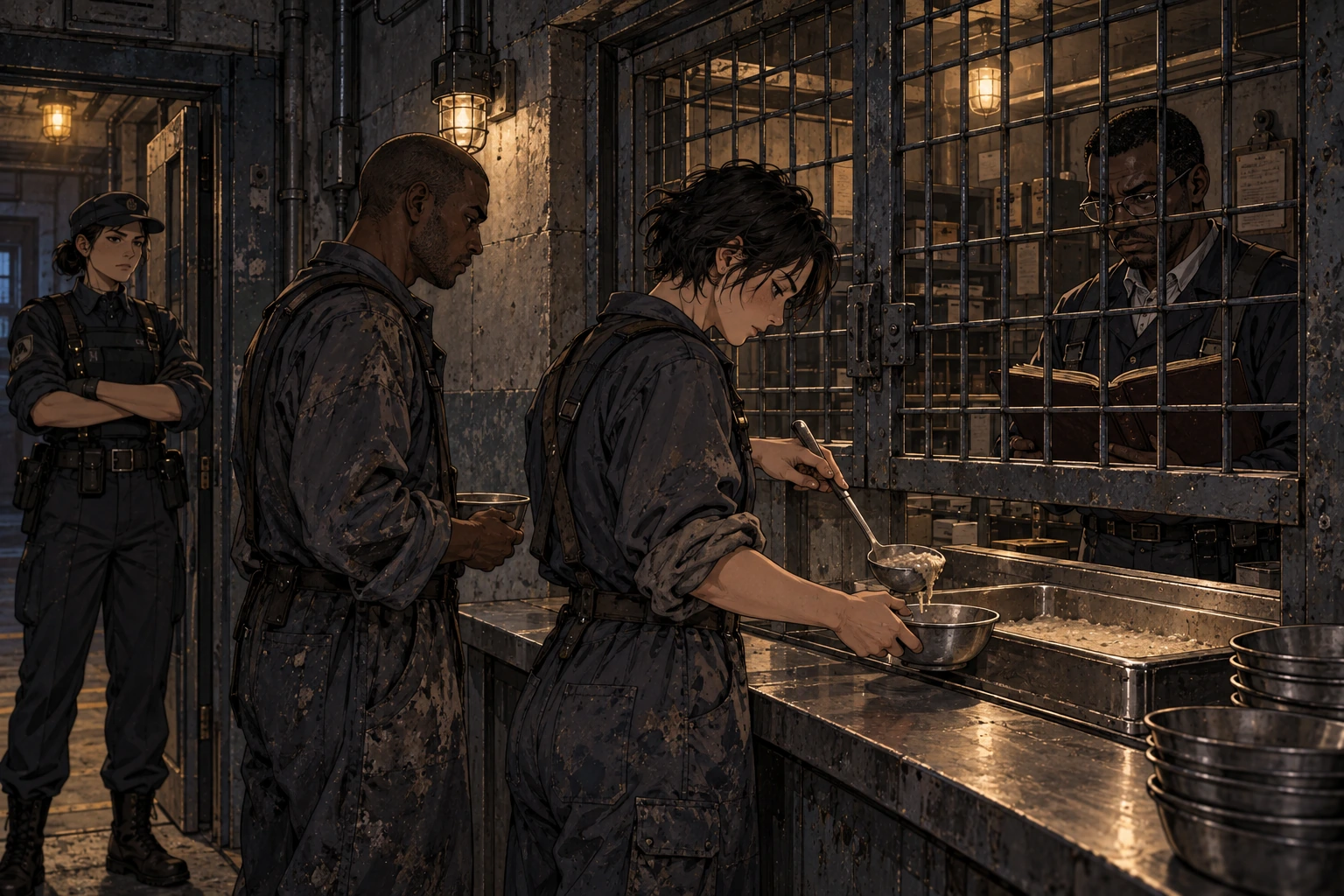
Posted meal issues, supply records and actual food received are different things to examine.
Open full-size illustration ↗People in this picture · 4
Neri Vos
foreground, portioning paste into the bowl · Goes by Neri
Kaltbruch ID: A00031520
Residence: Kaltbruch adult shared housing. Neri is an inmate kitchen server who checks the line of waiting bowls before emptying the next pot. Dima is the waiting prisoner; Leon checks the stores ledger and Esra supervises the area.
Dima Orel
left of the server, waiting at the hatch · Goes by Dim
Kaltbruch ID: B00012744
Residence: Kaltbruch adult shared housing. Dim is an inmate cleaning worker who wants an ordinary meal after the shift. Waiting does not give him authority over the server. Neri is a fellow prisoner; Esra is a custody sentry.
Leon Markev
behind the right-hand grille with the ledger · Goes by Leon
Residence: service lodging outside Kaltbruch’s adult housing. Leon is a civilian kitchen stores clerk who checks the delivery ledger against issues. He wants damaged records reported before the next audit. Neri works the serving hatch; Esra holds custody responsibility.
Esra Kalen
far left, standing at the doorway · Goes by Esra
Military rank: Strazhnik
Residence: Kaltbruch service barracks. Esra is a custody sentry assigned to the serving area. She is expected to keep movement orderly while civilian staff handle the stock record. Neri and Dim are prisoners; Leon is a civilian colleague.
Families, transfers and public reputation
Ordinary correspondence passes through institutional control in this proposed practice; availability and delay depend on classification and staff decisions. It is not an inmate-compellable external remedy. A family can seek information through a sponsor or administrative contact without acquiring a right to review detention. Their effort may recover an address, settle a household account or fail to obtain an answer. A powerful transfer order can override local staff for reasons the receiving clerk does not know.
Outside, Kaltbruch is described as necessary containment, a threat used in arguments, a source of wages and a place people try not to discuss. Different accounts circulate simultaneously. A civilian story might follow a supplier refusing a dishonest invoice or a family maintaining a household after a disappearance. An internal story might concern a real ration discrepancy, a room arrangement or conflicting work orders.
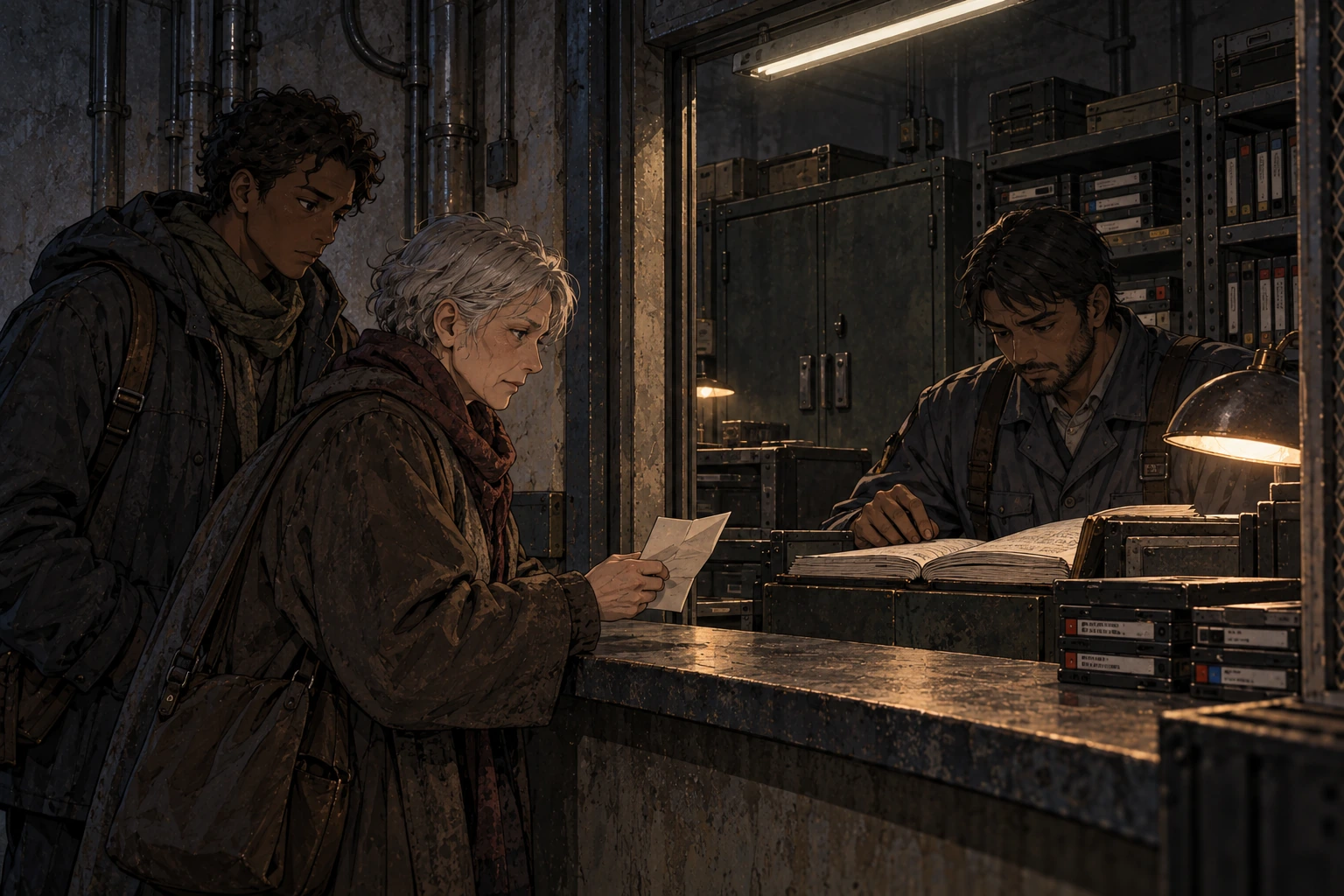
A family can seek information without gaining a right to compel review of a prisoner’s confinement.
Open full-size illustration ↗People in this picture · 3
Helena Vardin
centre-left, holding the letter at the counter · Goes by Helena
Residence: Northbank, Stavenbruck. Helena is a retired school cleaner trying to establish where a relative is held. She has kept the last envelope she received. Arik is her adult grandson accompanying her; Vas is the clerk.
Arik Vardin
left, standing behind Helena · Goes by Arik
Residence: Northbank, Stavenbruck. Arik is a delivery porter who arranged time off to accompany his grandmother. He wants a usable address before they leave the counter. Helena is his grandmother; they are visitors, not prisoners.
Vas Orenek
right, consulting the paper index · Goes by Vas
Residence: service lodging outside Kaltbruch’s adult housing. Vas is a civilian prison enquiries clerk who works from the index available to him. He cannot promise an answer from another office. Helena and Arik are visitors seeking information.

Steadier institutional work can attract applicants whose motives and futures differ.
Open full-size illustration ↗People in this picture · 3
Sana Veld
standing before the recruitment desk · Goes by Sana
Residence: a rented room in Northbank, Stavenbruck. Sana is a casual warehouse worker applying for steadier custody employment. She wants to understand the duties before accepting the apparent security. Lise is her partner waiting behind her; Kurt is the recruiter.
Lise Veld
seated behind Sana in the waiting area · Goes by Lise
Residence: a rented room in Northbank, Stavenbruck. Lise repairs household clothing for pay and worries about both uncertain wages and the cost of prison service on home life. Sana is her partner; she is accompanying the application, not applying herself.
Kurt Draven
right, seated at the recruitment desk · Goes by Kurt
Military rank: Oberleutnar
Residence: Kaltbruch service barracks. Kurt is a custody recruitment officer who must fill posts and explain their terms. He pays attention to why an applicant needs the wage. Sana is the applicant and Lise her accompanying partner.
Illustrated scenes

People in this picture · 2
Severine Holt
right, facing the male inmate · Goes by Severine
Military rank: Oberstar
Residence: the command residence at Kaltbruch. Kaltbruch’s warden is beautiful, cunning, sadistic and ruthless. She notices attachment and uses personal attention to make obedience costly. Rask is the prisoner she has stopped; she holds command authority over the encounter.
Rask Varlen
left foreground, facing the warden · Goes by Rask
Kaltbruch ID: C00005284
Residence: Kaltbruch adult shared housing. Rask is an inmate assigned to heavy stores work. He is determined to answer a direct question without giving away more than it asks. Holt is Kaltbruch’s warden, not a personal acquaintance outside custody.
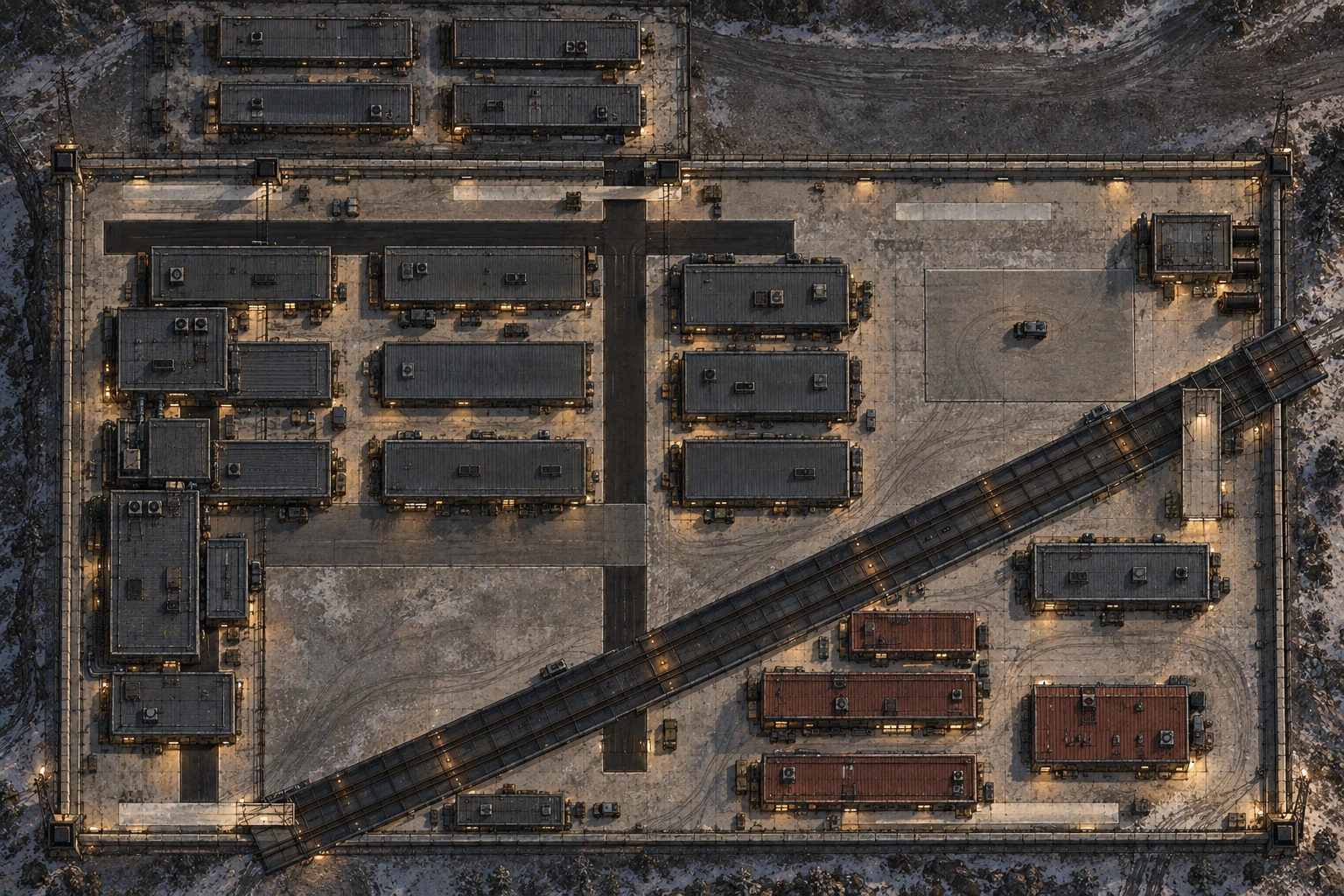
Kaltbruch’s housing blocks, service yards and perimeter surround the clear diagonal transport corridor.
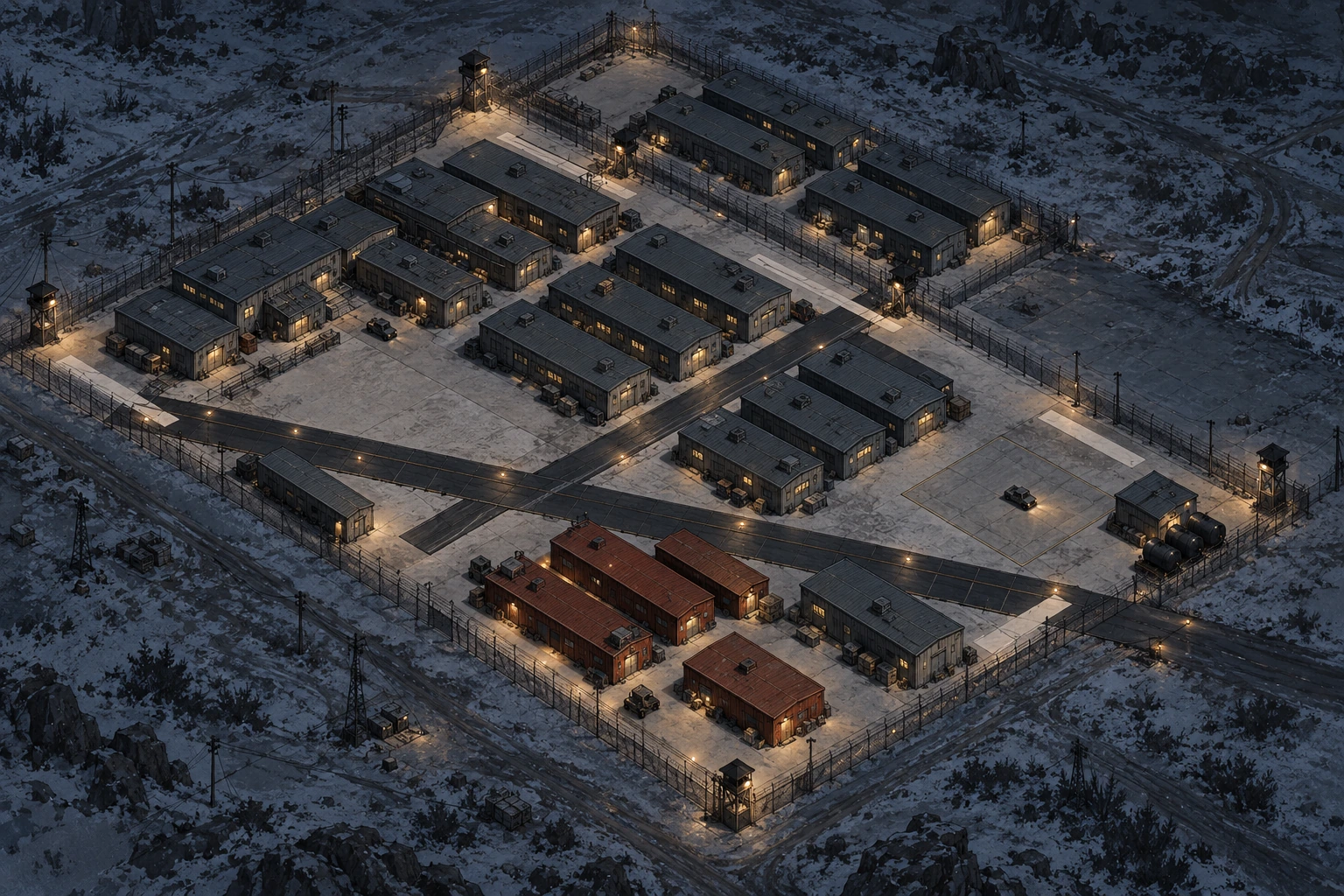
Low industrial buildings and guard posts frame the transport corridor through Kaltbruch.
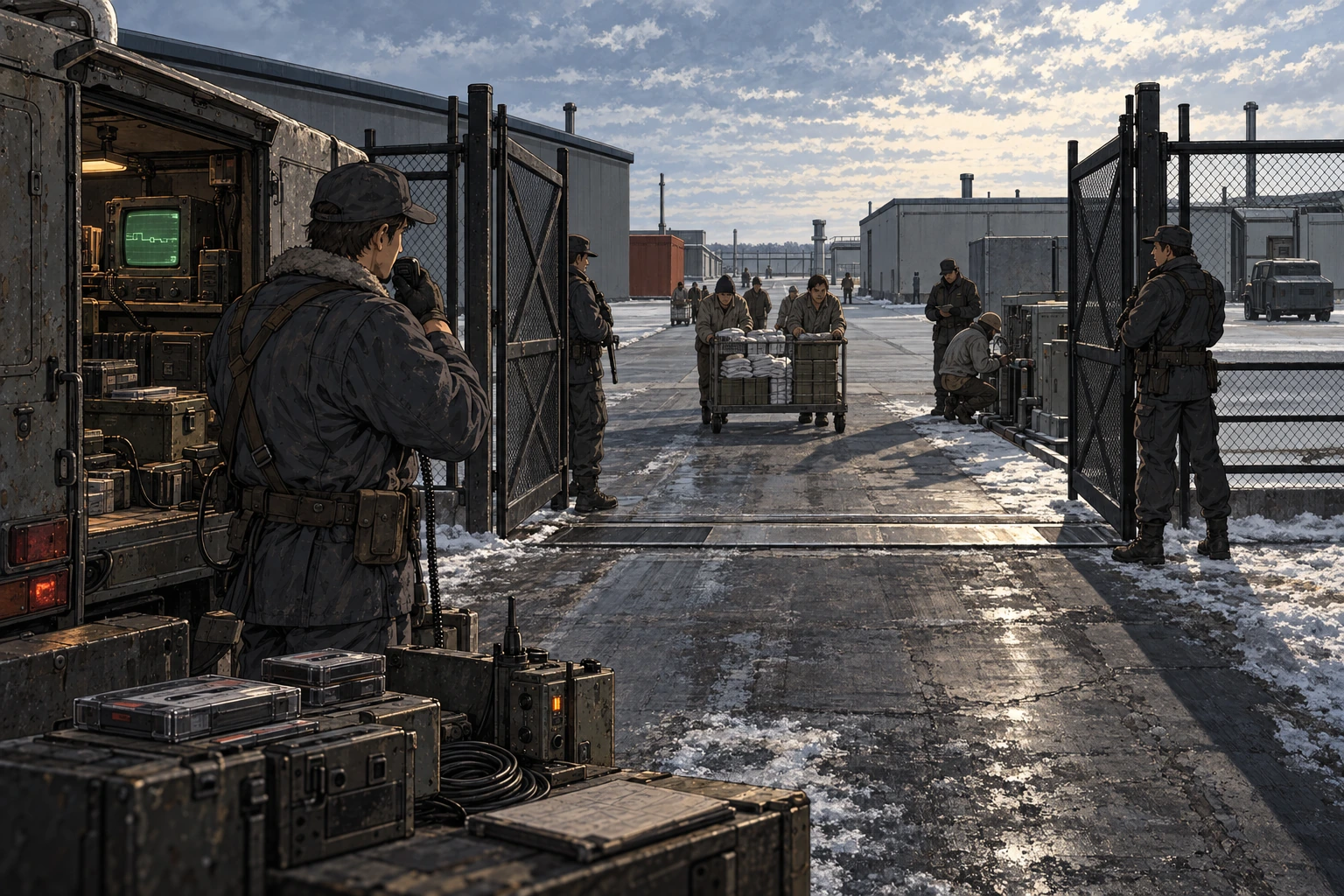
Guards oversee military arrivals at the gate while supervised work continues inside the prison.
People in this picture · 5
Henrik Soren
left foreground, using the vehicle radio · Goes by Hen
Military rank: Leutnar
Residence: the basin-road military barracks. Hen is a military transport officer coordinating a routine gate arrival. He wants the vehicle cleared without losing track of its next duty. Tarek is the custody sentry at the gate; the cart workers are supervised prisoners.
Tarek Iven
right, standing at the gate threshold · Goes by Tarek
Military rank: Oberstrazhnik
Residence: Kaltbruch service barracks. Tarek is a custody sentry who checks the movement before turning back to traffic. An open gate does not transfer his responsibility to the driver. Hen is the visiting transport officer; Ilan and Bessa work inside the gate.
Ilan Vorsk
left worker at the laundry cart inside the gate · Goes by Ilan
Kaltbruch ID: A00030314
Residence: Kaltbruch adult shared housing. Ilan pushes laundry carts in custody and checks the wheels before loading more cloth. He wants the load balanced before anybody orders haste. Bessa is his inmate work partner; Tarek supervises the gate.
Bessa Kelmik
right worker at the laundry cart · Goes by Bess
Kaltbruch ID: B00016325
Residence: Kaltbruch adult shared housing. Bess is an inmate laundry handler who keeps clean returns away from the wheels and wet ground. She relies on an agreed pace with the other handler. Ilan is her work partner, not a relative.
Kel Iven
inside the gate, crouching beside the right-hand wall · Goes by Kel
Residence: service lodging beside Kaltbruch’s maintenance workshops. Kel is a civilian maintenance worker checking a low fitting beside the traffic route. He waits for a gap before shifting his tools. The guards supervise movement around his work; he is not an inmate.
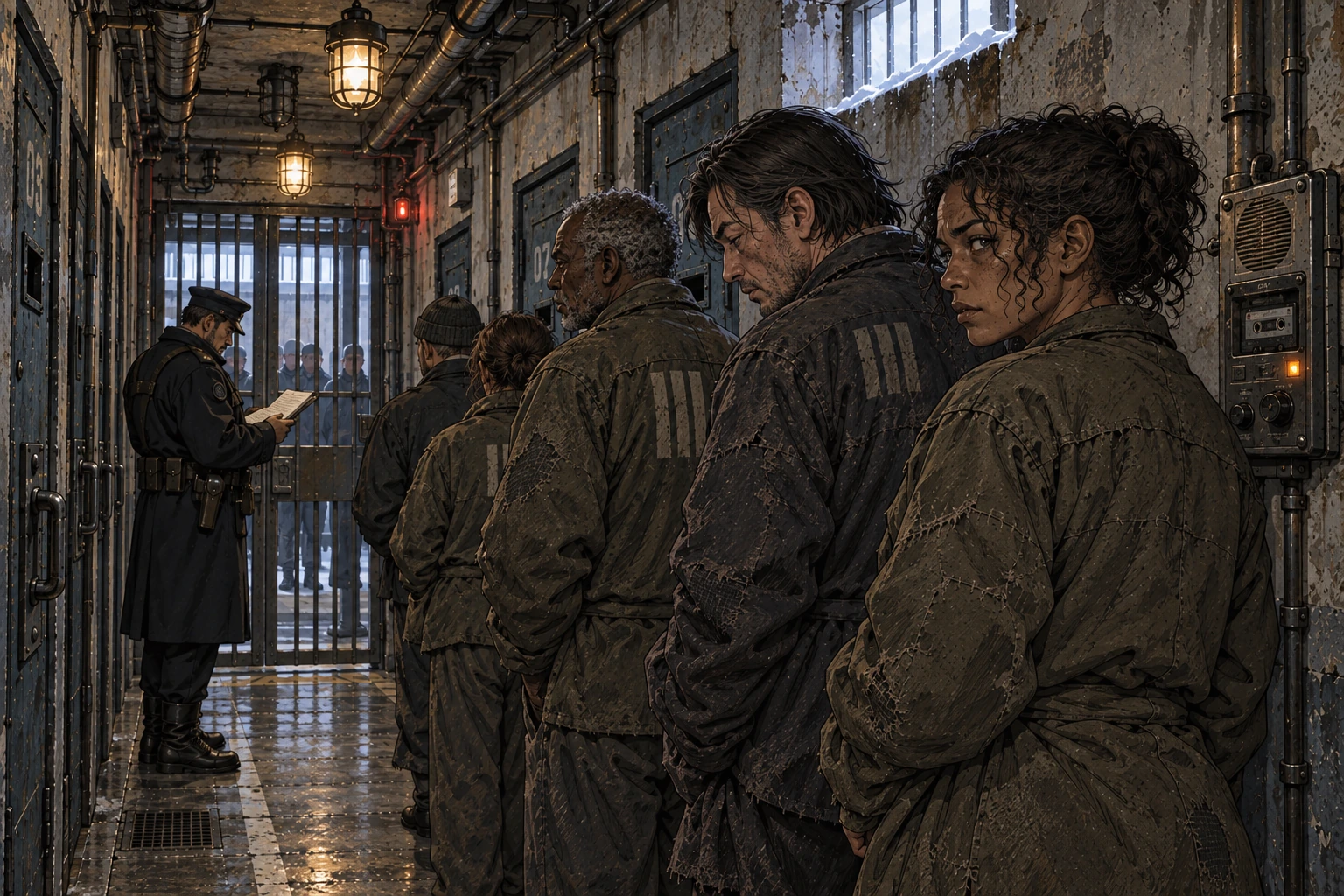
People in this picture · 4
Mira Narek
right foreground, looking back along the corridor · Goes by Mira
Kaltbruch ID: A00030784
Residence: Kaltbruch adult shared housing. Mira is an inmate packing worker who wants to know whether this movement will cost her the whole work period. Viktor and Aben are fellow prisoners waiting ahead of her.
Viktor Dres
centre foreground, dark-haired prisoner · Goes by Vik
Kaltbruch ID: B00013097
Residence: Kaltbruch adult shared housing. Vik repairs prison workwear and dislikes being moved without knowing where his unfinished task will be left. Mira and Aben share this custody movement, not a family relationship.
Aben Kors
centre-left, older prisoner in the queue · Goes by Aben
Kaltbruch ID: A00019854
Residence: Kaltbruch adult shared housing. Aben works on the prison’s cleaning detail and saves energy during waits that cannot be hurried. Mira and Vik are fellow prisoners; Leon holds the movement list.
Leon Strav
left, holding papers beside the barred doorway · Goes by Leon
Military rank: Korporal
Residence: Kaltbruch service barracks. Leon is a custody movement supervisor who checks a list before opening the next controlled passage. The waiting residents are prisoners in his charge for this movement.