Waking before readiness
A room wakes in pieces. Someone has already been listening to a pipe for an hour. Someone else has only just fallen asleep. Blankets are folded, shaken or held around shoulders while people wait to learn whether an ordinary arrangement has changed. The smell of damp cloth survives the night's reduced heat.
Counts and assignments divide the day into obligations. A person can be physically present while an entry is missing; an entry can be present while the person is elsewhere on an authorised task. Resolving that difference may interrupt everyone within reach. For the people waiting, the distinction between a small clerical error and an important custody question can be the length of the delay.
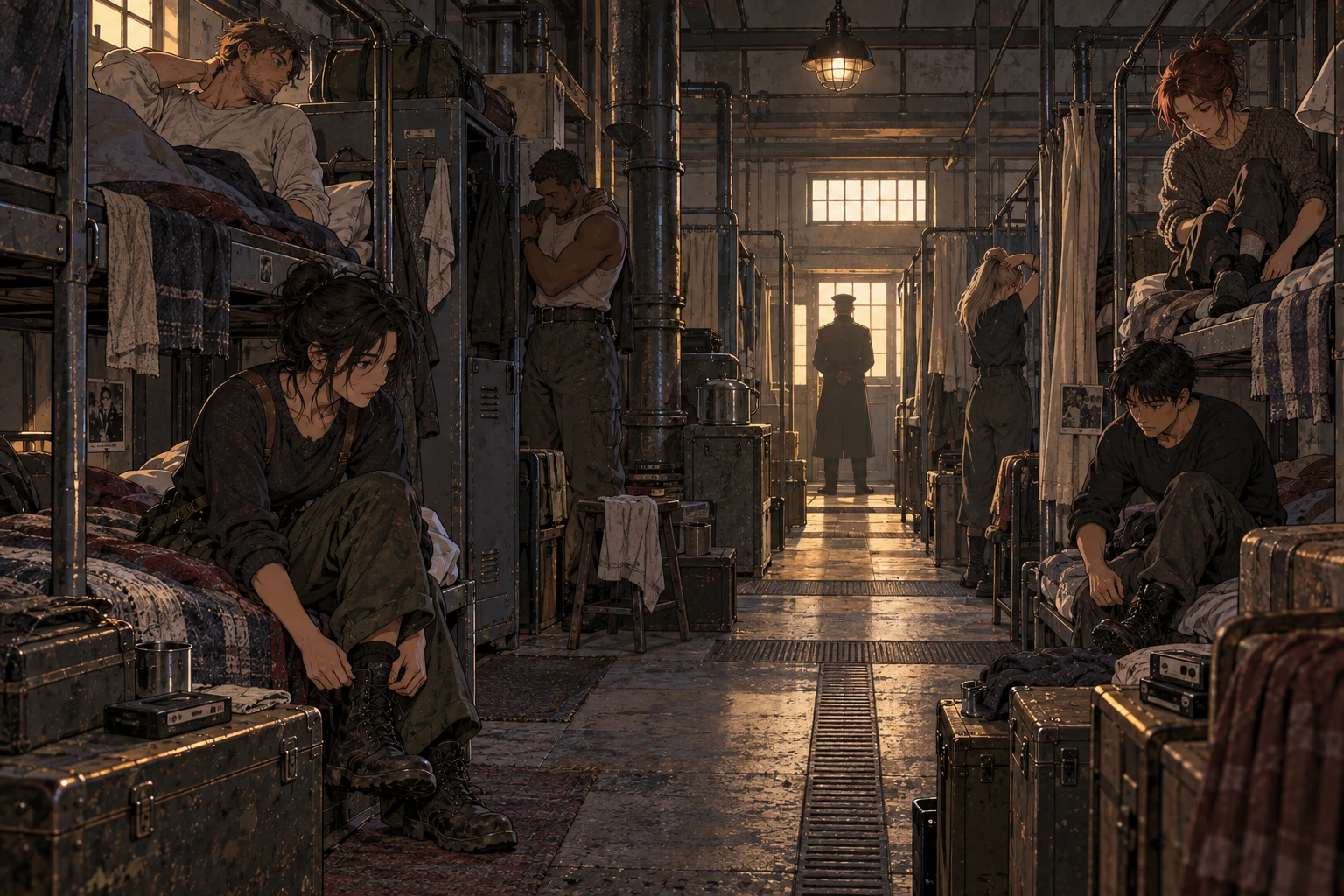
The shared room wakes unevenly beneath tired lights.
Open full-size illustration ↗People in this picture · 4
Ilse Pem
upper-left bunk, preparing to rise · Goes by Ilse
Kaltbruch ID: B00008031
Residence: Kaltbruch adult shared housing. Ilse is an inmate linen sorter who folds personal belongings before the count. The routine helps her notice when something has gone missing. The others occupy the same shared room; she has no family tie to them.
Mira Tor
lower-left bunk, fastening a boot · Goes by Mira
Kaltbruch ID: A00028204
Residence: Kaltbruch adult shared housing. Mira cleans prison workrooms and tries to keep her own boots dry. She wants the morning count finished before the first heavy task. Ilse, Lyra and Niko are room neighbours.
Lyra Orn
upper-right bunk, arranging bedding · Goes by Lyra
Kaltbruch ID: A00030087
Residence: Kaltbruch adult shared housing. Lyra works on the kitchen wash-up detail and keeps her bedding folded away from the traffic below. She shares accommodation with the other residents, not a household formed by choice.
Niko Lat
lower-right bunk, handling footwear · Goes by Niko
Kaltbruch ID: C00009513
Residence: Kaltbruch adult shared housing. Niko is an inmate stores runner who checks a loose sole before the shift begins. He would like replacement footwear before it fails during work. The other focal residents are his room neighbours.
Privacy made from ordinary things
Individual bunks and small personal storage give residents a limited place to arrange a life. A folded cloth can mark a boundary that is respected by one neighbour and ignored by another. Privacy also depends on habits: announcing an approach, turning away, lowering a voice, asking before borrowing. These gestures matter because the room does not supply enough space to avoid needing them.
Washing uses stalls or screens where they are available, scheduled by block rather than a universal division by sex. A loose fastening or missing panel can turn a routine task into something a resident postpones. Runa's repair of a screen is practical work on another person's ability to endure the day. The screen can still be removed or neglected by staff who assign it little importance.
Proximity does not confer consent. A friendship, shared ration, repaired shirt or offer of protection does not entitle someone to another person's body or affection. Residents can maintain relationships, desire and tenderness, while the conditions around them make refusal harder to express safely. Respect is visible in what a person allows someone else to decline.
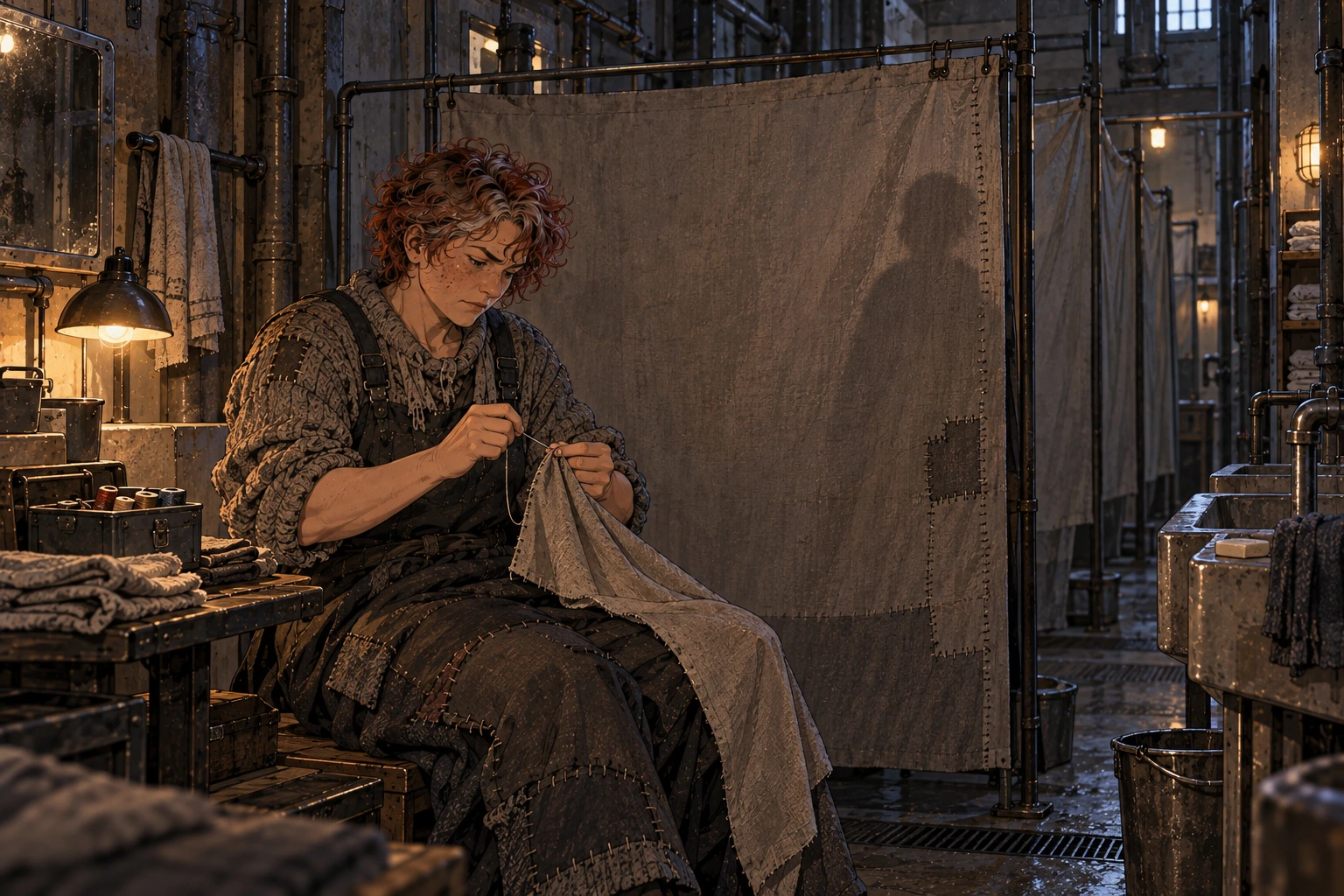
A mended screen offers a limited boundary within shared accommodation.
Open full-size illustration ↗People in this picture · 1
Runa Drell
seated beside the privacy screen · Goes by Runa
Kaltbruch ID: B00009241
Residence: Room Group Cinder, Kaltbruch. A repair worker associated with Warm Bench, Runa offers practical help with firm limits. An argument need not end her care for a neighbour. She is mending a shared boundary for fellow residents; no companion is foregrounded.
The serving hatch
U.N.P. (Universal Nutritional Paste) supplies much of the ordinary food. The posted three issues structure expectations, but an entry in a book is not a bowl in a hand. The amount served, a missed opportunity and whether a substitute is offered are separate facts. A resident returning from assessment can find the queue dispersed and the vessel already taken away.
People notice differences in portion and consistency even when nobody can weigh them. Complaints may be accurate, mistaken or based on several bad days becoming one memory. A serving worker can recognise a genuine omission without having enough left to remedy it. Staff may prefer an argument about manners to an argument about food.
Residents develop preferences within limited supplies. One batch makes a better crust when reheated; another is easier to swallow while still warm. Such distinctions permit memories and conversation without making the issue generous. Fresh vegetables remain a premium. A few visible leaves at an exceptional table would describe that table's privilege, not the ordinary prison meal.

Posted issues and actual portions can leave different impressions of the same meal.
Open full-size illustration ↗People in this picture · 2
Mik Sorev
right foreground, holding his bowl · Goes by Mik
Kaltbruch ID: B00018462
Residence: Room Group Cinder, Kaltbruch. A laundry worker imprisoned for violence, Mik is skilled with cloth and easily ashamed of needing help. Present kindness does not erase his past conduct. Glena is the inmate serving the portion; she does not determine the prison’s supply.
Glena Raf
left foreground, working the serving hatch · Goes by Glen
Kaltbruch ID: A00022078
Residence: Kaltbruch adult shared housing. Glen is an inmate meal-server who wants the posted issue and the pot in front of her to agree. She dislikes being blamed for shortages she cannot remedy. Mik is another prisoner receiving his meal.
The possession worth drying
Dara's socks occupy a place chosen for its distance from a dripping sleeve. Their value includes the work already spent repairing them and the discomfort they prevent. A small book can keep a paper flat. A cup with a steady base can save a person from spilling an issue they will not receive twice.
These arrangements are vulnerable to ordinary handling as well as deliberate interference. Someone sits on a drying cloth, a shelf is cleared, a bundle is returned to the wrong place. A dispute may sound disproportionate to an observer who can replace the object. To its owner, the missing thing also represents planning, competence and the claim to keep something in order.

Keeping one small possession usable takes attention.
Open full-size illustration ↗People in this picture · 1
Dara Venn
beside her bunk, hanging the socks · Goes by Dara
Kaltbruch ID: A00031874
Residence: Room Group Cinder, Kaltbruch. A former freight tally clerk, Dara wants to reach her sister and keep some time for herself. Literacy does not make her everyone’s unpaid clerk. No companion is foregrounded. This is care for her own possessions after other people’s demands.
Time that people make their own
Restricted personal time can hold a game, a remembered tune, a quarrel, mending or the decision to speak to nobody. The activity does not have to conceal a plan. Mik can enjoy a game and still dread the next work call. Runa can laugh at him and remain angry about an earlier refusal.
Small performances have their own politics. A good storyteller can be generous, repetitive or unwilling to let another person speak. A joke about an officer may unite a room briefly and make one listener nervous. A song from home may comfort one resident while reminding another how far away their own home has become.
Friendship requires more than mutual need. People discover whom they enjoy, whom they trust with silence and whose company becomes exhausting. A favour may survive a quarrel. A person may stop sitting beside someone without announcing why. These shifts are part of prison life even when no official record notices them.

An unfinished game briefly redirects a crowded room’s attention.
Open full-size illustration ↗People in this picture · 4
Runa Drell
left foreground, at the game board · Goes by Runa
Kaltbruch ID: B00009241
Residence: Room Group Cinder, Kaltbruch. A repair worker associated with Warm Bench, Runa offers practical help with firm limits. An argument need not end her care for a neighbour. Mik is her opponent; Leonie and Vira are fellow residents watching.
Mik Sorev
right foreground, studying the counters · Goes by Mik
Kaltbruch ID: B00018462
Residence: Room Group Cinder, Kaltbruch. A laundry worker imprisoned for violence, Mik is skilled with cloth and easily ashamed of needing help. Present kindness does not erase his past conduct. Runa is his opponent; the two spectators are room neighbours, not his relatives.
Leonie Dask
behind Runa, leaning on one hand · Goes by Lea
Kaltbruch ID: A00028651
Residence: Kaltbruch adult shared housing. Lea works in the prison laundry and enjoys watching a game before committing to a side. She remembers questionable moves longer than their makers do. Runa and Mik are her fellow prisoners; Vira is another spectator.
Vira Halin
behind the board, with folded arms · Goes by Vira
Kaltbruch ID: B00013822
Residence: Kaltbruch adult shared housing. Vira sorts prison packing cloth and prefers games with rules people can repeat without consulting a faction’s favourite player. Lea is a room neighbour; neither has authority over the players.
The care group
The children's care room has a different daily rhythm from adult work housing. Sleep, washing, meals, quiet occupation and the availability of an attentive adult affect its hours. A repaired toy can be important because it is familiar. A caregiver can be patient in one encounter and overwhelmed in the next.
Separation from general adult housing does not provide independence from the institution. Supplies still pass through stores. An appointment or placement decision can alter who is present. Staff may mistake an orderly room for a room whose children are well, while a distressed child may need attention that the posted routine does not easily accommodate.
Caregivers retain lives and fears of their own. A detained parent does not control the terms of remaining nearby. A staff carer may care sincerely and still comply with a harmful decision. Their practical work deserves attention without being treated as proof that custody is benign.
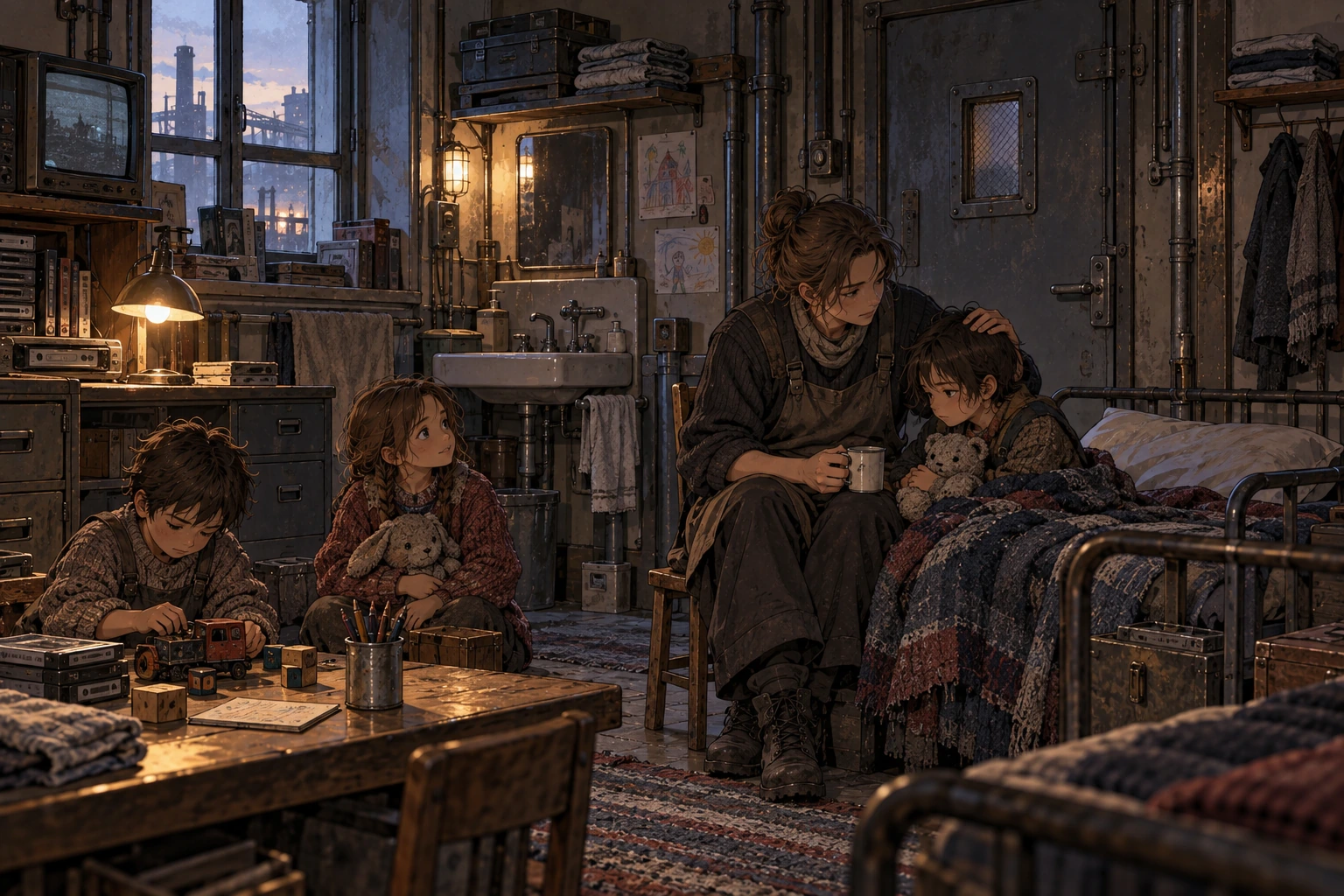
Children’s daily care takes place apart from general adult housing.
Open full-size illustration ↗People in this picture · 4
Klara Nelm
right, comforting the seated child · Goes by Klara
Residence: staff lodging beside Kaltbruch’s separate care rooms. Klara is a civilian childcare attendant who keeps routines separate from the adult prison’s work cycle. She wants enough staff for unhurried care. She is caring for Romi, Kati and Yan, who are children in care, not prisoners.
Romi Veln
right, leaning against Klara · Goes by Romi
Residence: Kaltbruch’s separate children’s care accommodation. Romi is a young child with no job. A familiar cup and blanket help make this room feel less strange. Klara is Romi’s care attendant; Kati and Yan share the care room. No prisoner number is assigned.
Kati Drenek
centre-left, holding the soft toy · Goes by Kat
Residence: Kaltbruch’s separate children’s care accommodation. Kat is a child in care with no paid work. She likes choosing where the toys wait when a game ends. Yan is her brother; Klara looks after the care group. She is not registered as a prisoner.
Yan Drenek
left, playing with the toy vehicle · Goes by Yan
Residence: Kaltbruch’s separate children’s care accommodation. Yan is a child with no job and a strong interest in how wheels turn. He attends lessons within the care routine. Kat is his sister; Romi is another child in the room. He has no prisoner number.
After the last movement
Night reduces the number of people available to ask. It does not quiet every machine or resolve the worries carried into a bunk. Someone coughs, a pipe strikes, a light stays on beyond a door. Tavi listens to these sounds while trying to learn which ones other residents ignore.
Poor sleep changes the following day's patience and judgment. A person may snap at the neighbour who helped them yesterday. Another may choose a seat near a familiar sound because the unfamiliar quiet is worse.
The next morning can begin with something improved: a dry shirt, a repaired screen, an answer, a place kept in a queue. It can also begin with the same cold and another demand.

Noise, cold and unfinished worries continue after the room settles.
Open full-size illustration ↗People in this picture · 1
Tavi Kelm
right, awake beside his bunk · Goes by Tavi
Kaltbruch ID: A00032706
Residence: Room Group Cinder, Kaltbruch. An adult newcomer assigned to the prison laundry, Tavi wants a predictable place in the day. He listens carefully before allowing a group to claim him. The sleeping residents are room neighbours; none is individually foregrounded.